


If you're finding it impossible to stay focused at work, you're not just losing time—you're losing ground in a world that demands peak performance. That struggle to concentrate is more than just a personal frustration. It's a massive economic issue.
In fact, the global loss in productivity from employee disengagement, a direct result of scattered focus, was estimated to cost the world economy $438 billion in 2025 alone. The connection between our ability to engage and our performance is undeniable, as highlighted in Gallup's State of the Global Workplace report.
But here’s what most people get wrong: focus isn't a trait you're born with. It's a skill you can train. The secret is to shift from a state of constant distraction to one of deep engagement—that immersive flow state where you're not only more productive but also more resilient to interruptions.
The Four Pillars of Unbreakable Focus
So, how do you get there? It’s not about "trying harder." That’s like telling someone to run a marathon without ever training. Instead, we need a strategic foundation to tackle the root causes of distraction. This guide is built on four core pillars that work together to defend your attention.
To give you a roadmap of what's ahead, here is a quick overview of the four pillars we will be building.
Four Pillars of Unbreakable Focus
| Pillar | Core Principle | Key Action |
|---|---|---|
| Morning Routines | How you start your day sets the tone for your cognitive performance. | Prime your brain for concentration with a structured morning. |
| Distraction Management | Proactively eliminating interruptions is the key to deep work. | Tame digital chaos, starting with your inbox. |
| Brain-Supportive Nutrition | Your diet directly fuels your brain's ability to maintain attention. | Eat for sustained energy, not sugar spikes and crashes. |
| Environment Design | Your physical workspace should be a sanctuary for focus. | Craft a space that minimizes interruptions and signals "work mode." |
By mastering these four areas, you create a system where focus becomes the default, not a constant struggle.
To achieve this, we need to address the root causes of distraction, not just the symptoms. Simply telling someone to "try harder" is like telling them to run a marathon without training. Instead, we'll build a strategic foundation based on these four pillars:
-
Morning Routines: How you start your day really does set the tone for your cognitive performance. A structured morning primes your brain for concentration before you even sit down at your desk.
-
Distraction Management: You have to proactively eliminate interruptions. One of the best ways to reduce cognitive load is to finally get a handle on your email. You can achieve mental clarity with Inbox Zero and stop your inbox from being a constant source of distraction.
-
Brain-Supportive Nutrition: What you eat directly impacts your brain's ability to pay attention. The right fuel creates sustained energy without the inevitable crash that comes from sugary snacks and drinks.
-
Environment Design: Your workspace should be a sanctuary for deep work, not a battlefield of interruptions. A few simple tweaks can make all the difference.
The real path to unbreakable focus is building a system that supports your brain. It's about making concentration the path of least resistance. You can find more tips by checking out our guide on how to improve focus naturally.
Featured Product
Maximum Slim Organic Espresso | Rich & Smooth Coffee | Natural Energy
Organic espresso with a rich, smooth flavor. Crafted for a clean, natural energy boost and everyday coffee enjoyment.
Shop Now →
Build a Focus-Priming Morning Routine
Your ability to concentrate during the workday is often determined long before you even sit down at your desk. A chaotic morning—rushing from bed to work—starts your day in a state of cognitive stress. The key isn't to cram more into your morning, but to implement a few strategic habits that set your brain up for peak performance.
The first, and most critical, is hydration. Your brain is composed of roughly 75% water, and even slight dehydration can negatively affect attention, memory, and overall cognitive function. Before reaching for coffee, make it a habit to drink a large glass of water to replenish what was lost overnight.
Get Moving to Wake Up Your Brain
Next, get some light. A quick morning walk does much more than just stretch your legs; exposure to natural sunlight helps set your circadian rhythm, signaling to your brain that it’s time to be awake and alert. Research confirms that even a 10-minute walk can elevate alertness and improve your mood for hours.
Your morning routine shouldn't feel like a chore. The goal is to create a series of simple, automatic habits that give you clean, steady energy, making it much easier to slip into a flow state when you sit down to work.
This small dose of activity also boosts blood flow to the brain, delivering the oxygen and nutrients necessary for sharp concentration. It’s a simple trade: instead of spending ten minutes scrolling on your phone, invest that time in a walk. The mental return on that investment is substantial.
Fuel for Sustained Focus Not a Sugar Crash
The food you eat for breakfast has a direct impact on your focus throughout the morning. A meal heavy in refined carbohydrates and sugar, like a pastry or sweetened cereal, will trigger a sharp spike in blood sugar followed by an inevitable crash, leaving you feeling foggy and lethargic.
To maintain stable energy, build your breakfast around protein and healthy fats. These macronutrients digest more slowly, providing a steady release of glucose that supports consistent concentration. Here are a few simple swaps to consider:
- Instead of Sugary Cereal: Try Greek yogurt topped with berries and nuts.
- Instead of a Plain Bagel: Opt for scrambled eggs with spinach and a slice of whole-grain toast.
- Instead of a Sugary Latte: Blend a smoothie with protein powder, a handful of SuperGreens, and unsweetened almond milk.
For a warm beverage, replacing a sugar-filled coffee with a clean alternative like an Organic Detox Tea can offer a gentle lift without the jitters or crash. If you need more ideas, our guide to a healthy breakfast for energy is a great resource. By starting your day with these deliberate choices, you build the biological foundation required for deep, sustained focus at work.
Master Your Time and Defeat Digital Distractions
Even if you’ve nailed your morning routine, the modern workplace seems designed to shatter that focus. The constant pings, endless email threads, and social media notifications are the real enemies of deep, meaningful work. To truly learn how to stay focused, you have to build a solid defense against these interruptions.
First, let's look at the actual cost. Research shows that distractions hit the average professional every three minutes, and it can take over 23 minutes to get back on track after just one interruption. This constant cycle means many of us are only truly productive for about 60% of the day. You can find more eye-opening insights on this by looking into workplace productivity trends.
This "focus tax" makes one thing painfully clear: multitasking is a productivity-crushing myth. Instead of trying to juggle everything at once, you need a proven system to proactively manage your time and attention.
Implement Strategic Time Management
Two of the most effective techniques for taking back your day are Time Blocking and the Pomodoro Technique.
-
Time Blocking: This is where you schedule out every part of your day—not just meetings, but deep work sessions, shallow tasks like email, and even your breaks. A project manager, for instance, might block 9:00-11:00 AM for "Deep Work: Q3 Budget Analysis" and a separate 3:00-3:30 PM slot for "Email & Slack Catch-up."
-
The Pomodoro Technique: This method uses a timer to break your work into focused 25-minute sprints, separated by short breaks. It’s a fantastic way to train your brain to concentrate for longer stretches without feeling completely drained.
Of course, this mental discipline is much easier when your body is primed for success.
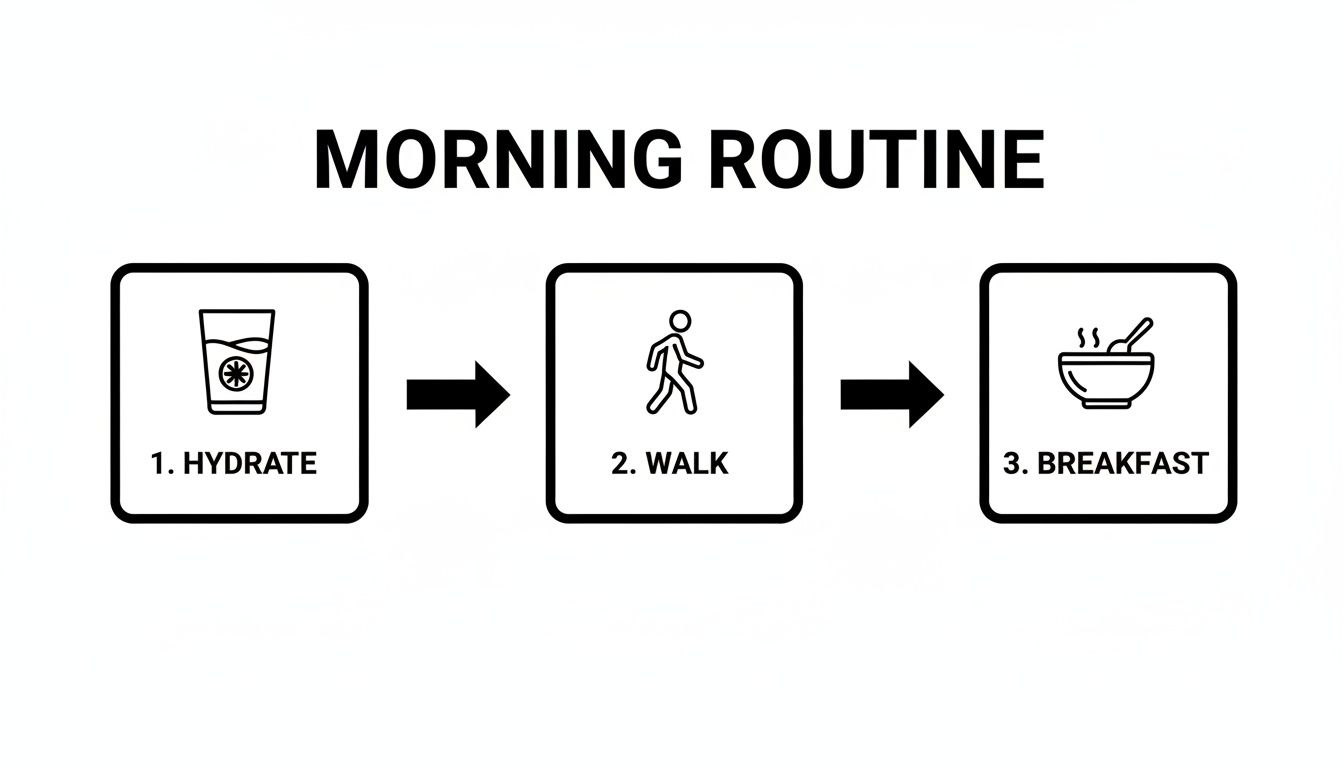
The simple sequence shown here—hydration, movement, and a solid meal—builds the biological foundation you need before you even start thinking about your schedule.
Tame Your Digital Environment
Your digital tools are supposed to serve you, not the other way around. It’s time to do a digital declutter and create a sanctuary for your attention. This means getting aggressive about protecting your focus by taking back control of your notifications.
You are not required to be available to everyone at all times. Setting boundaries on digital communication is a professional strength, not a weakness. It shows you're in control of your workflow and committed to producing high-quality results.
Here are a few things you can do right now to make a difference:
-
Disable Non-Essential Notifications: Go into your phone and computer settings. Turn off all banners, sounds, and pop-ups for social media, news, and personal email. The only thing that should be able to break through is an urgent, direct call.
-
Use Website Blockers: During your deep work blocks, use a browser extension to block distracting sites like social media or news aggregators. No more mindless scrolling when you should be concentrating.
-
Schedule Email Time: Don't let your inbox run your day. Instead, pick two or three specific times to check and respond to emails. This "batching" approach stops the constant context-switching that absolutely kills your focus.
Fuel Your Brain with Science-Backed Nutrition

It’s no secret that your ability to concentrate is directly tied to the fuel you put in your body. We’ve all been there—that midday brain fog after a heavy, processed lunch is a perfect example of this connection in action. The food you eat can either set you up for peak cognitive performance or completely sabotage your efforts to stay on task.
Sugary snacks and refined carbs are notorious for causing blood sugar spikes, which are always followed by a crash. This energy rollercoaster is a primary reason for poor concentration, irritability, and that drained feeling that seems to hit right around 2 PM. To maintain true mental clarity, you need clean, sustained energy.
Power Your Mind with Smart Food Choices
The key is to stabilize your blood sugar by choosing foods that provide a steady, slow release of energy. This means prioritizing complex carbohydrates, healthy fats, and lean proteins. These macronutrients keep you feeling full and your brain running smoothly, without the dreaded crash.
A few simple swaps can make a world of difference in your daily focus:
- Complex Carbs: Instead of white bread or pasta, try quinoa, brown rice, or sweet potatoes.
- Healthy Fats: Add foods like avocado, nuts, seeds, and olive oil to your meals.
- Lean Protein: Opt for chicken, fish, beans, and lentils to support healthy neurotransmitter function.
These choices aren't just about dodging a slump. They provide the essential building blocks your brain needs for memory, learning, and concentration. You're not just eating for your body—you're eating for your mind.
Elevate Your Focus with Targeted Nutrition
Beyond a well-rounded diet, certain supplements and functional beverages can give you a clean, effective edge. For busy professionals, finding jitter-free energy is crucial for maintaining high performance throughout the day.
Our Original Green Coffee, for instance, provides a natural lift without the harsh spike and crash you get from many traditional coffees. Its antioxidants and gentle caffeine content support alertness, making it an ideal choice for a morning or afternoon boost.
When your brain is constantly firing, it needs specific nutrients to maintain its pathways. Just as an athlete supports their muscles, a professional needs to support their cognitive hardware.
This is where ingredients with solid clinical backing come into play. A high-quality Alpha GPC + Citicoline supplement, for example, is designed to support the function of your neurotransmitters. These compounds are precursors to acetylcholine, a key neurotransmitter for memory, focus, and learning. You can dive deeper into how specific ingredients work by exploring our guide to natural energy and focus supplements.
Likewise, not all calming beverages are made the same. A product like our Functional Cocoa is formulated to create a calm, centered boost. It combines the natural benefits of cocoa with other functional ingredients to foster a state of relaxed alertness—perfect for tackling a complex project without feeling wired.
Choosing clean-label formulas is non-negotiable. By avoiding artificial colors, added sugars, and unnecessary fillers, you ensure you’re giving your brain the pure, effective support it needs to thrive. Ultimately, proper nutrition is the foundation of learning how to stay focused at work.
Optimize Your Workspace for Deep Work

Think of your physical environment as an active partner in your workday—it either supports your focus or actively works against it. Creating a dedicated focus sanctuary is one of the most powerful things you can do to reclaim your attention. This isn't about buying expensive furniture; it's about sending clear signals to your brain that this space is for deep, concentrated effort.
Whether you have a corner of the living room or a formal office, the mission is the same: eliminate distractions and remove any friction that gets in the way of starting your work. A great place to start is with visual clutter. A desk piled high with old papers, half-empty mugs, and random gadgets creates mental noise before you even begin.
Take five minutes to clear your desk. If something doesn't serve an immediate purpose for the task at hand, it needs to go. You'll be amazed at how much clearer your mind feels when your physical space is clear.
Design for Comfort and Concentration
Few things kill focus faster than physical discomfort. When your back is aching or your neck is stiff, your brain’s precious resources are diverted from your work to managing that pain. This makes investing in proper ergonomics a strategic move for productivity, not a luxury.
Make a few simple adjustments. Set your chair height so your feet are flat on the floor and your knees are bent at a 90-degree angle. Position your monitor at eye level to prevent hunching and neck strain. These small tweaks can make a huge difference in your ability to stay locked in for longer periods.
Sound is another common enemy of concentration. The constant hum of an open office or the unpredictable noises of a busy household can shatter your focus. Noise-canceling headphones are a game-changer here, creating an auditory bubble that tells your brain—and your colleagues—that it's time for deep work. Even in a seemingly private space, applying some office cubicle privacy strategies to boost focus can help you reclaim your headspace.
Putting It All Together: A Sample Schedule
It's one thing to know the principles, but it's another to see them in action. Here’s a look at how you could structure a day to protect your focus, integrating time blocking, breaks, and other focus-friendly habits.
Sample Focus-Optimized Daily Schedule
| Time | Activity | Focus Goal |
|---|---|---|
| 8:30-9:00 AM | Pre-work routine: Hydrate, plan top 3 priorities | Set clear intentions for the day |
| 9:00-10:30 AM | Deep Work Block: Tackle most important task | Use peak morning energy for high-value work |
| 10:30-10:45 AM | Short break: Walk, stretch, get water | Reset attention and prevent burnout |
| 10:45 AM-12:00 PM | Deep Work Block: Continue with priority task | Maintain momentum and achieve a milestone |
| 12:00-1:00 PM | Lunch: Eat away from desk, no screens | Refuel brain and body, detach from work |
| 1:00-2:00 PM | Shallow Work: Respond to emails, Slack messages | Batch administrative tasks to avoid constant interruption |
| 2:00-3:30 PM | Collaborative work or meetings | Engage with the team during a designated period |
| 3:30-3:45 PM | Short break: Light snack, quick meditation | Counter the afternoon energy slump |
| 3:45-4:30 PM | Wrap-up: Finish smaller tasks, plan for tomorrow | End the day with a sense of accomplishment and clarity |
| 4:30-5:00 PM | Daily shutdown: Tidy desk, close tabs | Create a clear boundary between work and personal time |
This schedule is just a template, of course. The key is to find a rhythm that works for your specific role and energy levels, intentionally building your day around your most important work.
How to Overcome Common Focus Killers
Even when you’ve done everything right, some days just don't cooperate. Your concentration fractures, and your to-do list feels miles long. These are the moments where knowing how to stay focused at work becomes less about strategy and more about smart, in-the-moment troubleshooting.
It’s not about forcing yourself to power through a mental roadblock. The real skill is learning to manage your energy and attention with intelligence.
Take the classic afternoon slump—that dreaded, energy-sucking feeling that hits around 3 PM. Your first thought might be to grab another coffee, but that can often backfire, leading to jitters and an even worse crash later.
There’s a better way. Instead of fighting your body’s signals, work with them. A quick, 10-minute walk is a fantastic reset, pumping fresh blood and oxygen to your brain. Pair that with a large glass of water to counter the subtle dehydration that often masquerades as fatigue. It’s a simple one-two punch that’s frequently more effective than another hit of caffeine.
Taming Overwhelm and Burnout
Another all-too-common focus killer is that paralyzing sense of overwhelm when you’re facing a massive project. When a task seems impossibly big, our brains naturally want to avoid it, which is procrastination’s favorite breeding ground.
The secret is to manufacture momentum. You do this by breaking the behemoth project down into its smallest possible parts—what I like to call micro-tasks.
So, instead of a vague goal like "Finalize Q4 Report," your list becomes a series of clear, concrete actions:
- Compile sales data from the dashboard.
- Draft the introduction and executive summary.
- Create charts for key performance indicators.
- Write the conclusion and next steps.
Every time you check one of these off, you get a small dopamine reward. This builds momentum and transforms the daunting project into a series of achievable wins.
If you’re feeling the early signs of burnout—cynicism, exhaustion, and a sense of ineffectiveness—the only real solution is to truly disconnect. Pushing harder is the worst thing you can do. Sustainable focus is built on periods of genuine rest where you are not thinking about work at all.
Ultimately, you have to accept that your capacity for deep focus is a finite resource. If you find yourself consistently running on empty, it's a clear signal from your body that you need more restorative activities outside of work. This gets to the heart of the matter: focus isn't about brute force. It's about the sophisticated management of your energy, your work, and your well-being.
Frequently Asked Questions About Workplace Focus
Even after you've put the right systems in place, mastering focus is a journey, not a destination. Questions always come up. Here are some quick thoughts on the most common hurdles people face when trying to reclaim their attention at work.
How Long Does It Take to Build a Focus Habit?
That really depends on the habit. You'll feel the benefits of simple tweaks, like shutting off your phone notifications, almost immediately. It’s an instant win.
But for the bigger shifts—like truly internalizing a time-blocking method like the Pomodoro Technique or completely overhauling your morning routine—give yourself some grace. You should start seeing consistent, solid results after about 3 to 4 weeks of dedicated effort.
Is It Bad to Listen to Music While Working?
This is a classic "it depends" situation. The answer hinges on the type of music and, more importantly, the type of work you're doing.
For repetitive, almost-on-autopilot tasks, the right music can be a game-changer. Think instrumental tracks, ambient sounds, or anything without lyrics. It can boost your mood and, crucially, drown out more distracting office chatter.
However, if you're tackling something that requires deep concentration, learning a new skill, or solving a complex problem, music is often a net negative. Even your favorite songs can siphon off precious cognitive resources and get in the way of high-level thinking.
The biggest mistake I see is people treating focus as a personal failing that needs a quick fix. More often than not, the real culprits are systemic issues—a culture of constant interruptions, vague priorities, or an unsustainable workload. Lasting focus comes from a combination of individual tactics and a supportive environment.
What if My Job Requires Constant Multitasking?
I'd challenge that assumption. Very few roles actually demand true, simultaneous multitasking. What they usually demand is rapid task-switching—jumping from one thing to another in quick succession. If that sounds familiar, your goal shouldn't be to multitask better, but to switch tasks more efficiently.
Try these strategies to reduce the cognitive whiplash:
- Batch similar work. Knock out all your emails in one dedicated block. Then, handle all your return calls in another. Don't ping-pong between them.
- Create tiny transition rituals. Before jumping from a spreadsheet to a client call, take one deep breath. Do a quick two-minute stretch. This small pause signals to your brain that it's time to change gears.
- Be ruthless about protecting deep work. Even a single, uninterrupted 30-minute block can be incredibly productive. Find it, schedule it, and defend it.
At Maximum Health Products, we provide science-backed nutritional support to help you achieve your peak cognitive performance. Our clean-label supplements and functional beverages are designed to give you the sustained energy and mental clarity you need to conquer your workday. Discover the right tools for your goals at https://maximumhealthproducts.com.

