


Some days you want your brain to feel sharper without the coffee shakiness. Other days you want your thoughts to stop circling at bedtime so you can settle down. That's usually when people start asking about the best time of day to take L-theanine.
The tricky part is that there isn't one universal best time.
L-theanine works more like a timing tool than a one-size-fits-all supplement. If you take it before a focused work block, it can help smooth mental noise. If you take it before bed, it may help quiet the “tired but wired” feeling that keeps your body in bed while your mind keeps talking.
I like to explain it this way to clients: L-theanine is less like an on-off switch and more like adjusting the lighting in a room. The room is still the same room. You're just changing the conditions so focus, calm, or sleep comes a little easier.
Finding Your Perfect Timing with L-Theanine
You finish your coffee at 8:00 a.m. By 8:30, your body feels faster than your thoughts. Then at 10:00 p.m., the reverse happens. Your body is tired, but your mind keeps running through tomorrow's to-do list.
That pattern is why timing matters so much with L-theanine.
Instead of asking for a universal best time, it helps to match L-theanine to a biological window. For many people, that means taking it about 30 to 60 minutes before the moment they want to feel different. The goal is not to chase the clock. The goal is to arrive at the right state at the right time.
A simple way to picture it is to treat L-theanine like setting the oven before cooking, not after the food is already on the table. If you want steadier focus for a work block, take it before the work starts. If you want a calmer body before a stressful meeting, take it before the meeting. If you want your mind to settle at night, take it before the usual second-wind window shows up.
This pharmacokinetic view is more useful than the oversimplified advice of “morning for focus, night for sleep.” Morning is only the right answer if your target is morning performance. Night is only the right answer if your target is bedtime calm.
That also clears up a common point of confusion. L-theanine does not have to be an everyday supplement for everyone. Some people do best with daily use because they want a consistent baseline of calmer focus. Others use it situationally, such as before presentations, long study sessions, travel, or nights when their brain feels especially busy.
A practical rule is to build your timing around the effect you want to feel in the next hour.
- For deep work or studying: take it 30 to 60 minutes before you sit down to concentrate
- For caffeine smoothing: take it with coffee, or shortly before, especially if caffeine tends to make you feel tense. If you want to compare tea and coffee caffeine, that can also help you predict when L-theanine may be most useful
- For acute stress: take it before the known trigger, such as a meeting, commute, social event, or flight
- For bedtime support: take it before your usual mental “lights stay on” period, not only once you are already frustrated in bed
That last point matters. Good timing is often about prevention, not rescue. If your mind predictably gets noisy around 9:30 p.m., taking L-theanine at 9:00 may make more sense than waiting until 11:00.
So the better question is not, “Should I take L-theanine in the morning or at night?” It is, “What effect am I trying to line up, and when does that window begin?”
Featured Product
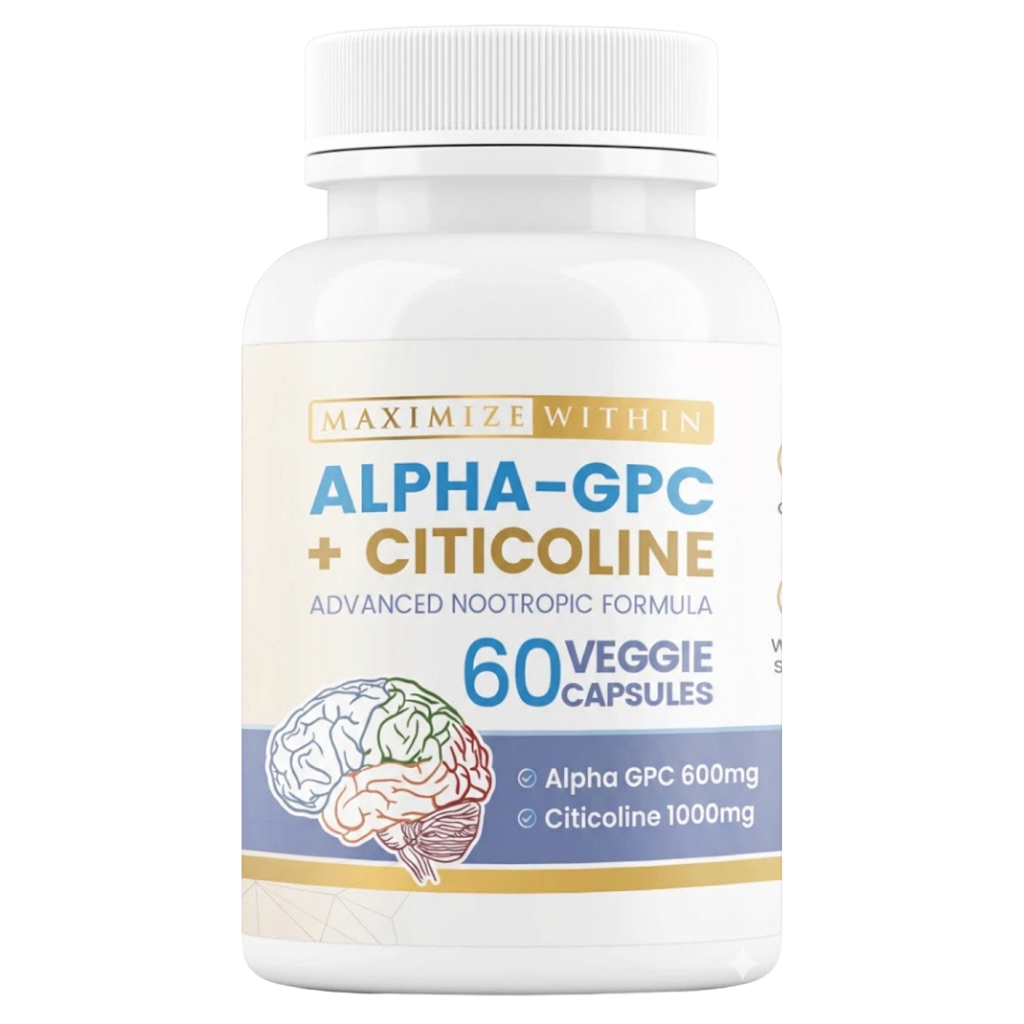
Alpha-GPC + Citicoline - Maximize Within | Advanced Nootropic Formula
A premium blend of Alpha-GPC (600mg) and Citicoline (1000mg), two well-known nootropic ingredients, in a convenient daily veggie capsule. Made in the USA. Gluten-free, soy-free, and preservative-free.
Shop Now →The Science of Calm How L-Theanine Works in Your Brain
You drink tea or take L-theanine and, about a little later, the mental room can feel quieter. Your thoughts are still there. They just stop talking over each other.
L-theanine works like noise-canceling headphones for your brain. It does not knock you out or flip you into a stimulant-like high. It helps lower the background static so focus, patience, or bedtime calm can come through more clearly.

What relaxed alertness actually feels like
“Relaxed alertness” can sound vague, so let's make it practical. It often feels like having access to your thoughts without the usual friction. You can still work, study, talk, or drive. You just may feel less mentally crowded.
That distinction matters because many adults hear “calm” and assume “sleepy.” L-theanine is better known for taking the edge off than for sedating you. For coffee drinkers, that can mean fewer jitters. For people with busy minds, it can mean less internal chatter while staying functional.
The timing piece starts with pharmacokinetics, which is the body's timeline for a compound. Two terms matter here:
- Onset is how soon you may start noticing an effect.
- Half-life is how long the compound stays at meaningful levels before the effect begins to taper.
If you remember nothing else, remember this. L-theanine is usually more useful when you line it up with the window you care about.
Why brain effects and timing are linked
A lot of supplement advice stays at the level of “take this for focus” or “take this for sleep.” That skips the more helpful question. When do you want the calmer, steadier feeling to show up?
That is why onset matters so much. If your stressful meeting starts at 2:00, taking L-theanine after the meeting begins misses part of the window. If your mind tends to speed up in the evening, waiting until you are already frustrated in bed can be late for the effect you wanted.
Another point that confuses people is the caffeine connection. L-theanine is naturally found in tea, which is one reason tea often feels different from coffee for some people. If you want to compare tea and coffee caffeine, that can help you choose the right base for your timing strategy. A cup of coffee creates one kind of stimulation window. Matcha or tea may create another, and this guide on matcha caffeine versus coffee can help you think through which one fits your goal.
The key idea is simple. You are matching L-theanine to a biological window, not taking it at a random “best” time.
Why the effect can feel subtle
L-theanine usually does not feel dramatic. That is part of its appeal.
People expecting a strong sensation may miss what is happening. The better comparison is lowering the volume on static in the background, not pressing a turbo button. If your goal is to stay composed during work, social stress, caffeine use, or your evening wind-down, subtle can be exactly what you want.
That also explains why some people use it daily and others use it only for certain situations. The question is less about whether L-theanine is a morning or night supplement, and more about whether you want a steady baseline or support for a specific event.
Morning Ritual for Enhanced Focus and Energy
You wake up, pour coffee, and open your laptop with a clear plan. Twenty minutes later, your brain is on, but your body feels a little too on. Your thoughts move fast, your tab count climbs, and the workday starts with speed instead of control. That is the morning window L-theanine often fits best.

The goal is not just “take it in the morning.” The goal is to line up L-theanine with the part of your day when you want calm focus to show up. For many adults, that means taking it shortly before or with the first caffeinated drink so the effect arrives as the first real work block begins.
A common range for focus is 100 to 200 mg, often paired with caffeine. Effects are often noticed within about 30 to 45 minutes, and general safety guidance for healthy adults commonly places total daily intake up to 500 mg. As noted earlier, this is one reason timing matters more than the label on the bottle. If your hardest thinking starts at 8:30 a.m., taking L-theanine at 10:00 a.m. misses the window you had in mind.
Why the coffee pairing helps
Caffeine acts like the gas pedal. L-theanine works more like better steering.
That pairing can feel useful for people who want alertness without the rougher edges of stimulation. Writers, students, analysts, and anyone who has to stay mentally sharp and emotionally steady often notice the difference most during tasks that require sustained attention, not quick bursts of energy.
The effect is usually subtle. You may not feel “different” so much as less scattered, less jittery, and easier to keep on task.
| Goal | Timing idea | Why it helps |
|---|---|---|
| Deep work session | Take L-theanine 30 to 45 minutes before the block, or with coffee just before it | Helps the effect arrive as you begin concentrated work |
| Morning coffee jitters | Take it with your first caffeinated drink | Can make the stimulation feel steadier |
| Study block | Use it before reading, review, or problem-solving | Supports a calmer attention window |
A simple morning schedule
Use this if your most demanding work happens early:
- Wake and hydrate: Give your body a few minutes to come online first.
- Choose your caffeine source on purpose: Coffee hits differently than tea or matcha. If you are deciding between them, this guide on matcha caffeine vs coffee can help you match the drink to the kind of focus you want.
- Take L-theanine close to that first caffeine window: Pairing them keeps the timing simple and easier to repeat.
- Start your primary task during the onset window: Put writing, analysis, studying, or planning here, not email triage.
Food still matters. If breakfast leaves you on a blood sugar roller coaster, supplements cannot fully smooth that out. For practical meal ideas that support steadier output, I like PlateBird's energy food insights, especially for people trying to build a calmer, more sustainable morning routine.
A quick demo can help if you're trying to visualize how people use the stack in real life:
Morning test: Try L-theanine on a morning with real cognitive demand. A deadline, a study session, a strategy block. That gives you a much better read on whether this timing works for your biology and your schedule.
Midday Reset for Situational Stress
Not everyone needs L-theanine every morning. Some people need it most at 1:30 p.m., right before a tense meeting, a presentation, or a difficult conversation.
That's where situational use makes a lot of sense.
The current evidence base doesn't clearly show a long-term cumulative advantage, and many studies evaluate single-dose or short-term use. NIH and NCCIH summaries discussed in Cleveland Clinic's overview also note that evidence for L-theanine benefits is still limited, with small samples and mixed formulations. In practical terms, that means the better question may be best use-case rather than best clock time (Cleveland Clinic's overview of L-theanine use and evidence limits).
When situational use is the smarter choice
Midday L-theanine can be a good fit if your stress shows up in spikes rather than all day long.
Good examples include:
- Before a presentation: You want your voice and thoughts to feel steady, not sleepy.
- Before a hard conversation: You need less internal tension, but you still need your words.
- After too much caffeine: You feel overstimulated and want to take the edge off without crashing.
A common timing mistake occurs when people wait until the stressful event has already started. That's usually too late for the most useful effect.
A practical midday playbook
Try this simple approach:
- Identify the event, not just the feeling. “Team meeting at 2 p.m.” is easier to plan for than “stress.”
- Take L-theanine before the pressure window, not in the middle of it.
- Keep expectations realistic. It's not a sedative and it's not emotional anesthesia. The goal is composure, not numbness.
If your stress is situational, your L-theanine routine can be situational too.
That can be a relief for people who don't want another supplement they feel obligated to take every day.
Evening Wind-Down for Relaxation and Sleep
Evening use is where L-theanine gets misunderstood most often. People hear that it supports sleep and assume it works like a sleeping pill. That's not the best way to think about it.
L-theanine is better framed as a pre-sleep state modifier. It helps reduce cognitive hyperarousal, which is the fancy term for “my body is tired but my mind won't stop.”

For sleep support, the most evidence-aligned timing is 30 to 60 minutes before bedtime. Reported effects typically last about 4 to 6 hours, with a half-life around 2.5 to 3 hours, which lines up well with the early part of the night. A controlled study in healthy adults also found improvements in sleep-latency and daytime-dysfunction scores on the PSQI, supporting the idea that L-theanine helps lower pre-sleep stress load rather than acting as a classic hypnotic (PMC review and study summary on L-theanine and sleep timing).
Who benefits most from bedtime use
Evening L-theanine tends to make the most sense for people who say things like:
- “I'm exhausted, but my thoughts won't slow down.”
- “As soon as I lie down, my brain starts reviewing the day.”
- “I don't want a heavy sleep aid. I just want to settle.”
If your issue is racing thoughts, tension, or a hard mental transition from work mode to rest mode, timing L-theanine before bed is often more logical than taking it randomly during the evening.
A bedtime routine that fits the biology
A useful sleep routine doesn't rely on the supplement alone. Think of L-theanine as one part of a landing sequence.
You might pair it with:
- Dimmer lighting: Help your brain register that stimulation is ending.
- Less mental input: Fewer screens, fewer work tasks, fewer “just one more email” moments.
- A repeated cue: The same tea, the same book, the same shower, the same wind-down pattern.
For broader ideas on how to improve your sleep habits, gentle behavioral changes often work better than chasing stronger and stronger sleep aids.
If sleep quality is your bigger wellness project, this article on how to improve sleep quality is a useful companion to bedtime supplement timing.
L-theanine doesn't force sleep. It creates a calmer runway for sleep to happen.
That distinction matters. If someone expects a knockout effect, they may think it “doesn't work.” But if the goal is to soften the mental friction that delays sleep, the timing and use-case make much more sense.
Building Your Personal L-Theanine Protocol
A useful L-theanine routine starts with one question: What window are you trying to hit?

If you take it at random times, your results can feel random too. If you time it to the part of the day when your stress, distraction, or mental chatter usually rises, the routine becomes easier to judge.
Earlier research discussed in this article suggests L-theanine can support both daytime calm and evening relaxation when used consistently. That matters because the true decision is often not “morning or night.” It is “daily or situational,” and “which biological window do I want to influence?”
Start with one goal and one window
L-theanine works best as a targeted tool. A hammer is useful when you know where the nail is. The same idea applies here.
Ask yourself:
- Do I want smoother focus during a predictable work block?
- Do I need help during occasional high-stress events, like meetings, travel, or deadlines?
- Do I want a calmer mental transition before bed?
Your answer shapes the protocol more than the clock does.
Three sample protocols
These are starting templates, not fixed rules.
| Person | Best fit | How to use the timing idea |
|---|---|---|
| Busy professional | Morning focus support | Take it before your main concentration block, especially if coffee helps your energy but adds mental static |
| Fitness enthusiast | Pre-workout mental steadiness | Take it before training if you want a calmer, more locked-in headspace without feeling overstimulated |
| Sleep-seeker | Evening wind-down | Take it before your usual bedtime routine if the problem is a busy mind, not just physical fatigue |
Notice the pattern. Each example ties L-theanine to a repeatable moment, not a vague hope that it will help at some point during the day.
Daily use vs. situational use
Many people often struggle with this point.
Daily use makes sense when the same challenge shows up on a regular schedule. Maybe every workday starts with caffeine jitters. Maybe most nights involve a long mental cooldown before sleep. In that case, a consistent routine gives you a fair test.
Situational use makes sense when stress arrives in spikes. Presentations, packed travel days, a difficult conversation, or an afternoon when you overshot your caffeine intake are all examples. Here, L-theanine works more like a planned support tool than a daily habit.
If you are unsure which camp you fall into, use a notebook for two weeks. Write down three things: when you took it, what you wanted it to help with, and what you noticed 30 to 90 minutes later. Patterns usually show up fast.
Build your protocol like a simple experiment
Keep the test boring on purpose.
Pick one dose range you already feel comfortable with, one timing window, and one goal. Do that for several days before changing anything. If you change the timing, dose, caffeine intake, and bedtime routine all at once, you will have no idea what caused the result.
A simple plan could look like this:
- For focus: Use it before the same morning work block for several weekdays in a row
- For stress spikes: Reserve it for known trigger events and track whether the edge feels lower
- For sleep support: Use it at the same point in your evening routine and note whether your mind settles more easily
That gives you something better than guesswork. It gives you a repeatable personal pattern.
Safety and common-sense guardrails
A few basics still matter.
- Stay within commonly cited adult guidance discussed earlier: More is not automatically better
- Watch your own response: Some people feel calm and clear, while others feel more noticeably relaxed
- Account for combinations: Caffeine, sleep blends, and other calming ingredients can change the overall feel
- Check with a clinician if you take medications or manage a health condition: That step matters more if you are using L-theanine regularly
If your bigger goal is sharper concentration across the day, this guide to supplements for mental clarity and focus support can help you build a broader routine around L-theanine instead of expecting one ingredient to do everything.
Best personal formula: Choose one goal, one timing window, and one routine. Test that setup before changing multiple variables.
That approach helps you figure out whether L-theanine belongs in your morning coffee ritual, your pre-meeting plan, or your evening wind-down.

