


Biotin gummies are marketed like they're harmless insurance for growing kids, but most healthy children don't need a separate biotin supplement at all. In pediatric care, biotin usually matters for two very different reasons, a confirmed deficiency or a rare inherited disorder, not as a routine beauty add-on for hair and nails.
That distinction matters because children's needs are small. The NIH lists age-based adequate intake targets in the microgram range, and that's why a typical children's multivitamin often already covers biotin without any extra product. If you're deciding whether to buy another bottle, start with the basics, what biotin does, how much kids need, which foods already provide it, and when a supplement is justified.
If you've been comparing ingredient lists, it may help to first look at ingredients backed by research in context, rather than just the claims on a gummy label. Parents who want a broader supplement framework can also compare their options with ingredients backed by research, but biotin for kids deserves its own careful filter before anything goes in the cart.
Why Most Kids Do Not Need a Biotin Supplement
The default assumption around biotin for kids is usually wrong. Most parents see a hair-and-nails bottle, read “B7” or “beauty support,” and assume a little extra can't hurt. In reality, the healthy child eating a mixed diet is usually not the child who needs a biotin product.
The two times biotin really comes up
In pediatric medicine, biotin usually enters the conversation in two situations, a confirmed deficiency or a genetic disorder that blocks normal biotin recycling. Biotinidase deficiency is the classic example, because untreated cases can cause secondary biotin deficiency and developmental harm, which is why newborn screening exists for it biotinidase deficiency screening and incidence.
For every other child, the question is not “Should I add biotin?” but “What problem am I trying to solve?” Hair shedding, brittle nails, and skin irritation have many more common explanations than biotin deficiency. Families often chase the supplement first and the diagnosis second.
Practical rule: if your child is eating normally and passed newborn screening, a biotin gummy is usually not the first answer.
Why the beauty marketing misses the mark
Adult beauty supplements are built for adult labels, adult dosing, and adult expectations. Children's needs are much smaller, and the NIH's pediatric intake values make that clear. The ordinary child often gets enough biotin through food or a standard multivitamin, without needing a separate high-dose product NIH biotin fact sheet and Oregon State biotin overview.
A helpful way to think about it is this. If a product is selling “hair support” first and explaining pediatric nutrition later, it's probably designed for marketing, not for a child's actual biotin status. For parents who prefer guidance tied to developmental stages rather than supplement hype, stages of child development can be a useful way to keep expectations age-appropriate.

Featured Product
Maximum Kids Complete ORGANIC Powder Mix
This organic powder mix combines real fruits, vegetables, and greens into a tasty drink kids actually enjoy. Every serving is packed with 26 vitamins and minerals, 20g of plant-based protein, and 3g of fiber
Shop Now →What Biotin Actually Does in a Child's Body
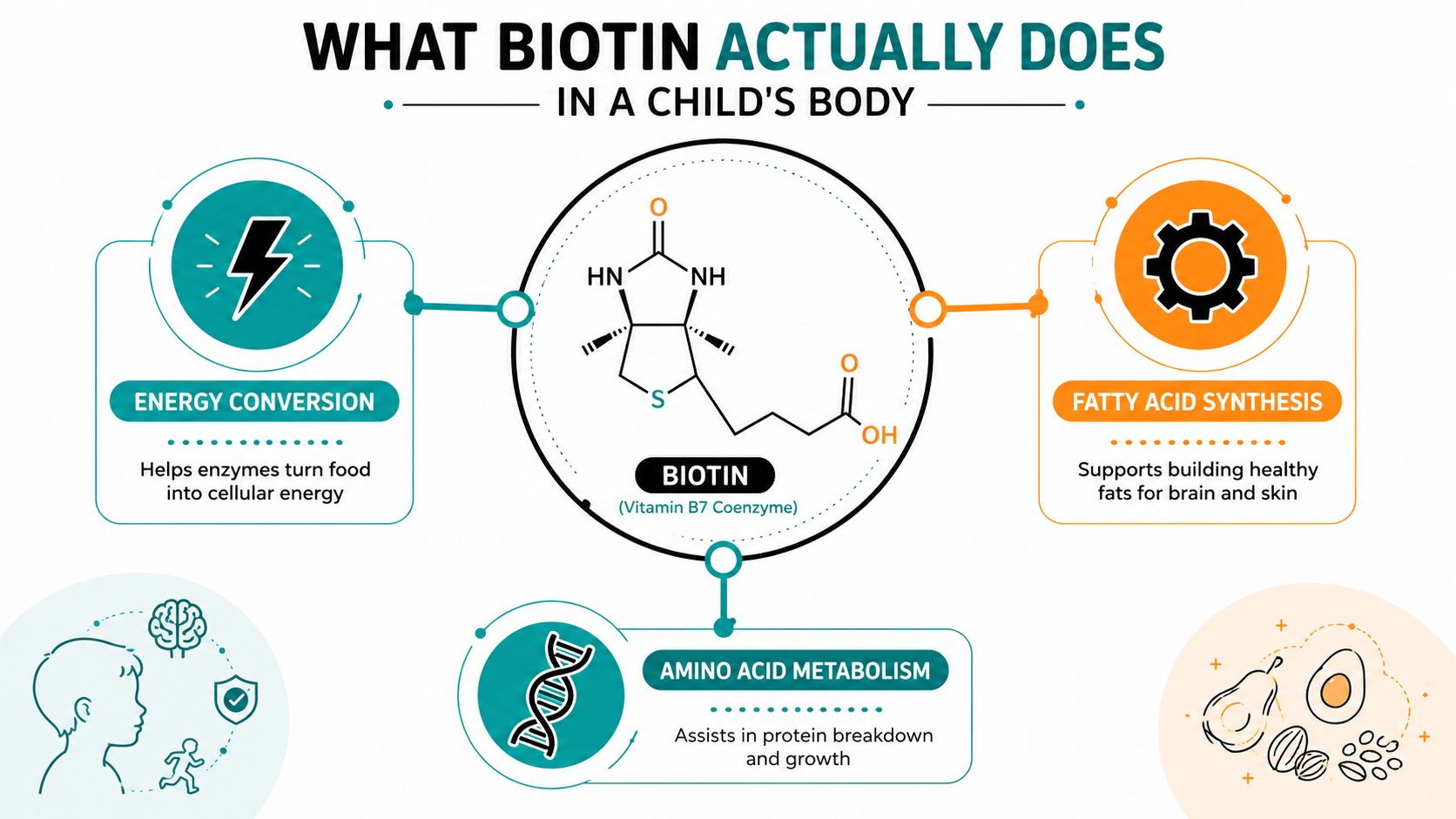
Biotin is a B-vitamin coenzyme. In plain terms, it helps enzymes do their work, especially when the body is turning food into energy and processing fats and certain amino acids. It is more like a small wrench in a very busy factory than a building block on its own.
The factory tool idea
A factory can have plenty of raw materials, but without the right tools, the assembly line slows down. Biotin works in that same kind of support role inside the body. It helps enzymes keep certain metabolic steps moving, which is why biotin belongs to normal nutrition rather than to cosmetic marketing.
That is also why biotin labels can be confusing. Parents often see words like keratin, collagen, or “hair strength” and assume biotin directly builds hair or nails. It does not. Hair and nails are made of structural proteins, while biotin supports the metabolism that keeps cells functioning normally. If you want a parent-friendly reminder that skin care and supplement marketing are not the same thing, see advice from Little Venture Co..
Why this matters for hair and nails
A child's hair growth, skin turnover, and nail formation depend on overall health, not on one supplement. Biotin is one small part of that picture. If a child is healthy and eating well, biotin is usually already present in the diet in the amount needed for normal metabolism.
That is the main reason “more” is not automatically better here. A product may promise a cosmetic effect, but biotin's real job is metabolic support, not direct beautification. For parents who want a simple visual explanation of how that works, this short video overview of biotin's role can help connect the science to the label language.
Bottom line: biotin supports metabolism. It does not act like a hair serum in pill form.
How Much Biotin Kids Need at Each Age
The NIH uses Adequate Intake, or AI, values for biotin in children, and those numbers are very small. That's a good clue that routine megadosing is not what pediatric nutrition is built around NIH biotin fact sheet.
Age-based targets in plain language
A baby's need starts at 5 mcg/day for birth to 6 months, then rises to 6 mcg/day for 7–12 months. For toddlers, the AI is 8 mcg/day for ages 1–3. For elementary school children, it's 12 mcg/day for ages 4–8, then 20 mcg/day for ages 9–13, and 25 mcg/day for ages 14–18 NIH biotin fact sheet.
The Daily Value on supplement labels is 30 mcg for adults and children age 4 and older, which is why many kids' multivitamins already land in the right neighborhood without any extra “beauty” formula. No pediatric tolerable upper intake level has been established, but that doesn't mean high-dose products are useful, only that typical dietary intakes haven't shown a toxicity pattern in children Oregon State biotin overview.
Quick reference table
| Age | Adequate Intake (mcg/day) | Daily Value on labels (mcg) |
|---|---|---|
| Birth to 6 months | 5 | 30 |
| 7–12 months | 6 | 30 |
| 1–3 years | 8 | 30 |
| 4–8 years | 12 | 30 |
| 9–13 years | 20 | 30 |
| 14–18 years | 25 | 30 |
The practical takeaway is simple. If a child's supplement label shows biotin in milligrams, not micrograms, that's already a sign the product is built for adult-style beauty dosing rather than pediatric nutrition. Reading the unit matters more than reading the front-of-bottle claim.
For parents thinking in terms of growth stages, child development stages helps reinforce why nutrition needs rise gradually rather than jumping to adult-level supplement habits.
Everyday Foods That Already Provide Biotin
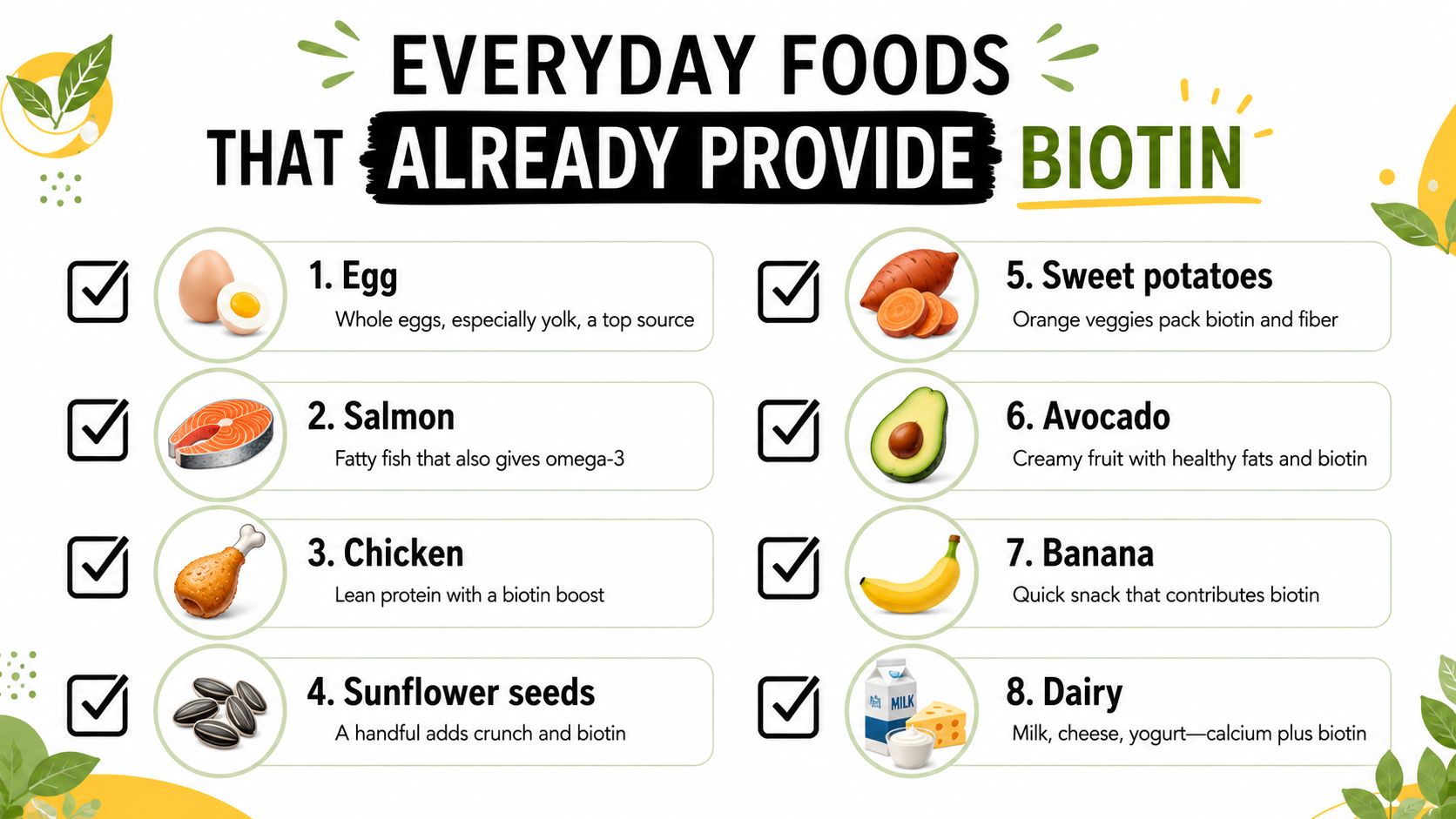
The easiest way to think about biotin for kids is food first, not bottle first. Biotin shows up in normal mixed diets, especially when a child eats a range of animal foods, produce, and seeds. That's one reason healthy kids often meet their needs without any special planning.
Foods that quietly cover the need
Eggs are the classic example, especially the yolk. Salmon and chicken contribute biotin too, along with protein that most children already need for growth. Sunflower seeds, sweet potatoes, avocados, bananas, and dairy also fit naturally into everyday meals and snacks.
A child does not need to eat all of those foods every day to get enough biotin. The point is that biotin is not a rare nutrient hidden in specialty powders. It's part of ordinary food patterns, so a varied diet usually does the job.
One food myth parents should know
Raw egg whites are often mentioned in hair discussions, but they are not a helpful biotin strategy. The problem is avidin, a protein in raw egg whites that binds biotin and can reduce absorption. That's a good reason to cook eggs rather than chase “natural” raw food advice.
Useful shortcut: if your child eats cooked eggs, dairy, fruit, vegetables, and a normal mix of proteins, biotin deficiency is much less likely than the internet makes it sound.
What symptoms mean, and what they usually don't
True biotin deficiency can show up as thinning hair, a scaly rash around the eyes, nose, or mouth, brittle nails, fatigue, or neurologic symptoms. But those signs are not specific to biotin. In real pediatric practice, eczema, alopecia areata, iron deficiency, thyroid problems, and harsh hair practices are more common explanations for hair or skin concerns.
That's why parents should resist the urge to self-diagnose from a supplement ad. A child with a dry scalp, a patch of hair loss, or a stubborn rash needs a broader look at diet, skin health, and medical history. The right question is not “Which gummy fixes this?” It's “What's causing it?”
If your child needs a gentler food pattern overall, the same kind of label awareness used for other specialty diets can help. A practical example is gluten-free foods for kids, which shows how families often build nutrition from real meals rather than single-nutrient fixes.
Biotinidase Deficiency and Newborn Screening
Biotinidase deficiency is the rare pediatric situation that gives biotin real medical urgency. In this condition, the body can't recycle biotin properly, so deficiency can develop unless it's treated. That's why newborn screening changed the outlook so dramatically biotinidase deficiency overview.
Why the screening matters
A worldwide neonatal screening survey cited by StatPearls estimates profound biotinidase deficiency at about 1 in 112,000 live births, partial deficiency at about 1 in 129,000 live births, and a combined incidence of 1 in 61,067 live births biotinidase deficiency overview. Another clinical review places the global incidence range at 1 in 40,000–60,000 births, which shows that estimates vary by population and dataset same source.
If a child passed newborn screening, this disorder has already been screened for. That doesn't rule out every medical reason for symptoms, but it does make biotinidase deficiency much less likely in a healthy child with no known metabolic diagnosis.
What this means for parents
This is the medical reason prescription-strength biotin exists. It's not for general hair-growth marketing. It's for a specific inherited disorder, and in that setting, timing and follow-up matter. If a clinician suspects a metabolic condition, they'll guide testing rather than asking families to guess from a gummy aisle.
A child with unexplained neurological symptoms, repeated rashes, or a family history of metabolic disease deserves medical evaluation. A child with normal growth and a normal screen usually does not need biotin “just in case.”
Choosing Between Food, a Multivitamin, or a Biotin-Only Product
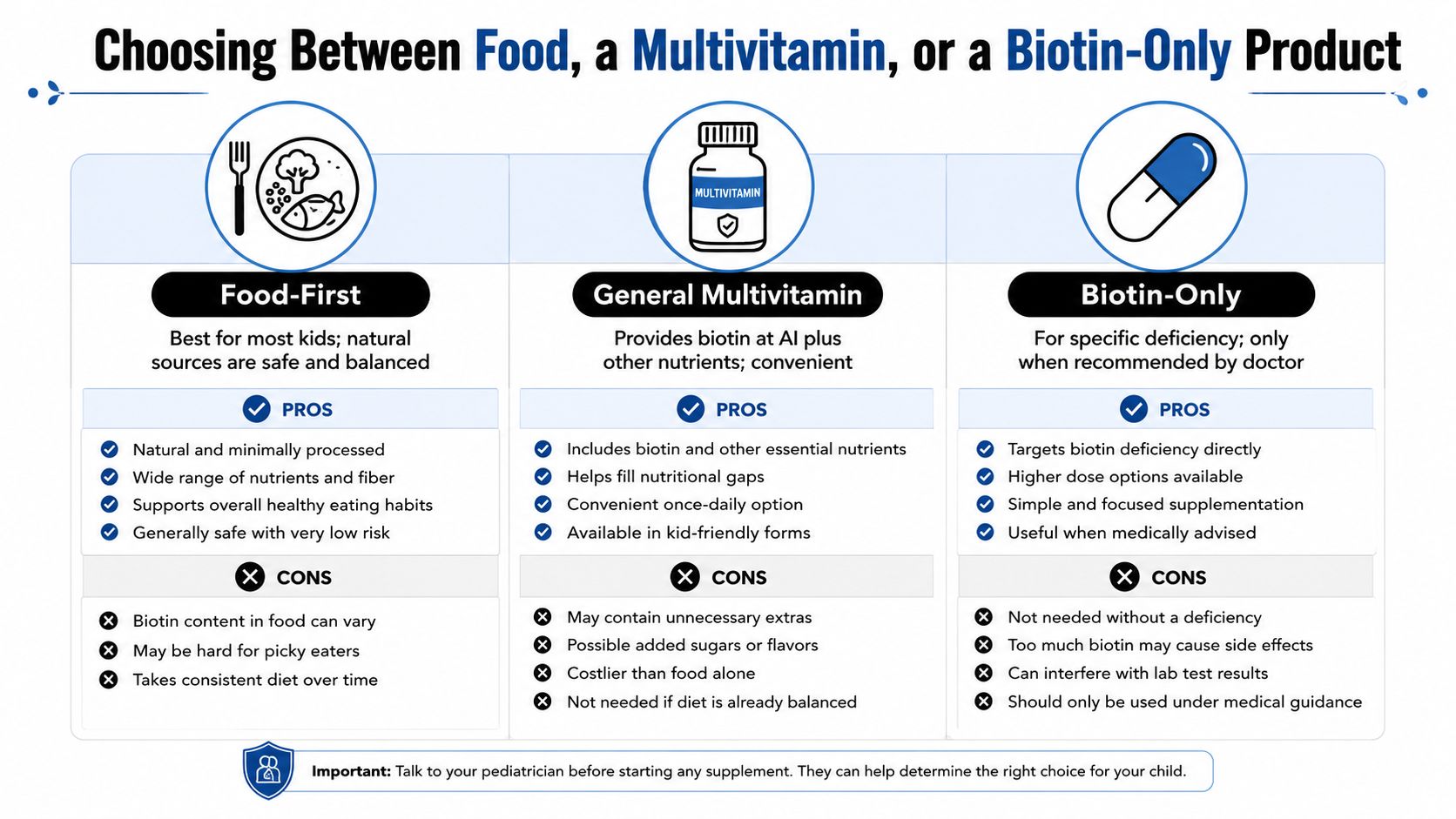
When parents are deciding what to buy, the simplest way to compare options is by necessity, dose, and label clarity. Food-first is usually the baseline. A standard children's multivitamin may already include biotin in an age-appropriate amount. A biotin-only product makes sense mainly when a clinician has identified a need.
A quick comparison
| Approach | When It Makes Sense | Watch Out For |
|---|---|---|
| Food-first | Most children with normal eating patterns | Doesn't help if there's a diagnosed deficiency or metabolic disorder |
| General multivitamin | When a pediatrician wants a broad nutrition backstop | Check whether biotin is already included before adding more |
| Biotin-only | Confirmed deficiency or specific medical recommendation | Adult-style high doses, unit confusion, and unnecessary megadosing |
A label can be misleading if you don't check the units. mcg is micrograms, mg is milligrams, and those are not close in everyday use. The high-dose “beauty” products that advertise 5,000 to 10,000 mcg are adult formulations, not child-focused nutrition. That's exactly why the Daily Value line matters when you're comparing products.
If you're looking at a family supplement shelf, one option in the market is Maximum Health Products' Chewable Maxi Health tablets, which include biotin and are sold in a chewable format. The key question, though, is not whether a product contains biotin, but whether your child needs extra biotin at all. For a broader look at kids' supplement categories, best vitamins for kids can help frame the decision without making biotin the main event.
What to read on the label
- Check the unit first: Look for mcg, not mg, before you compare any number.
- Look at the serving size: One gummy may not be one day's dose.
- Compare against the AI: If the product already meets your child's age target, extra biotin usually adds clutter, not benefit.
- Ask why it's included: Biotin in a multivitamin is different from a separate high-dose biotin formula.
The Lab-Test Interference Issue Parents Rarely Hear About
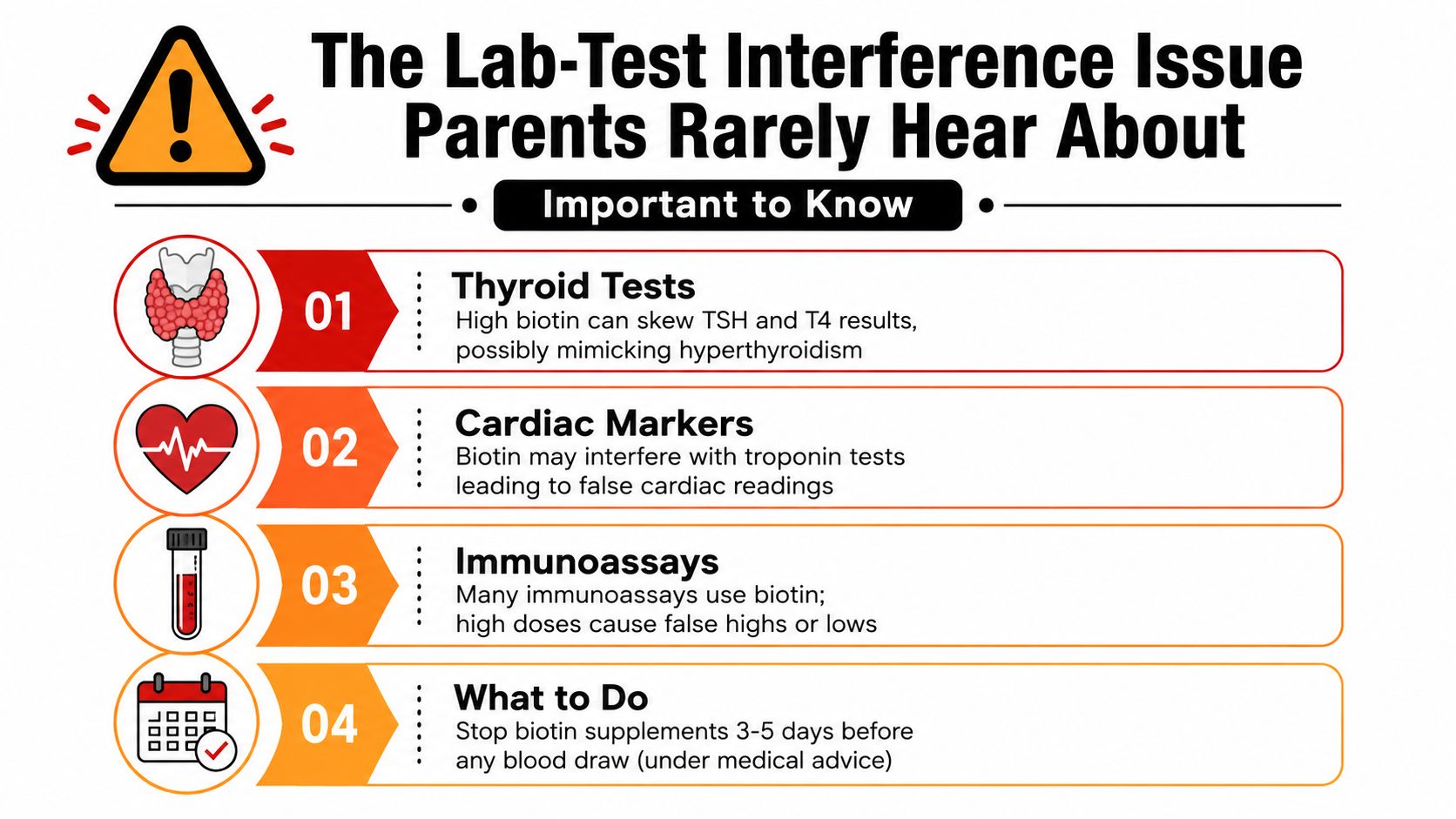
The biggest downside to casual biotin use is often not toxicity, it's lab-test interference. High-dose biotin can distort certain blood and immunoassay results, which can create a false sense of reassurance or an unnecessary scare depending on which test is affected Mayo Clinic biotin guidance.
Where the confusion shows up
Thyroid tests are one example. Cardiac markers are another. Some immunoassays use biotin-based chemistry, and supplement-level doses can push results in the wrong direction Mayo Clinic biotin guidance.
That matters in pediatrics because the child who takes a gummy “just in case” may later have blood work for an unrelated reason. A parent who forgets to mention the supplement can accidentally complicate interpretation. The risk is practical, not theoretical.
What to do before a blood draw
Tell the clinician and the lab about every supplement your child is taking, including biotin.
If a blood test is scheduled, ask whether biotin should be paused beforehand. Many clinicians advise stopping it several days prior, depending on the product and the test, but the timing should come from the child's clinician rather than from guesswork. The safest habit is simple, list the supplement before the lab draw, not after the result looks odd.
This is one reason I'm cautious about biotin-heavy products for children. The supplement may seem harmless, yet it can muddy the water when the medical team is trying to read a real signal from the blood.
When to Talk to a Pediatrician About Biotin
A pediatrician visit makes sense when the concern is more than a casual change in appearance. Persistent rash, sudden or patchy hair loss, neurological changes, and a family history of metabolic disorders all deserve a real conversation. Medication questions belong in that same conversation, especially if your child takes anticonvulsants or other medicines that may affect nutrient status. If you are also sorting through side effects from other B vitamins, the same careful approach applies, as outlined in this guide to methylated B-vitamin side effects.
What the clinician is likely to do
A good pediatric visit usually starts with diet, growth, skin, and medication history. The clinician may ask what your child eats in a typical week, whether a multivitamin is already in use, and whether anything changed before the symptom started. If the pattern suggests a deficiency or another medical issue, testing may follow.
That matters because biotin is only one possible explanation. A child with hair thinning may need a scalp exam, not a supplement. A child with a rash may need eczema care, not a gummy. A child with fatigue or developmental concerns may need a wider workup, not a beauty formula.
Helpful rule: if you are unsure whether the problem is nutritional, skin-related, or metabolic, start with the pediatrician, not the supplement aisle.
How to think about the decision
Before you buy biotin, ask three questions. Is there a clear medical reason? Does the label match my child's age, or is it an adult beauty dose? Could this supplement complicate lab testing later? If the answer to the first question is no, the safer next step is usually food review and medical guidance.
Maximum Health Products also offers other family-friendly supplement formats, including its KiddieMax Liquid B-Complex with biotin in a liquid serving. A product like that still belongs in the same decision framework, because a convenient format does not replace a real indication.
For parents who want to make supplement decisions with fewer assumptions and more context, the best move is to talk with your child's pediatrician, review the current multivitamin label if there is one, and visit Maximum Health Products only after you know whether you are filling a true need or reacting to marketing.

