


You take calcium. You add vitamin D. You assume your bases are covered.
So why do so many people still feel like something is missing?
The gap is usually magnesium. Most advice treats these nutrients like separate items on a checklist. Your body doesn't. It treats them like a team. If one player is out of position, the whole system gets less efficient.
This is the full story behind calcium vitamin D magnesium. It's not just about getting enough of each nutrient. It's about getting them in the right relationship, at the right times, and in a way your body can effectively use.
Why You Need More Than Just Calcium and Vitamin D
Why do calcium and vitamin D still fall short for some people who take them consistently?
Because absorption is only one step in the process. Your body also has to activate vitamin D, move calcium into the right places, and keep the whole system in balance. Magnesium helps with each of those steps, which is why a calcium plus vitamin D routine can look good on paper but work poorly in real life when magnesium intake is low.
That missing piece matters more than many supplement labels suggest.
Why the common approach falls short
Many people are taught a simple formula: take calcium for bones and vitamin D to help absorb it. Useful, yes. Complete, no.
A better way to understand the trio is to follow the sequence. Calcium is the raw material. Vitamin D helps your body absorb and use that material. Magnesium helps activate vitamin D and supports the enzymes involved in that process, as explained earlier in this article. If magnesium is in short supply, the plan can stall upstream.
This is why balance matters more than stacking nutrients one by one. Adding more calcium does not automatically fix a problem caused by poor vitamin D status. Adding vitamin D does not guarantee results if your body cannot efficiently activate it. Ratios matter, and so does context.
Why balance matters beyond bone health
There is also a placement issue. Your goal is not just to get more calcium into the body. Your goal is to help the body use calcium appropriately while supporting muscles, nerves, and the cardiovascular system at the same time.
That is where an imbalanced approach can become counterproductive. Pushing calcium intake higher while ignoring magnesium can work against the broader system you are trying to support. The question shifts from “Am I taking enough?” to “Am I taking these in a proportion my body can use well?”
A simple analogy helps here. Vitamin D is the gatekeeper. Magnesium is the key that helps the gatekeeper function. Calcium is the building material waiting at the door. If the key is missing, the process becomes less efficient, even when the building material is abundant.
Simple takeaway: Calcium and vitamin D work better when magnesium is part of the plan, and the balance between all three shapes the result.
Featured Product
Maximum Slim SuperGreens Powder | Plant-Based Nutrient Drink Mix
Maximum Slim SuperGreens delivers 27 organic superfoods in a single daily scoop — making it one of the easiest ways to fuel your body with real plant-based nutrition
Shop Now →
The Power Trio How Calcium Vitamin D and Magnesium Work Together
Why do some people take calcium and vitamin D consistently, yet still miss the results they expect?
The answer is often magnesium. Calcium, vitamin D, and magnesium act less like three separate supplements and more like a coordinated system. Calcium supplies the mineral your bones and teeth rely on. Vitamin D helps your body absorb that calcium. Magnesium helps your body activate and use vitamin D efficiently. If one piece is out of proportion, the whole process can work less smoothly.
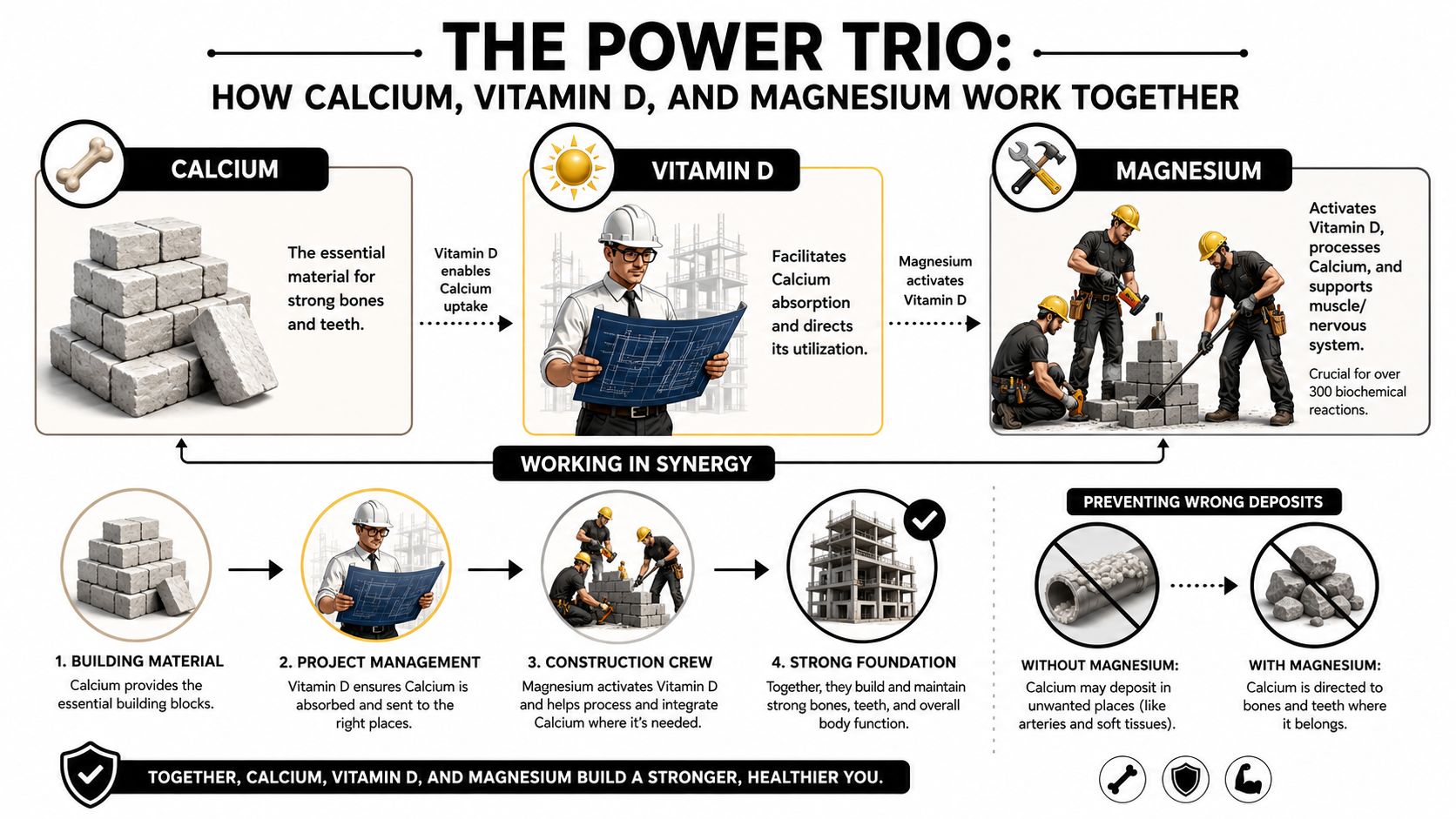
Calcium supplies the material
Calcium is the mineral your body uses to build and maintain hard tissue. That part is familiar. What gets missed is that calcium does not help much if your body cannot absorb it well or direct it where it belongs.
This is why a calcium-only mindset can fall short. More is not always better. Better use is better.
Vitamin D helps calcium get through the door
Vitamin D works like the gatekeeper in this trio. It supports calcium absorption from the gut, which means it helps determine how much of the calcium you eat becomes available to the body.
A person can have a calcium-rich diet on paper and still come up short in practice if vitamin D status is poor. That mismatch is one reason balance matters more than adding another pill to the routine.
Magnesium helps vitamin D become usable
Here is the step many readers do not expect. Magnesium is involved in the biosynthesis, transport, and activation of vitamin D, according to this review on magnesium as a cofactor in vitamin D metabolism.
The same review describes cases where magnesium and vitamin D taken together improved vitamin D status more effectively than vitamin D alone in people with low magnesium intake. In plain language, vitamin D may be present, but magnesium helps your body put it to work.
That has practical consequences beyond bone health. Magnesium also affects muscle relaxation and nervous system regulation, which helps explain why some people interested in mineral balance also look into ways to improve sleep quality and evening magnesium routines. If you are curious about topical options, you can also discover ArtNaturals magnesium benefits.
Balance matters more than taking everything together
People often assume that putting all three nutrients into one formula guarantees better results. Sometimes it does. Sometimes timing and proportion matter more.
Calcium and magnesium can compete for absorption when taken in large amounts at the same time. Calcium tends to have the stronger pull. So if a supplement delivers a high calcium dose with too little magnesium, you may be reinforcing the imbalance you were trying to fix.
A simple way to remember the relationship is this:
- Calcium provides the raw material
- Vitamin D helps your body absorb it
- Magnesium helps activate the vitamin D system and supports where that process goes next
That is the core power of the trio. The goal is not just getting enough of each nutrient. The goal is getting them in a balance your body can effectively use, especially if you care about both bone strength and cardiovascular health.
From Strong Bones to Better Sleep Key Health Benefits
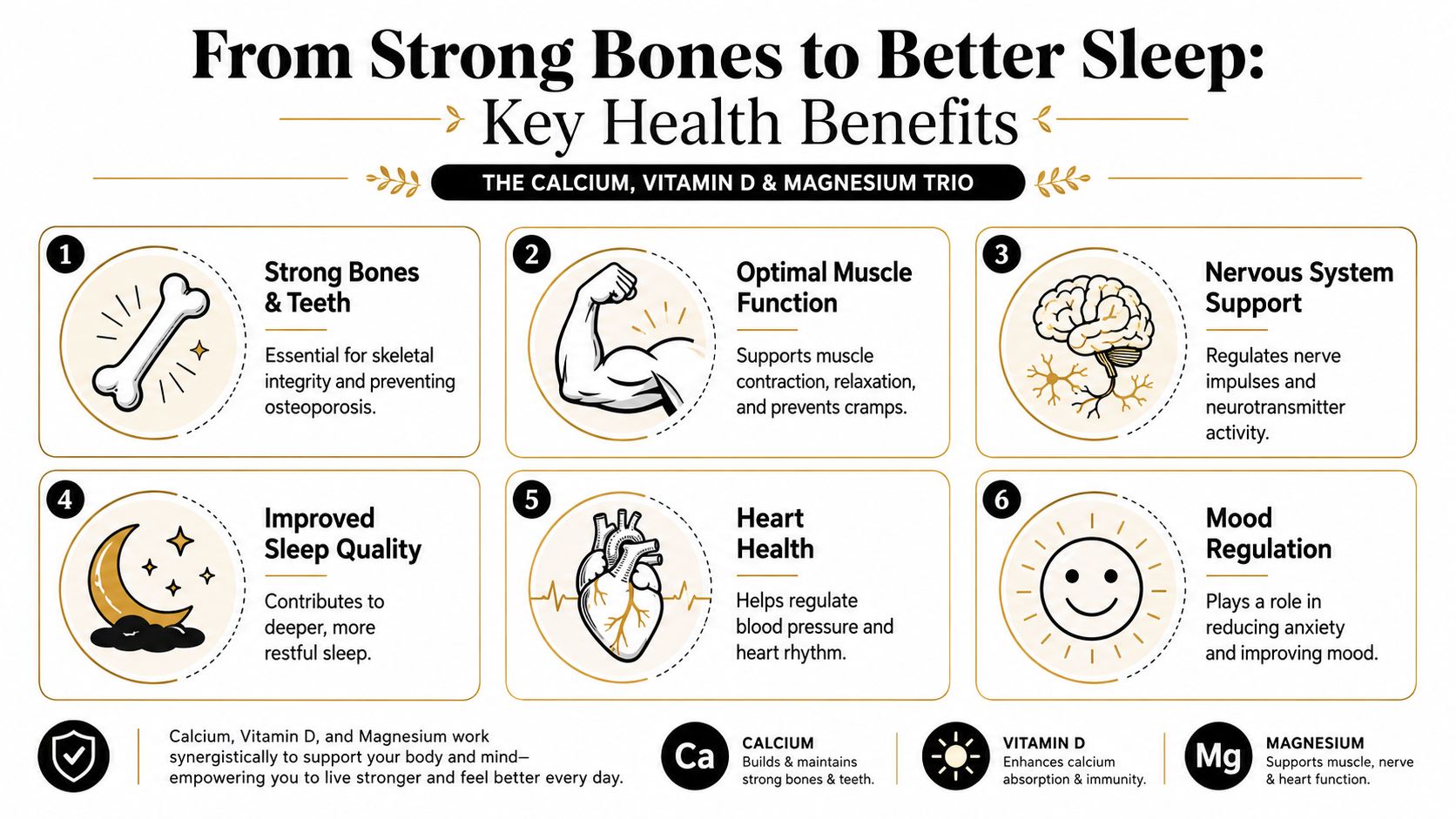
Once you understand the teamwork, the benefits make more sense. These nutrients don't just affect bone density. They influence how muscles fire, how the cardiovascular system responds, and how steady the body feels day to day.
Blood pressure and heart support
The best quantified data in this trio comes from magnesium. In a meta-analysis of 22 studies involving 1,173 normotensive and hypertensive adults, magnesium supplementation for 3 to 24 weeks decreased systolic blood pressure by 3 to 4 mmHg and diastolic blood pressure by 2 to 3 mmHg. The same review notes that an additional 100 mg/day of magnesium was associated with an 8% decrease in total stroke risk, as reported in this PMC review on magnesium, calcium, vitamin D, and blood pressure outcomes.
That doesn't mean calcium and vitamin D are irrelevant here. It means mineral balance has system-wide effects, not just skeletal ones.
Bone and muscle function
Bones aren't static. They're active tissue. They depend on a steady mineral supply and proper signaling. Muscles also rely on a balance between contraction and relaxation, and that's one reason people often notice that poor mineral intake shows up as tension, cramps, or restless sleep.
If you want a practical primer on topical and broader uses of magnesium, you can discover ArtNaturals magnesium benefits as a general educational resource.
Sleep and nervous system steadiness
Many people first get interested in magnesium because they're tired but wired. They fall asleep poorly, wake up tense, or feel like their body doesn't fully downshift at night.
That doesn't make magnesium a magic sleep fix. It does make it relevant to the bigger picture of relaxation and nervous system support. If sleep is part of your health puzzle, this guide on how to improve sleep quality gives a helpful lifestyle framework to pair with nutrition.
Practical insight: If your bones, muscles, and sleep all feel “off” at the same time, it's worth looking at nutrient balance instead of chasing each symptom separately.
Metabolic support
The same PMC review also reported that a 100 mg/day increase in total magnesium intake decreased the risk of developing type 2 diabetes by 15% in a meta-analysis of seven studies covering 286,668 patients over 6 to 17 years. That finding matters because it expands the conversation beyond bones and reminds us that this trio works inside whole-body metabolism, not in one isolated tissue.
This is why calcium vitamin D magnesium deserves to be approached as a coordinated strategy. When the balance is right, the effects tend to show up across multiple systems at once.
Finding Your Optimal Balance Dosages Ratios and Timing
How do you know whether your plan is balanced, or whether you are just stacking three supplements that may work against each other?
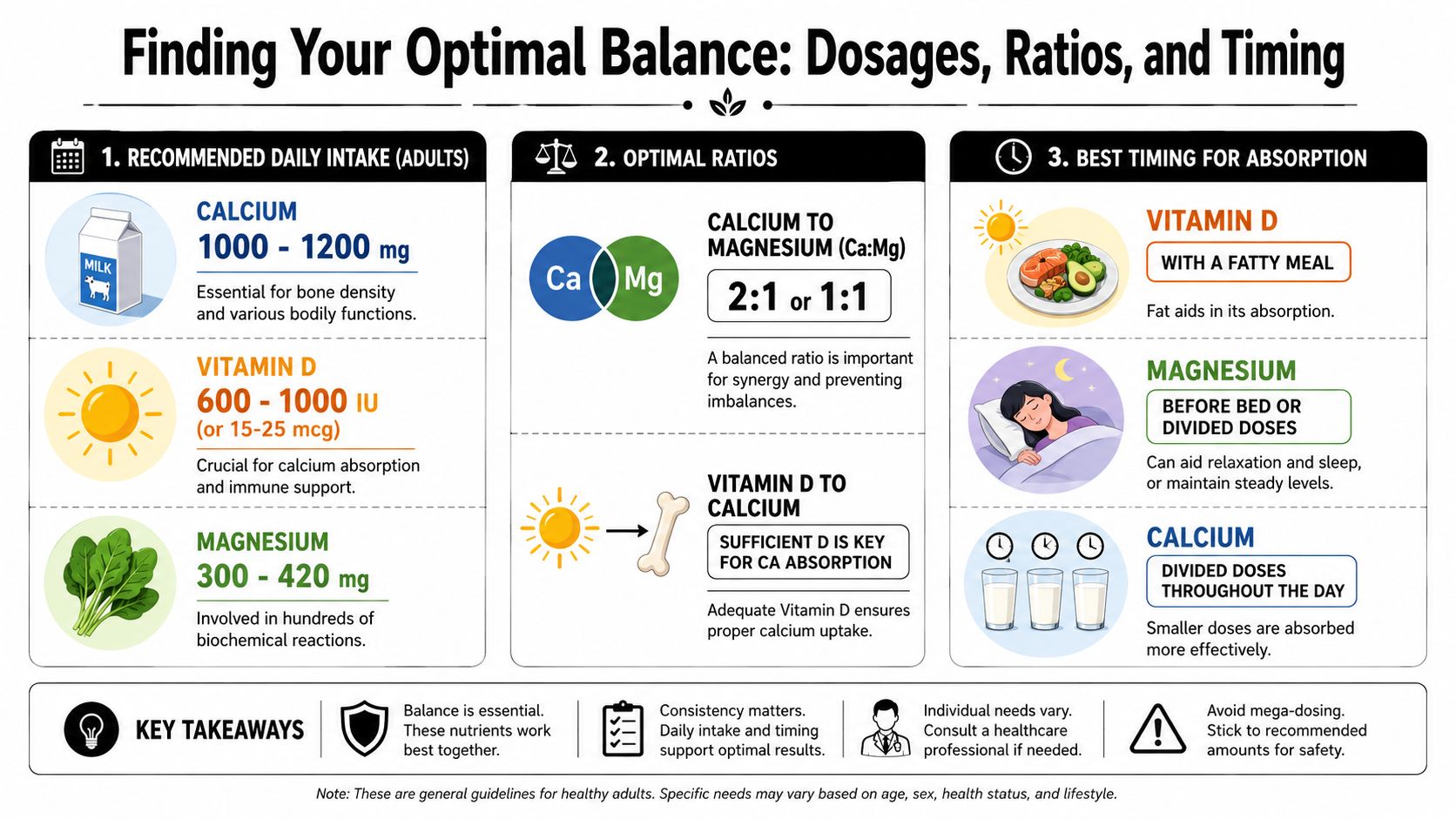
A smart calcium vitamin D magnesium routine starts with one idea. These nutrients behave less like isolated helpers and more like a team. Calcium is the building material. Vitamin D works like the gatekeeper that helps calcium get into circulation and be used well. Magnesium acts like the key that helps activate vitamin D and keeps calcium handling from becoming too one-sided.
That balance matters more than many supplement labels suggest.
Start with your baseline, not the bottle
Before choosing doses, look at your food pattern, sun exposure, symptoms, lab work if you have it, and any reason your clinician has already suggested supplementation. A person who eats yogurt, sardines, and greens regularly has a different starting point than someone who avoids dairy, works indoors, and rarely eats magnesium-rich foods.
The practical question is not “How much of each can I add?” It is “Where is the weak link in my current intake?”
If you are comparing options, a bone health supplement collection with calcium, vitamin D, and magnesium formulas can give you a sense of how these nutrients are commonly paired, but the best choice still depends on your diet and your actual gap.
The ratio many people miss
Calcium and magnesium need a workable relationship. If calcium climbs while magnesium stays low, the body may end up with plenty of raw material but less support for proper regulation. That is one reason a high-calcium approach can fall short, especially if someone is also taking vitamin D without enough magnesium to help activate it.
Research reviewed in this NIH-indexed paper on calcium-to-magnesium ratios and health outcomes suggests that the ratio between these two minerals matters, not just the total amount of each. For a plain-language overview, you can understand calcium and magnesium synergy.
A simple way to picture it is a construction site. Calcium supplies the bricks. Vitamin D opens the gate so materials can enter and be used. Magnesium helps run the equipment and direct traffic. More bricks do not help much if the gate is poorly managed or the equipment crew is missing.
Timing changes how well the plan works
Timing matters because minerals can compete for absorption. Large calcium and magnesium doses taken together may not be the smoothest setup for every person.
Many adults do better with a pattern like this:
-
Vitamin D with a meal that contains fat
That fits how this fat-soluble vitamin is absorbed and makes the habit easier to keep. -
Calcium split into smaller amounts if needed
Dividing supplemental calcium across the day is often more practical than taking one large dose. -
Magnesium at a different time from larger calcium doses
This can reduce competition in the gut. Some people also prefer magnesium later in the day because it fits their evening routine.
Here's the basic logic:
| Nutrient | Practical timing idea | Why it can help |
|---|---|---|
| Calcium | Smaller divided doses | May improve tolerance and absorption |
| Vitamin D | Take with food | Fits fat-soluble absorption |
| Magnesium | Separate from high calcium doses | May reduce direct competition |
A visual walkthrough can help if you like seeing this in action:
A simple check before you increase anything
Ask yourself four questions:
- Am I already getting plenty of calcium from food?
- Have I overlooked magnesium while focusing on calcium and vitamin D?
- Am I taking vitamin D without enough dietary fat or without considering magnesium status?
- Would splitting doses work better than taking everything at once?
That last point is easy to miss. An imbalanced plan can look good on paper and still work poorly in real life.
The goal is not the biggest dose. The goal is a proportion your body can use.
Best Dietary and Supplement Sources for the Trio
A strong plan starts in the kitchen, because food supplies these nutrients in patterns your body can use across the day. That matters for this trio. Calcium on its own is only part of the story. Vitamin D helps your body absorb and use calcium, and magnesium helps activate vitamin D and supports how calcium is handled in tissues, including the heart and blood vessels.
Food sources that support balance
You do not need a perfect meal plan. You need a repeatable pattern.
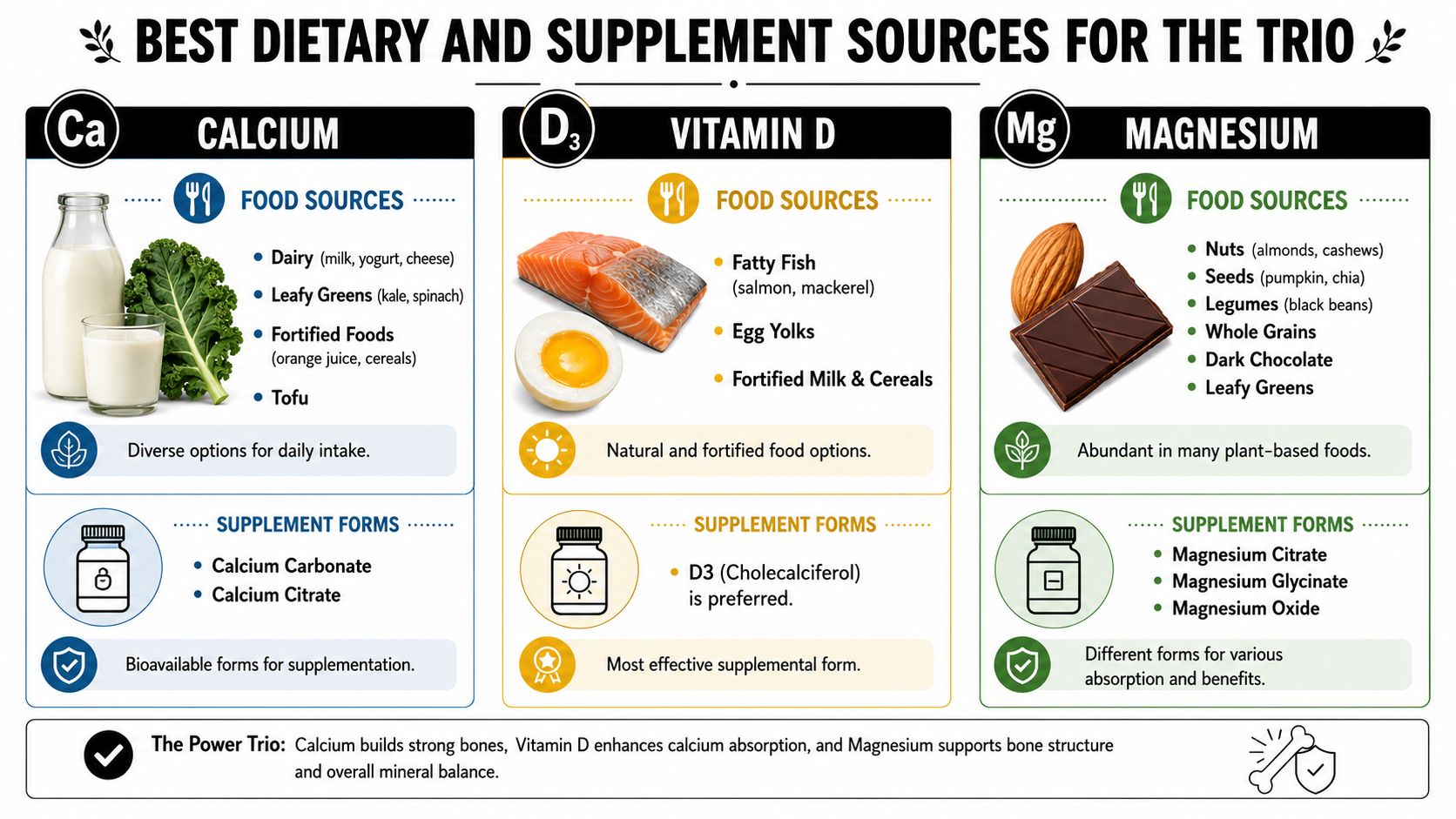
A helpful way to picture it is this: calcium is the building material, vitamin D works like the gatekeeper that helps calcium get in, and magnesium acts like the key that helps vitamin D do its job. If one part is missing, the whole system runs less smoothly.
Instead of chasing one nutrient, build meals that cover all three:
- Calcium-rich foods: yogurt, kefir, milk, calcium-set tofu, sardines with bones, and fortified plant milks
- Vitamin D foods: salmon, trout, sardines, egg yolks, and fortified dairy or plant beverages
- Magnesium-rich foods: pumpkin seeds, almonds, black beans, lentils, oats, spinach, and dark chocolate
Some foods overlap, which makes balance easier. Sardines can contribute calcium and vitamin D. Leafy greens can add calcium and magnesium. Fortified foods may help fill gaps, especially for people who avoid dairy or eat little fish.
That is one reason food-first works so well. Meals naturally spread intake out, and they bring along protein, fats, and other minerals that supplements cannot fully copy.
When supplements are useful
Supplements make sense when food intake is inconsistent, appetite is low, sun exposure is limited, digestion affects intake, or a clinician has identified a likely gap. They are also common for people who avoid dairy, follow restrictive diets, or want a more predictable vitamin D intake through the year.
If you're comparing options across categories, it can help to Explore Revive supplements as part of your broader supplement research. And if bone support is your main goal, this bone supplement collection shows the kinds of formats commonly used for calcium, vitamin D, and magnesium.
Choosing a form that fits your body and routine
The best form depends on digestion, tolerance, and what gap you are trying to fill. A label can look impressive and still create an unbalanced plan if it piles on calcium while barely supplying magnesium.
| Supplement Form | Common use | Best For | Notes |
|---|---|---|---|
| Calcium carbonate | Widely available | People who take calcium with meals | Often found in basic calcium products |
| Calcium citrate | Widely available | People who want a calcium option often considered gentler | Commonly chosen for flexibility |
| Magnesium citrate | General magnesium use | People looking for a commonly used magnesium form | Frequently used in everyday routines |
| Magnesium glycinate | General magnesium use | People who want a gentler magnesium option | Often chosen for evening use |
| Magnesium oxide | General magnesium use | People focused on cost | Common, though tolerance varies |
| Vitamin D3 | Vitamin D supplementation | People adding vitamin D | Commonly preferred in practice |
Read that table as a shopping guide, not a ranking.
A combined product can be convenient, but convenience is not the same as balance. If a formula gives you a large calcium dose with very little magnesium, it may look bone-focused while missing part of the partnership that helps vitamin D function well.
A smarter label check
Before you buy, look at the formula the way a nutritionist would:
- Check the ratio, not just the front label
- See whether magnesium is meaningfully included or treated like an afterthought
- Match the serving size to your eating and supplement habits
- Watch for stacked calcium from multiple products, such as a multivitamin plus a bone formula
That last point is easy to miss. A person can take vitamin D faithfully, add extra calcium for bones, and still come up short on results if magnesium intake stays low. The goal is not a crowded supplement routine. The goal is a trio your body can use together.
Navigating Potential Risks and Medication Interactions
More isn't always better, especially with calcium.
A caution raised in Today's Geriatric Medicine's review of calcium supplementation and cardiovascular risk is that multiple meta-analyses have indicated an increased cardiovascular disease risk in elderly adults taking calcium supplements when they are not deficient. The clearest fracture-related benefit was described as largely confined to institutionalized elderly adults with documented dietary deficiencies.
What this means in plain language
If someone needs calcium, supplementation can be appropriate. But taking extra calcium “just in case” may not be harmless, particularly if magnesium intake is low and the broader picture hasn't been assessed.
That's the unique tension in this topic. People hear “calcium supports bones” and interpret that as “more calcium must be safer.” The evidence doesn't support that simplistic jump.
Watch for imbalance, not just deficiency
Symptoms in this area can be messy. Low intake might show up as poor sleep, muscle tightness, cramps, or a sense that recovery is off. Too much supplementation can show up as digestive discomfort or a routine that keeps adding pills without solving the original problem.
Medication interactions matter too. Calcium, magnesium, and vitamin D can intersect with diuretics, antibiotics, and heart medications. If you take prescription drugs, it's smart to review your supplement list with your clinician or pharmacist before changing doses.
A second layer of safety is product quality. Independent verification matters, especially if you use supplements regularly. If you want a plain-English primer on why that matters, this article on what third-party testing means for supplements is worth reading.
The safest plan is targeted, not automatic. Match supplementation to need, diet, medications, and follow-up.
Your Personalized Plan for a Balanced Intake
A good calcium vitamin D magnesium routine should fit your life, not fight it.
For the busy professional
Keep it simple. Build meals around magnesium-rich foods like nuts, seeds, legumes, and greens. Take vitamin D with a regular meal you won't forget. If magnesium helps you feel more settled in the evening, place it later in the day and keep large calcium doses separate.
For the fitness enthusiast
Think recovery and structure. Calcium supports the skeletal side of training, while magnesium matters for muscle function and steadiness. If you use supplements, avoid the trap of loading calcium without checking whether your magnesium intake is keeping pace.
For the health-conscious parent
Use a food-first approach before building a supplement stack. Look at the whole pattern in the household. Dairy or fortified alternatives, leafy greens, eggs, fish, beans, seeds, and whole grains all help. If supplements enter the picture, keep the goal focused on filling gaps, not chasing a “more is better” mindset.
The smartest plan is usually the least dramatic one. Eat broadly. Space calcium sensibly. Respect the calcium-to-magnesium relationship. Treat vitamin D as part of a system, not a solo fix.
If you want clean-label wellness support from a brand focused on simple daily routines, browse Maximum Health Products. Their selection includes vitamins, supplements, and functional nutrition options designed to support energy, focus, metabolism, sleep, and overall well-being without the additives many shoppers want to avoid.

