


Most advice about a natural metabolism booster for women is built on the wrong promise. It treats metabolism like a light switch you can flip with one tea, one pill, or one “fat-burning” ingredient.
That's not how the body works.
Your metabolism is closer to an engine that responds to the quality of its fuel, the amount of muscle it has to maintain, the signals it gets from sleep and stress, and the consistency of your daily routine. Some foods and compounds can give that engine a short-term lift. But the women who feel steadier energy and see lasting progress usually aren't chasing a temporary spike. They're building a body that uses energy well, day after day.
That's good news, because it means your metabolism probably isn't “broken.” It may just need better support. If you want a practical starting point, it helps to first calculate your daily energy needs so your food and activity choices match what your body requires.

Featured Product
Maximum Slim Original
Science-backed formula to support metabolism, curb appetite, and help you reach your goals faster.
Shop Now →Beyond the Hype What Metabolism Really Means
Metabolism isn't a single process. It's the sum of all the work your body does to stay alive and active. Breathing, circulating blood, repairing tissue, digesting meals, moving through your day, and recovering from exercise all belong under that umbrella.
A lot of marketing turns metabolism into a drama. Fast metabolism, slow metabolism, damaged metabolism. In practice, it's more useful to think of metabolism as your body's energy management system. It's always running. The question is whether your habits are helping that system run efficiently.
Why quick fixes disappoint
A temporary lift is not the same as a resilient metabolism. Caffeine may raise energy for a while. A spicy meal may make you feel warm. A supplement label may sound impressive. None of that replaces the basics that shape how your body uses fuel over time.
Women often get confusing advice here because the messaging jumps straight to ingredients and skips physiology. If you're tired, under-muscled, chronically stressed, skimping on protein, or sleeping poorly, your body gets mixed signals. In that setting, even a well-studied ingredient can only do so much.
Practical rule: Ask “What supports my metabolism daily?” before you ask “What boosts it today?”
What actually helps
The strongest approach is layered, not flashy. A useful natural metabolism booster for women usually combines:
- Enough protein to support muscle and increase the energy cost of digestion
- Regular movement so your body keeps using fuel instead of conserving it
- Resistance training to preserve or build lean tissue
- Hydration so normal metabolic processes run smoothly
- Sleep and stress support because hormones shape how efficiently you use energy
That's the fundamental shift. You stop chasing a trick and start building capacity.
Your Metabolic Engine A Woman's Guide
Think of your metabolism like the operating costs of a car. Some energy is spent just keeping the engine on. Some is used to process fuel. Some depends on how far and how often you drive. Women's bodies follow the same logic, but hormones, age, and body composition change the pattern.
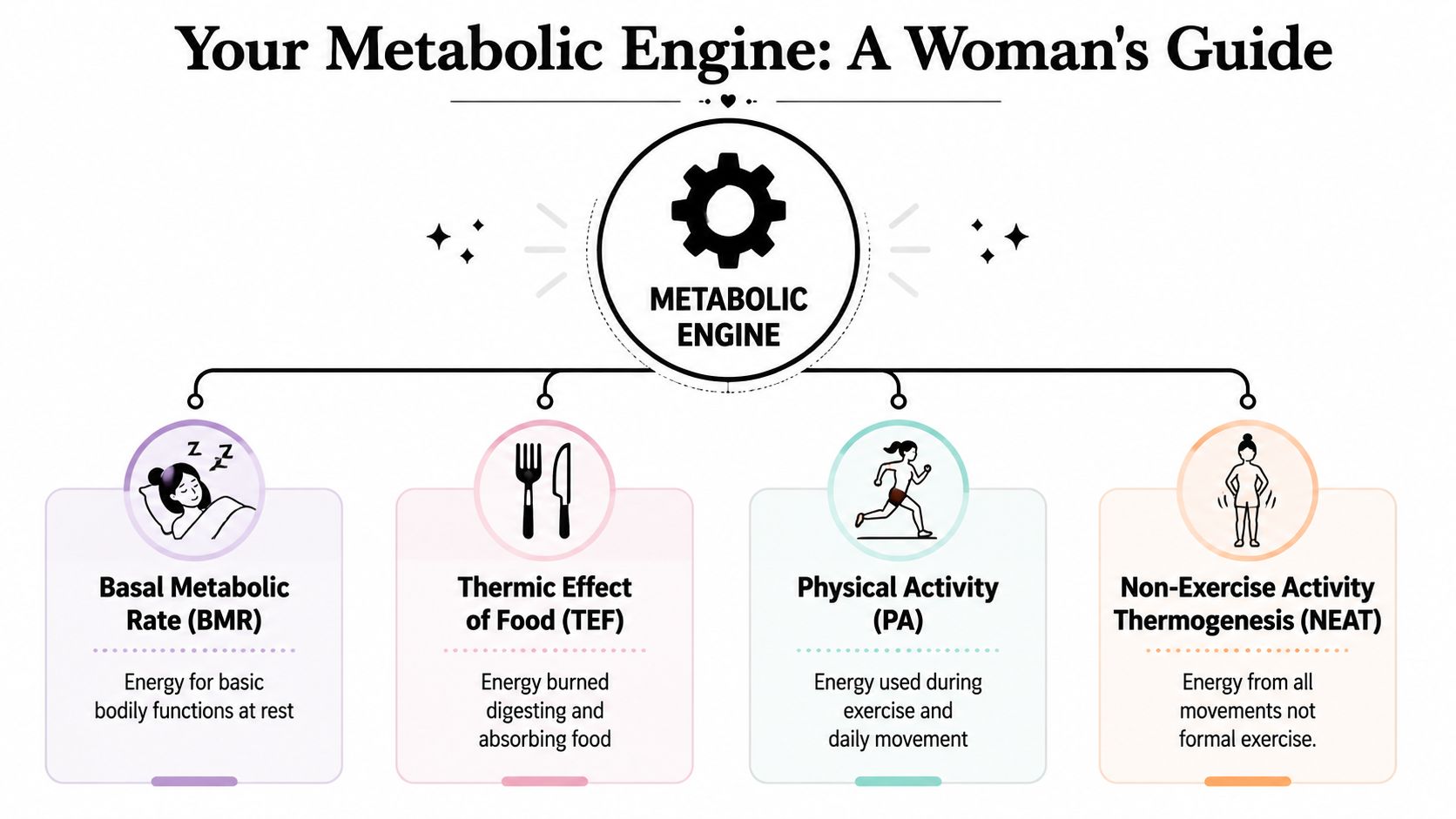
The four parts of daily energy use
Here's the simplest way to understand it.
| Component | What it means in plain language | Why it matters |
|---|---|---|
| BMR | Energy your body uses at rest | Keeps organs and basic functions running |
| TEF | Energy used to digest food | Some foods cost more to process than others |
| Physical activity | Planned exercise | Walks, workouts, sports, lifting |
| NEAT | Everyday movement outside exercise | Standing, cleaning, pacing, carrying bags |
Basal metabolic rate, or BMR, is the energy your body needs just to stay alive. If you rested all day, you'd still burn energy.
Thermic effect of food, often called TEF, is the energy your body uses to break down and absorb what you eat.
Then there's movement. Formal exercise matters, but so does NEAT, which means all the small motions that fill a normal day. Women with desk jobs often underestimate how much this category affects overall energy use.
Why metabolism advice often misses women
Generic advice tends to act as if all bodies respond the same way. They don't.
Women's metabolism is shaped by muscle mass, hormonal changes, menstrual cycling, thyroid function, stress load, and age-related shifts in body composition. If muscle decreases over time, resting energy use often drops with it. That's one reason broad advice like “just eat less” can backfire. It can lower energy, reduce training quality, and make it harder to maintain lean tissue.
For women after forty, the conversation gets even more specific. A useful overview of these age-related shifts appears in this guide on how to speed up metabolism after 40.
The female blueprint matters
One verified point is especially important here. Existing content often ignores the metabolic decline many women face after forty, even though protein needs may need to rise to 1.6 g/kg of body weight to help counter age-related muscle loss, while common metabolism boosters like capsaicin appear to offer only negligible temporary effects, according to Medical News Today's review.
A woman doesn't need a harsher plan. She usually needs a more precise one.
That's why a natural metabolism booster for women should never be framed as one ingredient. It should be framed as a system that protects muscle, supports hormones, and makes daily energy use more efficient.
Nutrition to Fuel Your Metabolic Rate
A faster metabolism is rarely built by chasing one spicy ingredient or one trendy drink. It is built the same way a steady fire is built. You need the right materials, added consistently, so the flame stays useful instead of flaring for a moment and fading out.
Food affects metabolism in two main ways. First, it provides the raw materials your body uses to maintain lean tissue and carry out thousands of chemical reactions. Second, some foods require more energy to digest and process than others. That second piece is called diet-induced thermogenesis, and protein is the clearest example.
Protein gives your body more to do
Protein is the most metabolically active macronutrient during digestion. The body has to break it apart, absorb it, and use those amino acids for repair, enzymes, hormones, and tissue maintenance. That work costs energy.
The Cleveland Clinic explains that protein has a higher thermic effect than carbohydrates and fats, which is one reason protein-rich meals can support metabolic health more effectively than low-protein ones. In plain terms, your body spends more calories processing a meal built around Greek yogurt, eggs, fish, tofu, beans, or chicken than a meal built mostly from refined starch or fat.
This matters for women because a metabolism-supportive plate is not just about short-term calorie burn. It also helps protect the lean tissue that keeps daily energy needs from drifting downward over time.
Simple ways to raise protein intake include:
- Greek yogurt with fruit or seeds at breakfast
- Eggs, tofu, or edamame for quick meals
- Fish, chicken, tempeh, or beans at lunch and dinner
- Protein-rich extras like cottage cheese, lentils, or roasted chickpeas in bowls, soups, and salads
Coffee and green tea can support the system
Caffeine can slightly increase energy expenditure for some people, and green tea contains compounds that may add a modest thermogenic effect. The key word is modest.
The Office of Dietary Supplements at the NIH notes that caffeine and green tea extracts have been studied for weight management, but the effects tend to be small and inconsistent. That makes coffee or green tea more like supporting tools than central strategy. They may help a little if you already eat well, sleep enough, and train consistently. They do very little if they are being used to cover up under-eating, poor sleep, or constant fatigue.
A good rule is to use stimulants in a way that still protects appetite, hydration, and sleep quality. One or two cups of coffee in the morning may fit well. Green tea in the afternoon may feel gentler for women who get jittery easily.
If you want more practical food-first ideas, this guide on how to boost metabolism through nutrition habits adds useful context.
Build meals that keep the engine supplied
Instead of looking for a single metabolism booster, build plates that support metabolic resilience day after day. A helpful pattern is:
-
Start with protein
This raises the energy cost of digestion and gives your body the building blocks it needs. -
Add fiber-rich plants
Vegetables, fruit, beans, and whole grains improve fullness and help steady energy intake across the day. -
Use smart extras
Coffee or green tea can fit, but they work best as additions to a solid routine, not replacements for meals or sleep.
A metabolism-supportive day often looks ordinary. Yogurt with berries in the morning. A grain bowl with salmon, tofu, or chicken at lunch. Beans or vegetables added generously at dinner. Tea or coffee used strategically, not constantly.
That is the bigger idea. Women usually get better results from repeating grounded habits than from chasing temporary boosts.
Lifestyle Habits That Fire Up Metabolism
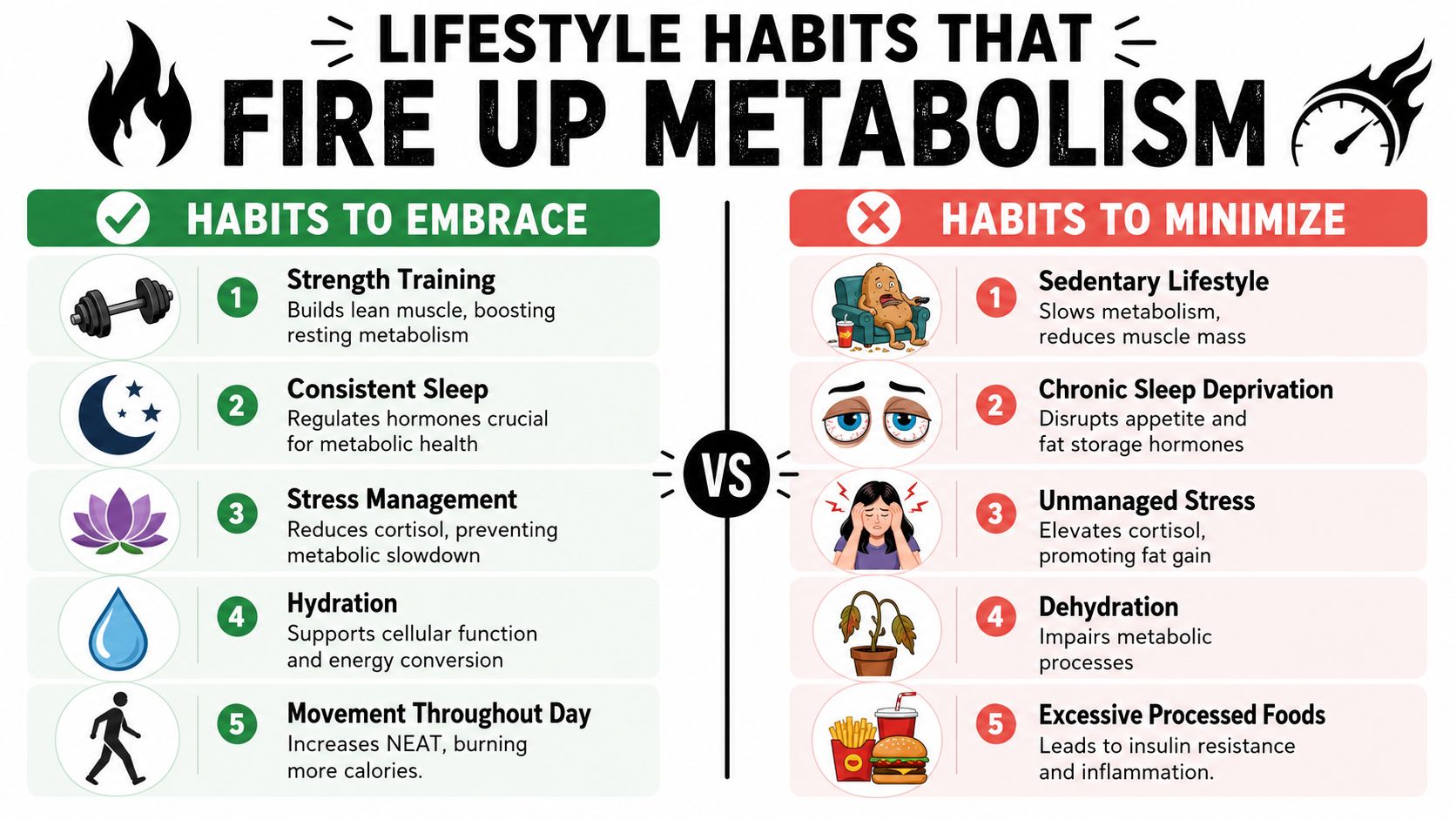
A faster metabolism is rarely built by one food or one supplement. It is shaped by the signals your body gets all day. Sleep, movement, muscle, stress, and hydration act like knobs on a control panel. Turn several in the right direction, and your metabolism becomes more adaptable and efficient.
Muscle is the long game
Muscle tissue uses more energy than fat tissue, even at rest. The difference is not dramatic enough to erase poor sleep, chronic dieting, or an inactive day. But over time, keeping more lean mass gives your body a larger engine to run. That matters for women, especially during midlife, when muscle loss can happen gradually if strength work is missing.
Resistance training helps send a clear message to the body: keep this tissue, repair it, and support it. The National Institute on Aging explains that strength training helps preserve muscle and supports function as women age, which is one reason it belongs in any metabolism-support plan National Institute on Aging.
Useful options include:
- Dumbbells at home for squats, rows, presses, and deadlifts
- Resistance bands if you want lower impact training
- Bodyweight sessions when time is tight
- Loaded walking or stair climbing if you prefer practical movement
Two or three sessions a week can be enough to make a difference if you stay consistent.
Here's a quick visual summary of the lifestyle side of the equation.
Water supports metabolism in quiet ways
Hydration gets dismissed because it feels too simple. Simple does not mean unimportant.
Water helps your body handle digestion, circulation, temperature control, and exercise performance. It can also create a small thermic response after drinking. Thermogenesis is your body producing heat, much like a car engine gives off warmth while it runs. The effect from water is modest, but staying hydrated helps the whole system run with less friction, especially if you exercise, drink caffeine, or live in a hot climate.
A practical target is to drink regularly across the day instead of trying to catch up at night. Pale yellow urine, steady energy, and fewer headaches are useful signs that intake is on track.
Sleep and stress set the background conditions
Metabolism does not operate in isolation. It responds to the environment your body senses.
If sleep is short or broken, hunger tends to rise, cravings get louder, and training recovery suffers. If stress stays high for weeks, your body often shifts toward energy conservation and less predictable appetite. The Centers for Disease Control and Prevention recommends adults get at least 7 hours of sleep each night, and that baseline supports far more than mood alone CDC sleep recommendations.
Stress management does not need to look perfect. A short walk after dinner, ten minutes of quiet breathing, a consistent bedtime, or saying no to one extra obligation can all lower the strain your body is carrying.
Protecting sleep is metabolic maintenance.
The larger point is simple. Women usually get better results from daily habits that build a resilient metabolism than from chasing short bursts of stimulation.
A Sample Daily Metabolism Support Routine
A good routine should feel doable on a workday. It shouldn't require perfect timing, expensive foods, or constant tracking. The goal is to stack small signals that tell your body to stay well fueled, well hydrated, and physically engaged.
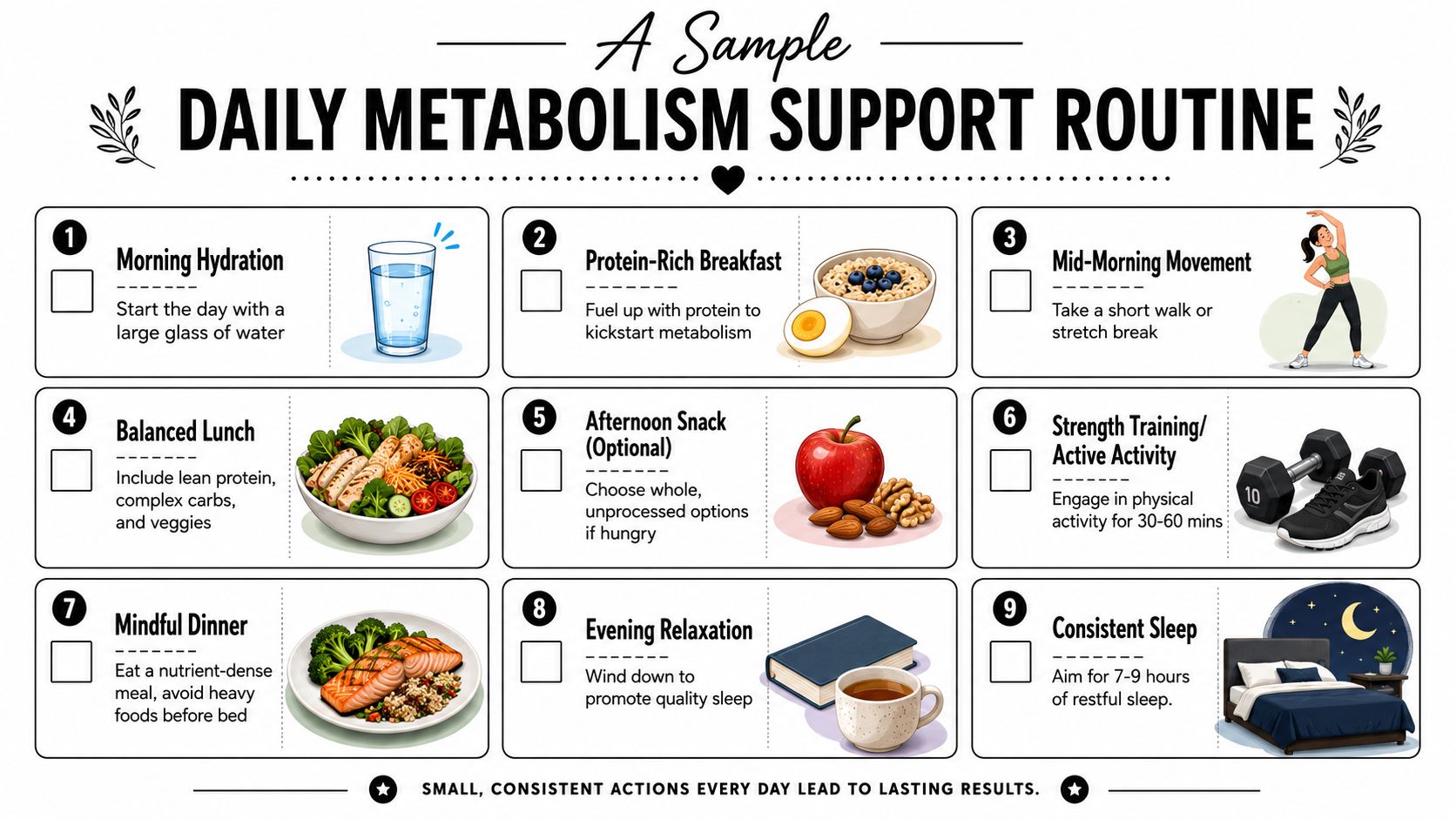
Morning and midday rhythm
Start with water soon after waking. If mornings are rushed, keep a glass or bottle where you'll see it.
Then build breakfast around protein. Greek yogurt with fruit, eggs with oats, or a smoothie with a protein source all work better than a breakfast that's mostly sugar and leaves you hungry by midmorning.
A simple midday pattern might look like this:
- Morning hydration before coffee or tea
- Protein-rich breakfast that keeps you steady
- Mid-morning movement like a short walk, stairs, or mobility work
- Balanced lunch with protein, vegetables, and a slower-digesting carbohydrate
- Optional tea or coffee if it still fits your sleep later on
Afternoon and evening rhythm
The second half of the day is where many women lose momentum. Energy dips, stress rises, and dinner becomes reactive.
A more supportive pattern is:
| Time of day | Practical choice | Why it helps |
|---|---|---|
| Afternoon | Whole-food snack if hungry | Prevents the crash-and-graze cycle |
| Late afternoon | Strength session or active movement | Supports muscle and daily energy use |
| Dinner | Balanced, not overly heavy | Helps recovery without feeling sluggish |
| Evening | Calm wind-down routine | Makes sleep more likely and more restorative |
Keep the routine boring enough to repeat. Consistency beats novelty.
This kind of day won't feel like a dramatic “boost.” That's the point. It supports a metabolism that becomes more stable, not more chaotic.
How to Choose a Clean and Effective Supplement
Supplements can help, but they're where marketing gets loudest. The safest mindset is to treat a supplement like a tool, not a shortcut. A strong product should make sense on the label before it ever sounds exciting on the front of the bottle.
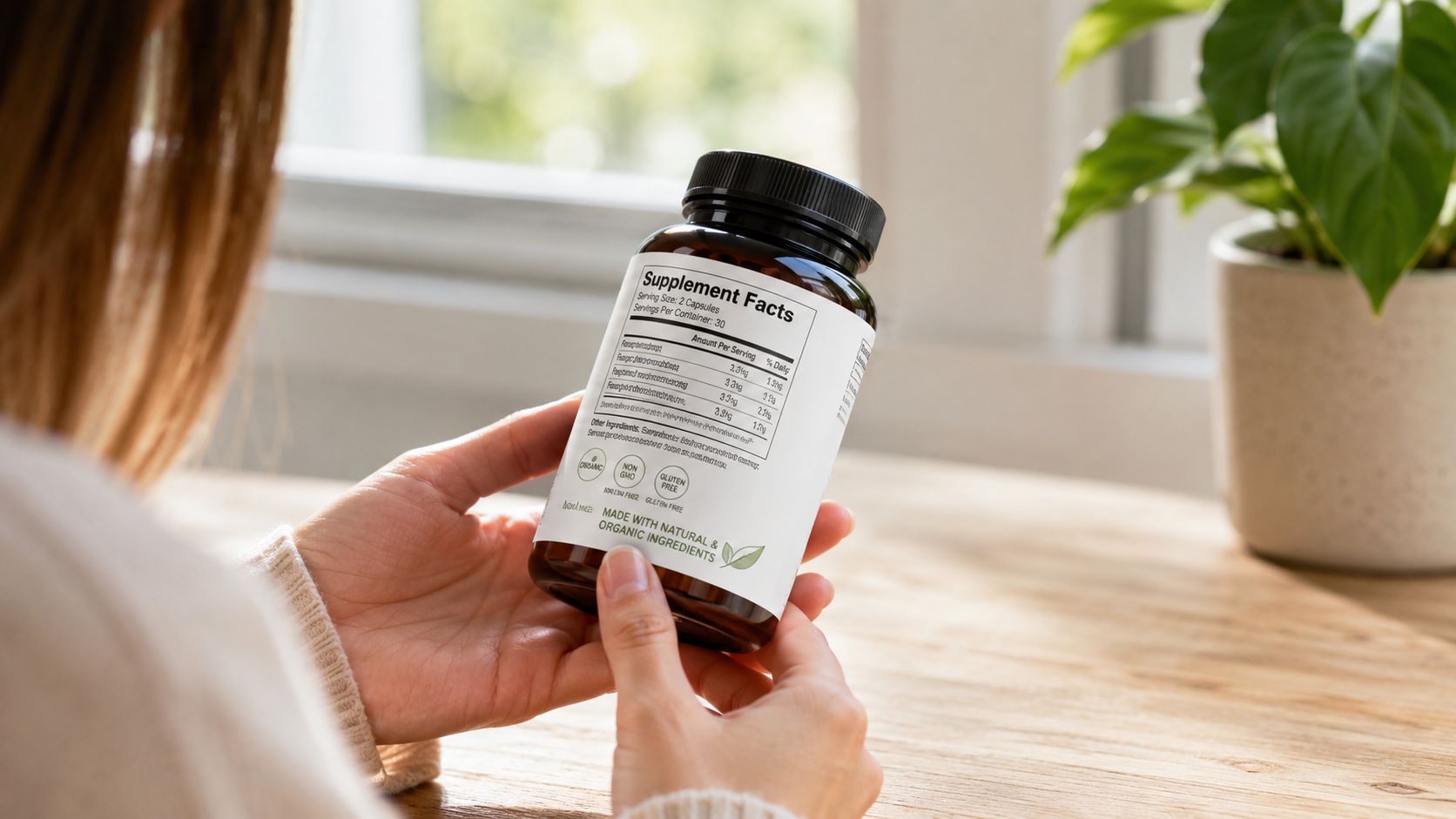
What to look for on the label
A clean supplement usually has a short ingredient list, clearly listed amounts, and no mystery blend hiding the dose. If a formula claims to support metabolism through green tea or green coffee, you should be able to see the active ingredient and the amount.
Use this checklist:
- Transparent dosing so you know how much of each ingredient you're taking
- No proprietary blends that hide clinically relevant amounts
- Simple excipients instead of long filler lists
- A clear purpose such as caffeine support, tea extract, or protein support
- Compatibility with your routine so it doesn't disturb sleep or appetite in an unhelpful way
Which ingredients deserve attention
For metabolism support, the ingredients with the clearest evidence in this article are caffeine from coffee and EGCG from green tea. Protein powders can also be useful if they help you meet your daily intake more consistently.
Women whose metabolism concerns overlap with cycle symptoms, insulin concerns, or PCOS often need a broader lens than metabolism alone. In that case, this guide to supplements for hormone balance offers helpful context.
If you want a practical breakdown of what separates stronger formulas from weak ones, this overview of best metabolism booster supplements is worth reading.
Red flags that should make you pause
Some warning signs are easy to miss:
- Buzzwords without amounts such as “thermogenic matrix”
- Too many stimulant ingredients packed into one capsule
- Promises that sound medical or extreme
- No guidance about timing, especially if caffeine is included
- A label that ignores your bigger picture, including stress, sleep, and protein intake
A natural metabolism booster for women should fit into a healthy routine. If it asks you to ignore food quality, strength training, recovery, or hydration, it's selling fantasy.
Frequently Asked Questions About Metabolism
How long does it take to notice a difference
Metabolism changes usually show up in layers, not all at once. Early signs often include steadier energy, fewer late day crashes, and better appetite control after you improve meal timing, hydration, and sleep. Body composition takes longer because your body is rebuilding habits, recovery patterns, and muscle tissue, much like tuning an engine before you expect better mileage.
Can I permanently increase my metabolic rate
A permanently higher metabolic rate is not the most useful goal. A more realistic and more helpful goal is a metabolism that stays steady under real life pressure, including busy weeks, poor sleep, stress, and hormonal shifts.
You build that kind of resilience by keeping muscle on your frame, eating enough protein across the day, staying active outside workouts, and protecting sleep. Those habits do not create a constant dramatic "boost." They help your body use energy more predictably and efficiently.
Are metabolism boosters safe for everyone
No. Even natural ingredients can hit the body hard, especially stimulants or concentrated extracts.
Caffeine, green tea compounds, and higher protein plans may be a poor fit for some women, particularly during pregnancy or breastfeeding, or when thyroid concerns, anxiety, digestive issues, or medication interactions are part of the picture. A qualified clinician can help you sort out whether a supplement makes sense, or whether food, training, and recovery should be the first focus.
What if hormones seem to be part of the problem
That is common, and it confuses many women because the symptoms overlap. A slower feeling metabolism can reflect poor sleep, insulin resistance, cycle related appetite changes, thyroid issues, chronic stress, or a mix of several factors.
Hormones work like traffic signals for energy use. If those signals are inconsistent, your body may store, burn, or crave energy differently from week to week. For a broader wellness perspective, this article on optimizing female health with VitzAi offers helpful context.
What's the simplest place to start
Start small, but make it repeatable.
A good first step is to pair one morning protein habit with one recovery habit. For example, eat a protein-rich breakfast and keep a consistent bedtime for the next two weeks. That gives your body a clearer fuel supply and a better repair window, which often improves hunger, energy, and workout recovery before the scale changes.
If you want a simple checklist, begin here: protein early, water early, daily walking, strength training a few times each week, and a sleep schedule you can keep most nights. That is how women build a metabolism that works well beyond the short lived promise of a quick fix.
If you want clean-label support for energy, protein, weight management, and daily wellness, explore Maximum Health Products. Their product range focuses on simple, science-backed nutrition that fits the kind of sustainable metabolism routine described in this guide.

