


Most advice about a super greens powder supplement gets the starting point wrong. It treats the powder like a shortcut for vegetables, or it dismisses it as pure hype. Neither view is very helpful if you're busy, health-conscious, and trying to make smart decisions.
A better frame is this. Greens powders are not a salad in a scoop. They also aren't automatically useless. For some people, they can work as a practical backup when meals are rushed, produce intake is inconsistent, or travel disrupts routine. That makes them a supplement in the true sense of the word. They support a solid diet. They don't replace one.
That distinction matters because the marketing is often louder than the science. You'll see claims about detox, dramatic energy, glowing skin, and broad immune support. Some parts of those claims are plausible. Some are overstated. Some don't hold up well once you understand basic physiology.
What helps is a simple framework. Know what's usually inside these products. Separate evidence-backed benefits from branding language. Learn how to read a label with a clean-label mindset. Then use the powder in a way that fits your real day, instead of expecting it to fix a weak routine.
Featured Product
Maximize Within Green Coffee Bean Extract
Delicious mixed-berry Collagen Gummies promote glowing skin, strong nails, and healthy hair. Infused with biotin, vitamins, and collagen peptides, they support beauty, joint, and muscle wellness naturally.
Shop Now →Your Guide to Super Greens Supplements
The useful question is not whether a super greens supplement is a miracle or a scam. The better question is narrower and more practical. Can this product fill a real gap in your routine, and is the formula strong enough to justify using it?
A greens powder is a concentrated mix of dried plant ingredients, usually blended into a drink. Many formulas combine leafy greens, algae, fruit and vegetable concentrates, and added ingredients aimed at digestion or immunity. The selling point is convenience. That matters, because convenience can support consistency, and consistency often matters more than chasing a perfect routine for three days.
That said, convenience and equivalence are not the same thing. A scoop may add phytonutrients, small amounts of fiber, and sometimes probiotics or digestive enzymes. It does not give you the full nutritional experience of whole foods, where water content, intact fiber, chewing, fullness, and food variety all work together. If whole vegetables are the foundation, greens powder is the patch kit you keep nearby for the days your routine slips.
Practical rule: Use greens powders to cover gaps you already know you have, not to justify skipping the habits you know matter.
This middle-ground view is the one many labels avoid. Marketing often jumps straight to detox claims, all-day energy, or broad wellness promises. A more useful standard is to ask two simple questions. First, what ingredients are present in meaningful amounts? Second, does the product fit into an already decent diet, sleep pattern, and activity level?
The category has grown quickly, but the research base for the category as a whole is still limited, as noted earlier. That is why a balanced framework matters more than hype. Instead of asking whether all greens powders work or none of them work, judge the specific formula, the dose, and your reason for using it.
A realistic way to evaluate them
Use this lens before you buy or use one:
- Start with your gap: A greens powder makes more sense for uneven produce intake, travel, or rushed workdays than for someone who already eats a wide range of plants daily.
- Keep expectations narrow: It may support nutrient intake and make healthy habits easier to maintain. It should not be expected to fix fatigue, poor sleep, or a low-quality diet by itself.
- Read the label closely: Similar-looking tubs can differ a lot in ingredient transparency, sweeteners, add-ons, and whether the key ingredients are included in useful amounts.
- Prefer clean-label logic: Shorter ingredient lists, clear amounts, third-party testing, and clinically supported additions usually tell you more than flashy branding.
- Match the product to your context: Digestive sensitivity, medications, caffeine tolerance, and budget all affect whether a formula is a smart fit.
Used this way, a super greens supplement becomes easier to judge. It is not a stand-in for healthy eating. It is a tool, and like any tool, its value depends on the quality of the product and how you use it.
What Exactly Is Inside a Super Greens Supplement
A long ingredient panel can make a greens powder look more advanced than it is. In practice, most formulas are built from the same few parts, arranged in different proportions.
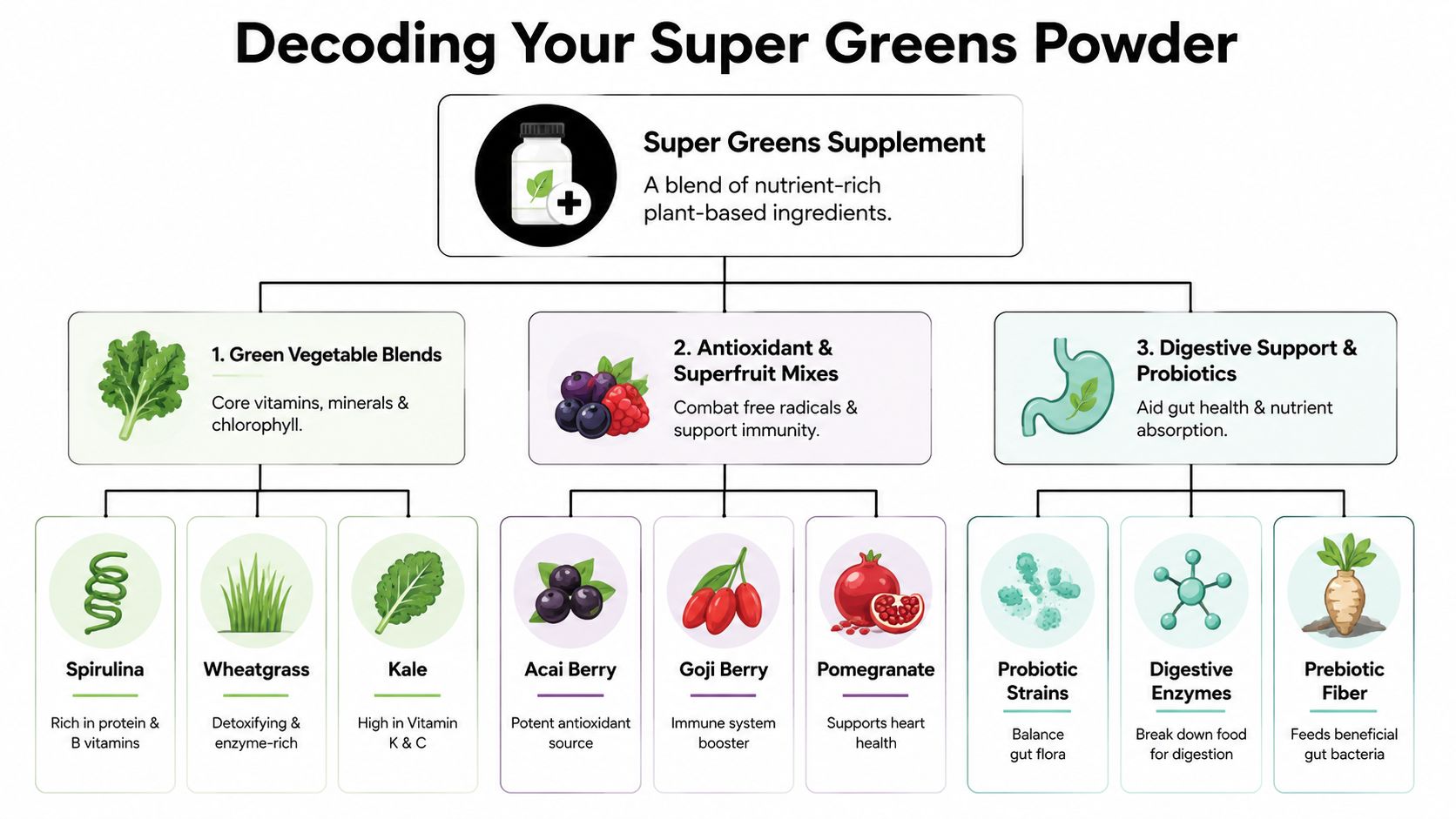
That matters because labels often create the illusion of complexity. A tub may contain 40 or 50 ingredients, but those ingredients usually fall into a handful of functional groups. Once you recognize those groups, the label becomes much easier to read and the marketing becomes easier to question.
Most products contain a green base, a blend of fruit and vegetable concentrates, and a set of optional extras such as probiotics, prebiotics, enzymes, sweeteners, or flavoring agents. The practical question is not whether those ingredients sound healthy. It is whether they are present in meaningful forms, sensible amounts, and a formula that fits your needs.
Green base ingredients
The first layer is the actual green blend. This commonly includes leafy vegetables, cereal grasses, and algae such as kale, spinach, wheatgrass, barley grass, spirulina, and chlorella.
These ingredients provide the identity of the product. They supply pigments, minerals, vitamins, and a wide mix of plant compounds. You can picture them as the frame of a house. They give the formula structure, but the frame alone does not tell you how useful or well built the final product will be.
One point often gets lost here. Powdered greens are concentrated plant ingredients, not whole servings of fresh vegetables. Drying and processing can preserve some nutrients while changing others, and the final product usually offers much less bulk and water than whole produce. That is one reason greens powders work best as a supplement to a decent diet, not a replacement for one.
Fruit and vegetable concentrates
The second layer is usually a collection of berries, beets, broccoli, pomegranate, or other colorful plant extracts and powders. Their main role is to add polyphenols and other phytonutrients.
That sounds abstract, so here is the plain-English version. These are the compounds that often give plants their deep colors and much of their antioxidant activity. Companies highlight them because they are tied to some of the more plausible benefits of greens powders, especially support for overall plant compound intake.
A longer ingredient list does not automatically mean a better formula, though. If a blend contains dozens of fruits and vegetables but hides the amount of each inside a proprietary mix, you still do not know whether any one ingredient is present in a useful quantity.
Probiotics and prebiotics
Many greens powders also add probiotics, prebiotic fibers, or both. This is one of the most misunderstood parts of the label.
Understanding this is straightforward. Some formulas include ingredients intended to support the gut microbiome, but that does not mean every product will noticeably improve digestion. It also does not mean a scoop can make up for a low-fiber eating pattern.
Prebiotics are easier to grasp if you separate them from probiotics. Probiotics are live microbes. Prebiotics are the fibers or compounds that feed beneficial microbes already living in the gut. A product may include one, the other, or both, and the benefit depends on strain selection, dose, storage stability, and your own digestive tolerance.
Added probiotics may help some people with digestion, but they do not replace a diet built around fiber-rich foods.
Digestive enzymes and other extras
Digestive enzymes often appear near the end of the ingredient list, alongside mushrooms, herbs, adaptogens, natural flavors, sweeteners, gums, and anti-caking agents, making clean-label judgment especially useful.
Enzymes can sound impressive, but they are not automatically meaningful. In many formulas, they function more as a selling point than a clear reason to buy the product. The same caution applies to trendy extras added in small amounts. A label can read like a wellness catalog without delivering much practical value.
The "other ingredients" section deserves close attention. If a powder uses several gums, artificial sweeteners, heavy flavor masking, or vague proprietary blends, that tells you something about the product quality. For a busy buyer, this section often gives a clearer signal than the front-of-package claims.
A simple label map
| Ingredient group | Why it's included | What to keep in mind |
|---|---|---|
| Leafy greens and grasses | Broad plant nutrient base | Powdered greens are not the same as whole vegetables |
| Algae like spirulina or chlorella | Concentrated nutrient and phytonutrient content | Sourcing and contaminant testing matter |
| Fruit and vegetable extracts | Added polyphenols and antioxidant compounds | More ingredients does not always mean better dosing |
| Probiotics and prebiotics | Microbiome and digestive support | Benefit depends on strains, dose, and your baseline diet |
| Digestive enzymes | Marketed for absorption and comfort | Often less convincing than the marketing suggests |
The Real Science Behind Super Greens Benefits
A useful way to judge a super greens powder supplement is to separate plausible benefits from marketing inflation. That sounds less exciting than promises about detox, metabolism, or total-body wellness. It is also much closer to how nutrition science works.
What has support
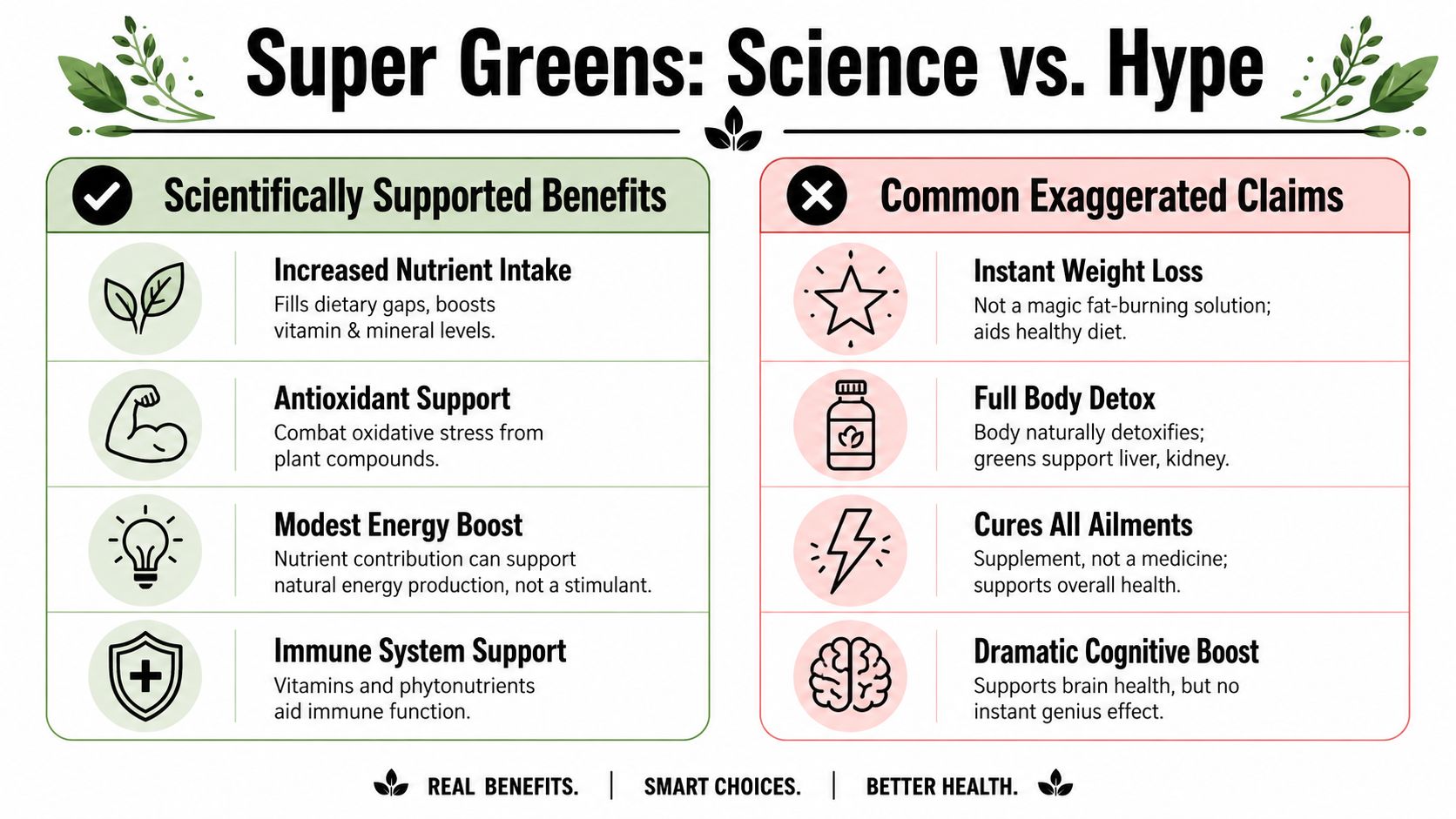
Greens powders make the strongest scientific case as a convenient source of plant compounds, not as a shortcut to the benefits of a high-quality diet. If a formula contains meaningful amounts of vegetables, algae, fruits, and herbs, it can add phytonutrients and some micronutrients to a routine that is otherwise inconsistent.
That matters most for people with low produce intake, limited meal variety, or busy schedules that make food quality uneven from day to day. In that context, a greens powder works like nutritional backup. It fills some gaps. It does not recreate the fiber structure, water content, chewing, satiety, and food matrix you get from actual vegetables.
The most believable benefit is support for antioxidant status and related markers of oxidative stress. Small studies on fruit and vegetable concentrates suggest these products can improve certain blood markers tied to nutrient exposure. That is a measured, plausible effect. It is also a long way from the dramatic health claims often attached to these powders.
A practical translation helps here. If you add concentrated plant compounds to a diet that lacked them, some lab markers may improve. That does not automatically mean major changes in energy, immunity, weight, or long-term disease risk.
Why people sometimes feel better
Buyers often get confused. A person starts a greens powder and notices better mornings, fewer snack cravings, or a greater sense of routine. Those changes can be real without proving that the powder has a unique physiological effect.
Several simpler explanations often fit:
- A nutrient gap may have narrowed.
- The powder may have replaced a less helpful habit, such as skipping breakfast or grabbing a sugary drink.
- Taking it each morning may have improved hydration and meal timing.
- Expectations may have shaped perception, especially for subjective outcomes like energy and focus.
Placebo is not the same as "fake." It means the brain and body respond to context, expectation, and routine. Nutrition is full of those effects.
The energy claim needs context
Greens powders are not stimulants. They do not create calories, and they do not work like caffeine.
If someone feels more energetic after starting one, the most likely explanation is indirect support. Better micronutrient intake can help normal metabolism if intake was poor to begin with. A steadier morning routine can also improve perceived energy. For someone already eating well, sleeping enough, and meeting nutrient needs, the upside is usually smaller.
That is one reason I encourage clients to compare a greens powder against other morning habits, not against an idealized sales page. If the powder helps replace a chaotic start with a consistent one, that benefit may be practical even if it is not dramatic. For readers comparing options, this guide to the best green powder supplements is most useful when you read it through that lens.
Where the claims outrun the evidence
Three areas deserve caution.
Detox claims are usually the weakest. Your liver, kidneys, gut, lungs, and skin already handle waste processing and elimination. No good shortcut replaces those systems, and greens powders have not been shown to supercharge them in healthy people.
Disease-prevention claims by implication also overreach. A diet rich in vegetables is associated with better long-term health. It does not follow that a mixed powder produces the same outcome. Whole-food eating patterns come with fiber, meal structure, lower intake of ultra-processed foods, and other habits that a scoop cannot reproduce.
Whole-food equivalence is another common stretch. Powdered greens can supplement a healthy routine. They do not match the full nutritional experience of eating produce across the day. If you already follow a more intentional eating pattern, whether that is Mediterranean-style, plant-forward, or guided by a guide to paleo principles and rice, the powder should sit in a supporting role.
A balanced conclusion
The useful middle ground is simple. Greens powders are neither miracle products nor automatic scams.
A well-formulated product may help raise plant nutrient intake, especially for someone whose diet is inconsistent. The effect is usually modest, and that is fine. In evidence-based nutrition, modest help is still help. The mistake is expecting a supplement to do the work of sleep, meals, movement, and actual vegetables.
How to Choose a Clean and Effective Greens Powder
A greens powder earns its spot in your routine the same way any supplement should. It needs a clear job, a clean label, and enough transparency for you to judge what you are buying.
That sounds obvious, but this category makes it easy to get distracted. Front labels talk about alkalizing, detox, immunity, gut health, stress, and energy all at once. A busy shopper sees a long list of plants and assumes more is better. In practice, a better question is simpler. Can you tell what is in the product, why it is there, and whether the amounts are likely to matter?
Start with the ingredient panel
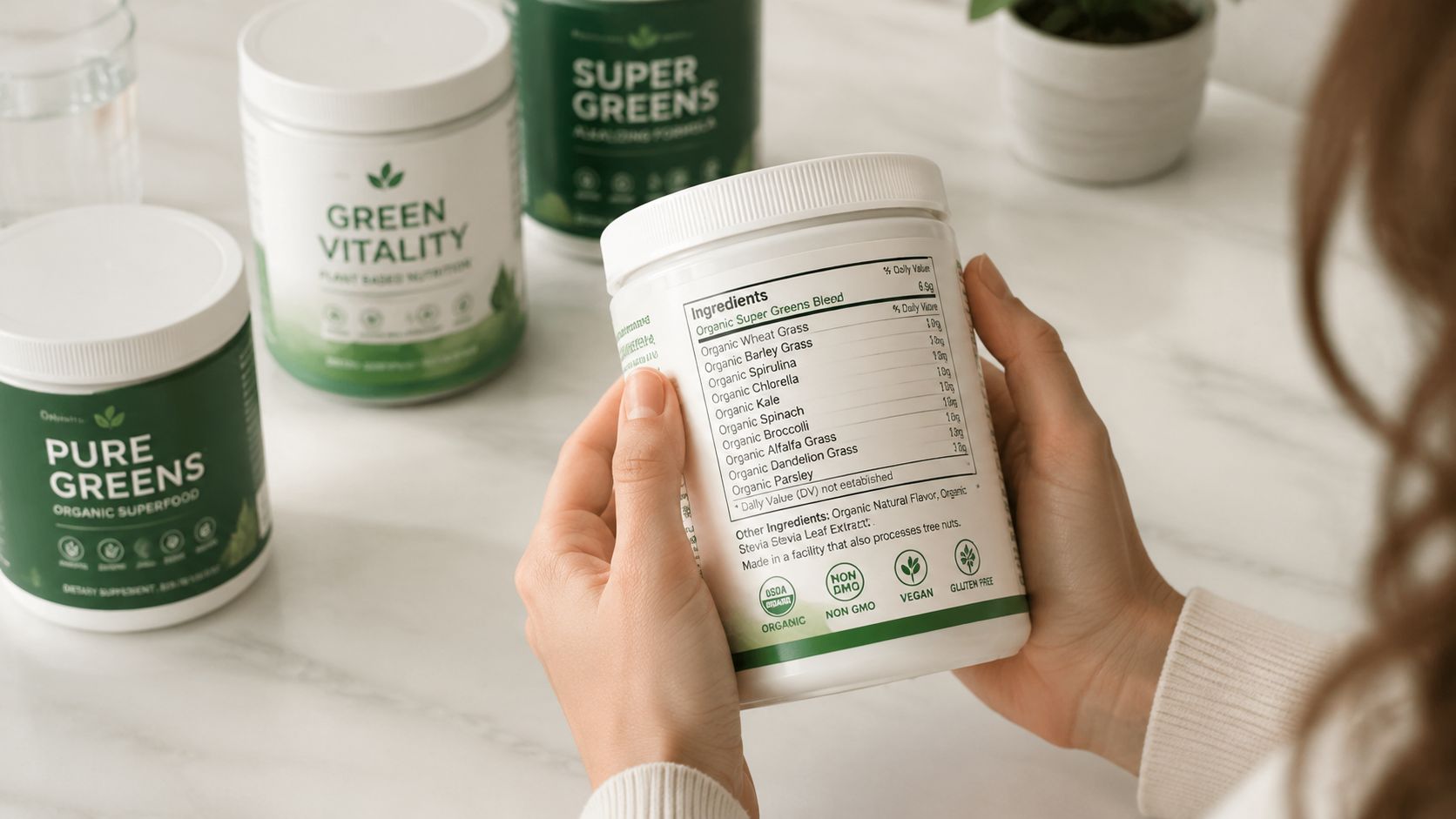
The ingredient panel usually tells you more than the marketing copy. A well-designed formula reads like a recipe with a purpose. A weak formula reads like a collage.
Here is what to look for first:
- Named ingredients you recognize: wheat grass, spirulina, chlorella, spinach, kale, or fruit and vegetable concentrates are easier to evaluate than vague blends with branding language.
- Disclosed amounts for key ingredients or blend totals: this gives you a way to compare products instead of guessing.
- A short support list: fewer fillers, gums, artificial sweeteners, and flavoring agents usually means less label clutter.
- A clear formula goal: daily greens support is a realistic goal. A product that tries to cover every health problem in one scoop often spreads itself too thin.
A useful analogy is a multivitamin. Ten pages of ingredients do not automatically make it better. A greens powder works the same way. Ingredient count is not the same as ingredient quality.
Be careful with proprietary blends
Proprietary blends are common in greens powders, and they create a basic problem. You can see the cast of characters, but not each person's role.
If a label lists dozens of botanicals inside one blend, the heaviest ingredients usually come first by weight. The ingredients near the end may be present in very small amounts. That does not make the product bad, but it does limit your ability to judge whether the formula includes meaningful amounts of anything beyond the headline ingredients.
This matters more if the company hints at targeted benefits from specific ingredients. If a product spotlights adaptogens, digestive enzymes, mushrooms, or probiotics, you should be able to see either the amount used or some other credible sign that the formula was built around function rather than label decoration.
For readers who like to align supplements with a broader food philosophy, the same label-reading skills apply outside the supplement aisle. This guide to paleo principles and rice is useful for seeing how ingredient quality and dietary context matter more than simple buzzwords.
Third-party testing matters because trust is not quality control
A clean-looking label is only the first screen. The next question is whether someone outside the company checks the product for purity and label accuracy.
Third-party testing works like an external audit. It does not make a product perfect, but it gives you more than the brand's own promises. Look for clear statements about testing, manufacturing standards, and contaminant screening. If a company mentions heavy metal testing, identity testing, or certificates of analysis, that is more informative than broad claims about being premium or wellness-focused.
If you want a practical reference point, compare a few labels against this greens powder buying guide from Maximum Health Products. The goal is not to find a miracle formula. It is to learn what transparent product pages do well.
A quick video can also help you sharpen your checklist before you buy.
My short buyer checklist
| What to check | Why it matters |
|---|---|
| Third-party testing | Adds a layer of verification for purity and label accuracy |
| Limited fillers and flavoring agents | Keeps the formula focused and easier to assess |
| Clear ingredient amounts or blend totals | Lets you compare products with less guesswork |
| Clinically supported add-ons when included | Helps separate meaningful extras from marketing extras |
| Good fit for your digestion and routine | A supplement only helps if you can tolerate it and use it consistently |
If a greens powder needs heavy flavor engineering to become drinkable, look more closely at the ingredient list, not just the taste.
Using Greens for Energy and Weight Management
Better energy and steadier weight habits usually do not come from a single scoop of anything. They come from reducing friction in your day. A super greens powder can help with that if you use it as a support tool, not as a stand-in for sleep, meals, or exercise.

That practical role gets lost in the usual argument. Greens powders are neither miracle products nor useless gimmicks. They can be useful for busy adults who want a simple, repeatable way to add nutrients, fluid, and sometimes fiber to a rushed day.
How they may help energy
Greens powders support energy indirectly. Unless the formula contains caffeine, they do not create a stimulant effect like coffee. Their value is closer to a better foundation. If your morning usually starts with nothing but caffeine, a greens drink can help turn that into hydration plus some micronutrients, which may leave your energy feeling less erratic.
Habits matter here more than hype.
For example, someone who sleeps poorly and skips breakfast will not feel restored by greens alone. Someone who uses a greens drink as part of a more structured morning routine may notice fewer crashes because the routine itself is better. If you want practical ways to support that bigger picture, this guide to boosting energy naturally pairs well with sensible supplement use.
How they may support weight management
Weight management is similar. Greens powders do not burn fat, speed metabolism in a meaningful standalone way, or cancel out a calorie surplus. What they can do is make a good decision easier.
A greens drink can work like a guardrail. If it helps you avoid skipping meals all morning, or helps you replace a grab-and-go snack habit with something more structured, it may support better appetite control later in the day. Some formulas also include fiber, which can improve fullness for some people. BodyBuddy's guide to fiber explains that connection well.
The key is context. A greens powder added to an already balanced routine may be mildly helpful. A greens powder poured into a smoothie loaded with juice, sweeteners, and high-calorie extras can work against the very goal you had in mind.
Three practical ways to use them
Use your powder where your routine tends to break down.
-
With breakfast when mornings are rushed
Mix it with water alongside eggs, Greek yogurt, or a protein-rich smoothie. This is often the best fit for people who rarely eat vegetables before lunch and default to coffee alone. -
As an afternoon anchor
Pair it with fruit, yogurt, or another protein source during the part of the day when energy and food choices tend to slip. That combination usually works better than chasing fatigue with another sweet snack. -
During travel or unusually busy weeks
Greens powders are often most helpful when normal meal quality drops. Airports, hotel breakfasts, long meetings, and late commutes are common examples.
Simple mixing ideas
These options keep the powder in its proper role, which is support, not meal magic.
-
Quick breakfast smoothie
Blend greens powder with unsweetened milk, frozen berries, and plain protein powder. -
Light afternoon option
Mix greens powder with cold water and have it with Greek yogurt or a boiled egg. -
Convenience shake upgrade
Add greens powder to a post-workout protein shake if produce tends to disappear from your day after lunch.
Common mistakes to avoid
-
Using it to compensate for poor basics
Greens can add support, but they cannot make up for chronic sleep loss, very low protein intake, or an all-processed diet. -
Turning it into a high-calorie smoothie by accident
Nut butters, juices, sweetened yogurt, honey, and granola add up quickly. -
Relying on it in place of meals too often
Drinking your nutrition is not always satisfying, and satisfaction affects adherence. -
Expecting a dramatic first-day effect
The real payoff usually comes from consistency and better daily structure, not a sudden surge in energy.
A good greens powder works a bit like keeping frozen vegetables in the freezer. It is not exciting, and it is not a substitute for a thoughtful diet. It is a practical backup that helps a healthy routine hold together on busy days.
Safety Guidelines and Potential Side Effects
Greens powders are usually low-risk for healthy adults, but low-risk is not the same as automatic. A concentrated powder can affect digestion, interact with medications, and vary widely in purity from one brand to the next.
The safest mindset is simple. Treat a greens powder the way you would treat any new supplement. Start cautiously, check the label closely, and make sure the product earns your trust before it earns a place in your routine.
Start below the full serving
Begin with a half serving for the first several days. That matters most with formulas that include added fiber, probiotics, digestive enzymes, algae, or sugar alcohols, because those ingredients can change how your gut feels before your body adjusts.
Mild bloating, gas, or a change in stool pattern can happen early on.
That does not always mean the product is "bad." It often means your digestive system is reacting to a sudden increase in fermentable ingredients or concentrated plant compounds. If symptoms are strong, or if they continue after a short trial, the formula is probably not a good fit for you.
Medication interactions deserve real attention
Vitamin K is the clearest example. Many greens powders contain leafy green concentrates, and leafy greens are naturally rich in vitamin K. For someone taking warfarin or another anticoagulant, big swings in vitamin K intake can interfere with how that medication is managed.
This is one area where "healthy" can be misleading. A greens powder may look like a harmless wellness add-on, but for people on blood thinners, consistency matters more than hype. Anyone taking prescription medication, managing kidney disease, pregnant or breastfeeding, or following a medically restricted diet should check with a clinician or pharmacist before starting.
Quality matters as much as ingredients
A label can read like a farmers market and still hide problems. Concentrated plant powders can carry contamination risks, including heavy metals, and some supplements contain ingredients that are not clearly disclosed on the front of the package.
That is why clean-label standards matter. Look for brands that explain where ingredients come from, how they test raw materials, and whether an outside lab verifies identity, purity, and contaminants. If you want a plain-English overview, this guide to third-party testing explains what independent verification should cover.
A practical safety checklist
- Start with half a serving: Give your digestive system time to adapt.
- Read the full label: Check for vitamin K, stimulants, herbs, sweeteners, algae, and probiotic blends.
- Watch your response: Ongoing nausea, cramping, reflux, or diarrhea means the product may not suit you.
- Review medications first: This matters most for blood thinners and other tightly managed prescriptions.
- Choose tested products: Clear quality control is one of the best filters for avoiding contamination and label surprises.
- Keep the powder in its proper role: It should support a solid diet, not replace regular meals or vegetables.
If your health plan depends on consistency, your supplement routine should be consistent too. Greens powders work best as a measured addition to healthy basics, not as a daily wildcard.
If you want a clean-label option that fits the practical standards discussed above, explore Maximum Health Products. Their wellness lineup emphasizes transparent, science-backed nutrition with no preservatives, artificial colors or flavors, added sugars, soy, gluten, fillers, or animal products, making it easier to build a daily routine around energy, digestion, weight support, and overall well-being.

