


Mitochondria generate approximately 90% of cellular ATP through oxidative phosphorylation, producing about 30 ATP molecules from one glucose molecule. That ATP is the immediate energy currency that powers the cell's work.
You may notice the result of this process during an ordinary afternoon. Your muscles feel heavy after a long morning, your concentration slips during a meeting, and the quickest solution seems to be another coffee or a sugary snack. Those sensations involve more than motivation or willpower. Every cell is balancing the energy it can produce against the energy it must spend.
Featured Product
Alpha GPC + Citicoline
A premium nootropic formula pairing Alpha GPC and Citicoline — two of the most recognized cognitive-support ingredients — thoughtfully blended for adults who want to support a sharp, focused daily routine.
Shop Now →The answer to what creates energy for the cell begins with mitochondria, but it doesn't end there. Cells also use glycolysis and other forms of substrate-level phosphorylation, while ATP is continuously consumed by a vast range of cellular reactions. The important question is therefore not only where ATP comes from, but whether production can keep pace with demand.
The Energy Crisis Hiding in Your Afternoon Crash
At three in the afternoon, an office worker may still have hours of tasks ahead, yet her attention keeps drifting. Her body can move, but each movement feels more effortful. The brain needs energy to maintain electrical signaling, the muscles need energy to contract, and every active cell is drawing from the same renewable currency, ATP.

ATP, or adenosine triphosphate, is a small molecule that stores and transfers usable chemical energy. It supports muscle contraction, nerve activity, transport across cell membranes, the construction of proteins, and many other tasks. Nutrients provide the raw material, but cells can't use a meal directly to power a nerve impulse or a muscle fiber. They must convert that fuel into ATP first.
Supply and demand inside a living cell
Mitochondria perform most of this conversion. They take electrons extracted from nutrients and use them to build a proton gradient across their inner membrane. ATP synthase then uses that gradient to join ADP with inorganic phosphate, producing ATP. This process is called oxidative phosphorylation.
A single glucose molecule oxidized in mitochondria yields about 30 ATP molecules, and roughly 90% of cellular ATP in aerobic metabolism comes through mitochondrial pathways rather than direct substrate-level phosphorylation, as described in this review of mitochondrial ATP production. The figures help explain why mitochondria matter so much, but they don't mean that energy is produced once and stored for the entire day. ATP is continually made, spent, and regenerated.
Your energy experience depends on the relationship between production and demand. A quiet morning, a brisk walk, a demanding workout, intense concentration, and recovery from illness all place different demands on cellular energy systems. When demand rises faster than supply can respond, you may experience fatigue, reduced focus, or a sense that ordinary tasks require more effort.
A balanced breakfast can provide nutrients that cells later process into ATP, but the meal itself isn't the energy currency. This distinction is useful when choosing a healthy breakfast for energy. Food supplies fuel and building blocks, while cellular respiration determines how efficiently those materials become usable energy.
The same system is operating whether you're reading this sentence, walking upstairs, or maintaining your heartbeat. A short visual explanation can help connect the microscopic process with the daily experience of energy:
The afternoon crash isn't proof that your mitochondria have stopped working. It is a reminder that energy is a regulated biological supply chain, not a switch. Sleep, oxygen delivery, nutrient availability, physical activity, illness, and the intensity of the task all influence how well supply meets demand.
Understanding Cellular Respiration and ATP Production
Cellular respiration is the process cells use to extract energy from nutrients and place it into ATP. A useful analogy is a power plant. Glucose and fatty acids are fuel, electron carriers are delivery vehicles, the inner mitochondrial membrane is the generator system, and ATP is the electricity delivered to the equipment that performs cellular work.
The process unfolds through connected stages rather than one reaction. Glucose is first dismantled into smaller molecules, those molecules are processed to capture high-energy electrons, and the electrons eventually pass through a membrane-based system that uses oxygen as the final electron acceptor.
From food to electron carriers
The first stage begins outside the mitochondria, in the cell fluid. Glycolysis breaks glucose into smaller carbon compounds and captures a limited amount of energy directly in ATP. A key feature for aerobic metabolism is that it transfers energy to molecules such as NADH, which carry high-energy electrons toward the mitochondrial system.
The carbon fragments then enter the mitochondrion and are converted into acetyl-CoA. The citric acid cycle, also called the Krebs cycle, processes those fragments and loads additional electron carriers, including NADH and FADH2. Fatty acids can enter through a different route, but their carbon units also feed into the same central mitochondrial network.
The membrane battery
The electron transport chain sits in the inner mitochondrial membrane. Electrons from NADH and FADH2 move through a sequence of protein complexes. The energy released during that movement pumps protons across the membrane, creating a difference in electrical charge and proton concentration.
That difference acts like a rechargeable battery. Protons tend to flow back across the membrane, but the inner membrane directs much of that flow through ATP synthase. As the enzyme turns, it uses the proton-motive force to combine ADP with inorganic phosphate and form ATP.
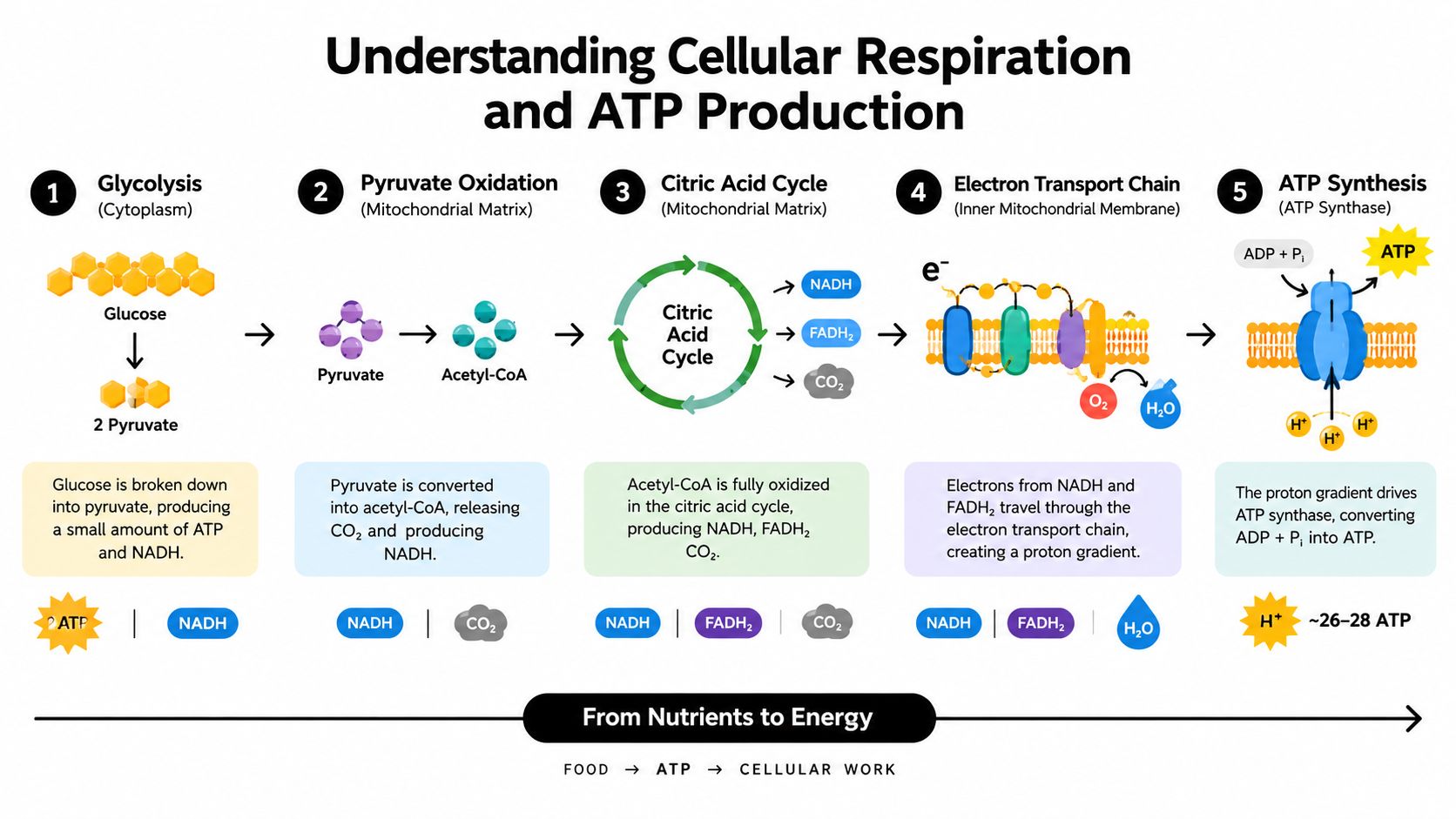
The core sequence is summarized in this cellular overview of mitochondrial ATP production: electrons from NADH and FADH2 move through the electron transport chain to oxygen, the released energy creates a proton gradient, and ATP synthase uses that gradient to phosphorylate ADP.
Oxygen has a specific role here. It doesn't provide the energy by itself, nor does it turn directly into ATP. It accepts electrons at the end of the chain, allowing electron flow to continue. Without sufficient oxygen, the chain cannot maintain its normal throughput, so cells rely more heavily on pathways that can operate without mitochondrial oxygen consumption.
Practical rule: Nutrients provide potential energy, but oxygen, intact mitochondrial membranes, electron carriers, and ATP synthase determine how much of that potential becomes usable cellular energy.
The Three Stages of Energy Production Explained
The familiar three-stage model makes cellular respiration easier to follow. It also explains why a cell can produce some ATP quickly but depends on mitochondria for sustained aerobic energy.
Glycolysis starts the process
Glycolysis occurs in the cell fluid, not inside the mitochondrion. It splits one glucose molecule into smaller carbon compounds and produces a small direct ATP return. It also produces NADH, which carries electrons to the mitochondrial energy system when oxygen-supported respiration is available.
Glycolysis is useful because it can begin quickly and doesn't require the electron transport chain to produce its direct ATP. However, it doesn't capture all the available energy in glucose. Much of the remaining potential is held in the carbon fragments and electron carriers that continue into mitochondrial pathways.
The Krebs cycle loads the shuttles
The Krebs cycle takes place in the mitochondrial matrix. It doesn't function like a storage tank that fills the cell with ATP. Instead, it progressively removes high-energy electrons from fuel fragments and transfers them to NADH and FADH2.
Those carriers are like rechargeable shuttles. They collect energy in one part of the pathway and deliver it to the electron transport chain in the inner membrane. The cycle also produces some direct ATP or an equivalent energy molecule, but its major contribution is preparing the electron supply for oxidative phosphorylation.
Oxidative phosphorylation delivers the largest share
Oxidative phosphorylation combines two linked events, electron transport and chemiosmosis. Electron transport releases energy in a controlled sequence, while chemiosmosis uses that energy to create and then exploit the proton gradient.
The inner membrane must maintain the separation between the proton-rich and proton-poor sides. If the gradient leaks or electron flow is interrupted, ATP synthase loses the driving force it needs. Oxygen availability also matters because oxygen receives electrons at the end of the chain.
This is why oxidative phosphorylation is more than a final chemical step. It is a coupled system whose output depends on membrane integrity, oxygen availability, and the supply of reduced NADH and FADH2. An expert review describes it as the primary source of metabolic energy in higher plants and animals and explains how disruption of the proton-motive force constrains ATP generation in this overview of oxidative phosphorylation.
The three stages work as a relay:
- Glycolysis begins glucose breakdown and provides rapid, limited ATP.
- The Krebs cycle processes fuel fragments and loads electron carriers.
- Oxidative phosphorylation converts electron energy into a proton gradient and then ATP.
A cell doesn't choose one stage and ignore the others under normal aerobic conditions. It adjusts the flow according to fuel availability, oxygen, workload, and the need to preserve stable ATP production.
How Mitochondria Generate Most Cellular ATP
Mitochondria earn the “powerhouse” description because their inner membrane gives the cell a specialized energy-conversion surface. The membrane separates two compartments, allowing the electron transport chain to pump protons to one side and ATP synthase to harvest their return.
This arrangement was a major shift in the history of bioenergetics. The chemiosmotic theory, formalized in modern biology after transforming the field in the 1960s, showed that cells don't just burn food and collect the released heat. They use controlled electron transfers to create an electrical and chemical gradient, then convert that gradient into ATP.
Why the inner membrane matters
Think of the membrane as a dam. The electron transport chain moves protons uphill, storing potential energy. ATP synthase acts like a turbine in the dam, allowing protons to flow back while using that movement to produce ATP.
The analogy has limits, but it highlights the essential point. A damaged or excessively permeable membrane can't preserve the gradient effectively, even if nutrients and oxygen are present. The cell may still produce some ATP through glycolysis or direct substrate-level phosphorylation, but the high-capacity mitochondrial system becomes less effective.
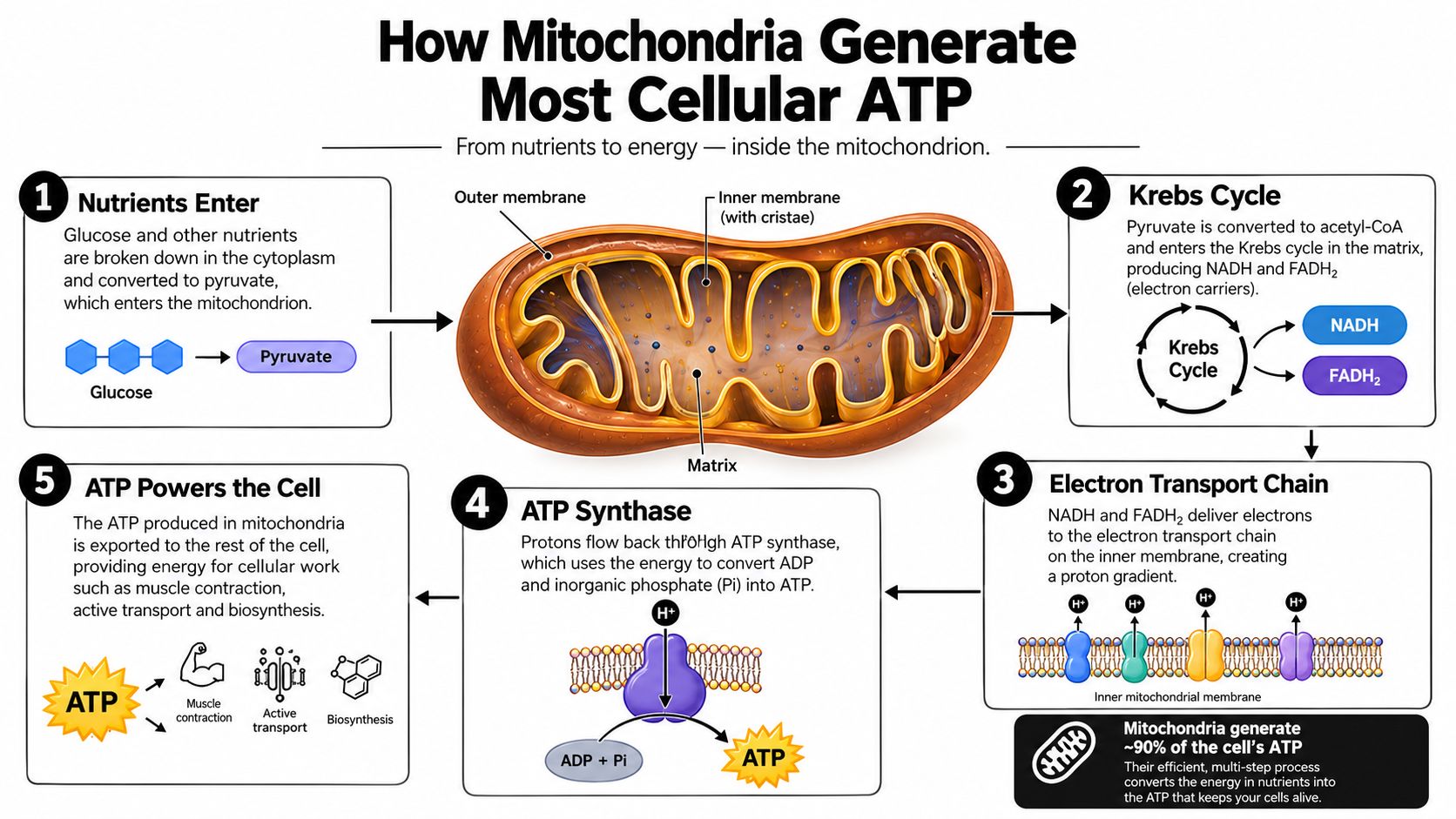
Mitochondria supply the bulk of ATP needed to maintain the cell's ATP/ADP ratio, which supports thousands of biochemical reactions, as outlined in this cell biology reference on mitochondrial energy production. Cells with high and continuous energy needs, including brain and muscle cells, depend heavily on this system because their work cannot pause whenever immediate fuel becomes limited.
Efficiency is only half the story
A theoretical capacity to produce ATP doesn't guarantee that a person will feel energetic. The cell must match production with demand, deliver ATP to the right compartment, and adjust fuel use as conditions change. A sedentary day can create one pattern of demand, while exercise, prolonged concentration, recovery, or illness creates another.
That supply-demand perspective also changes how we think about mitochondrial support. It isn't enough to ask whether a nutrient is associated with mitochondria. A useful question is whether the overall routine supports fuel availability, oxygen delivery, movement signals, recovery, and the membrane processes that turn electrons into ATP.
Readers interested in signaling pathways rather than only energy substrates can explore this contextual resource on mitochondrial signaling peptide research. It offers a separate perspective on how mitochondrial communication may relate to metabolic regulation, without replacing the basic bioenergetic sequence described above.
Heart muscle illustrates the practical stakes. It contracts continuously, so its cells need a reliable energy supply as well as adequate circulation and oxygen delivery. General wellness choices should therefore support the whole system, not treat mitochondria as an isolated organelle. For related nutritional considerations, see this guide to heart health supplements.
The strongest mitochondrial routine is not built around one ingredient. It supports the conditions that let cells produce, distribute, and use ATP throughout the day.
Real-World Impact of Mitochondrial Efficiency
Mitochondrial efficiency can decline before a person describes their health as poor. A person may still complete daily activities while their cells have become less effective at oxidizing sugar and fat or at converting oxygen use into useful work. That creates a subtle gap between capacity and experience.
A 2026 report from University of Colorado Anschutz described findings in healthy but sedentary individuals that make this point concrete. The report found a 28% to 36% drop in mitochondrial efficiency, about 49% lower MPC1 protein, roughly half the CPT1 activity, and 38% lower VO2max in the sedentary group, as reported in this University of Colorado Anschutz summary.
Production isn't the same as performance
MPC1 helps manage the entry of carbohydrate-derived material into mitochondrial metabolism, while CPT1 is involved in bringing fatty acids into the mitochondrial pathway. Lower activity in these parts of the system can make it harder for cells to switch between fuels efficiently.
That matters during an ordinary day. After a meal, cells may process available glucose. During movement or between meals, they may draw more heavily on stored fat. When fuel handling is less adaptable, the body may struggle to meet changing demand even when food is available.
| Cellular situation | Main energy challenge | Possible daily experience |
|---|---|---|
| Low activity for long periods | Less demand-driven stimulus for oxidative capacity | Reduced tolerance for physical effort |
| Sustained concentration | Continuous ATP demand in brain cells | Diminished focus as the day progresses |
| Exercise or recovery | Rapid changes in fuel and oxygen needs | Greater perceived effort |
| Metabolic or physical stress | Competition between ATP supply and repair demands | Slower recovery and persistent tiredness |
The table describes relationships, not a diagnosis. Afternoon fatigue can come from sleep loss, stress, inadequate food intake, illness, medication, or many other causes. Mitochondrial efficiency is one part of a larger physiological picture.
Movement changes the demand signal
A sedentary pattern doesn't merely reduce calorie expenditure. It also gives muscle cells fewer repeated reasons to adapt their energy systems to higher demand. Regular movement, within a person's abilities, creates a different signal from prolonged sitting because muscles repeatedly need to generate and use ATP.
This doesn't mean that a single workout instantly corrects cellular energy production. It means that the body responds over time to the demands placed on it. A practical routine can include walking, resistance exercise, mobility work, and occasional higher-effort activity when medically appropriate.
Weight management also belongs in this conversation, but not because mitochondria are a magic fat-burning switch. Body weight reflects energy intake, expenditure, appetite, sleep, stress, and metabolism. More adaptable fuel use may support activity and appetite regulation, yet no mitochondrial claim should substitute for medical evaluation when fatigue is new, severe, or persistent.
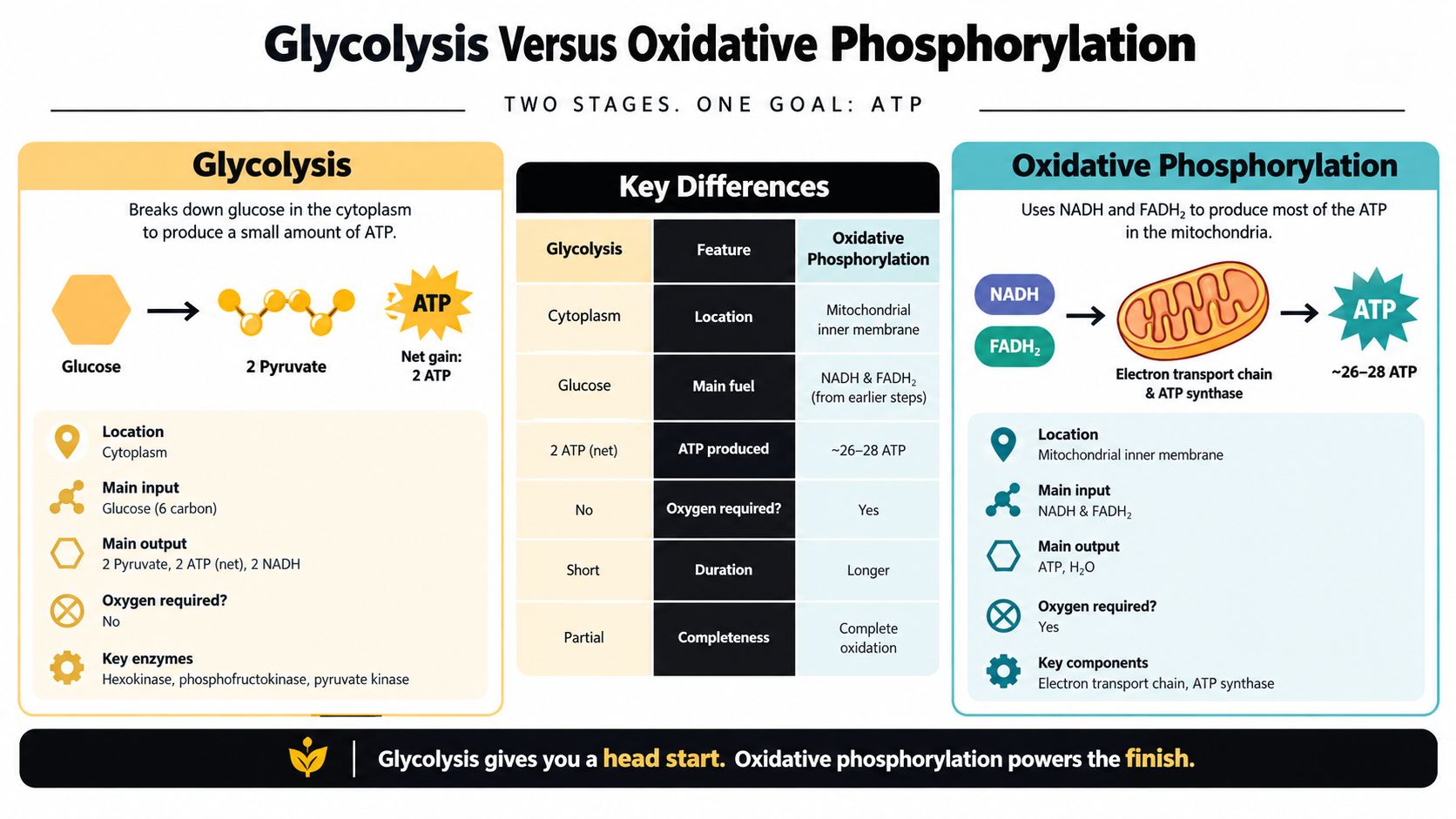
Glycolysis Versus Oxidative Phosphorylation
Glycolysis and oxidative phosphorylation are not competing systems in which one is always good and the other is always bad. They are different tools. Glycolysis can provide ATP without relying on the mitochondrial electron transport chain, while oxidative phosphorylation extracts more of the available energy through electron transport and chemiosmosis.
The quick route and the high-capacity route
Glycolysis takes place in the cell fluid and can continue when oxygen delivery is limited. It offers speed and flexibility, but it leaves more energy in the products of glucose breakdown. Oxidative phosphorylation depends on mitochondria and oxygen, yet it supports sustained aerobic energy production by capturing energy from NADH and FADH2.
A sprint, a sudden burst of muscular effort, or a low-oxygen environment can increase reliance on glycolysis. A steady walk, prolonged workday, or extended physical activity places greater value on the mitochondrial pathway. Real cells can use both, shifting their balance as conditions change.
Recent reviews emphasize that ATP can come from oxidative phosphorylation, glycolysis, substrate-level phosphorylation, and, in some organisms, photosynthesis. They also highlight that ATP is consumed by hundreds of reactions and must be distributed across cellular compartments, as explained in this review of ATP supply and cellular energy demand.
Why the balance affects daily energy
When oxygen is scarce or mitochondrial function is constrained, cells may shift toward a glycolysis-first or mixed-fuel strategy. That adjustment can help a cell survive immediate stress, but it may not meet the same pattern of demand as efficient aerobic metabolism.
For a wellness-focused reader, the useful takeaway isn't to avoid glycolysis. Your cells need it. The better goal is to support metabolic flexibility, the ability to respond appropriately to changing activity, food availability, and oxygen demand.
That starts with ordinary behaviors:
- Move regularly: Break up long periods of sitting and choose activities that challenge muscles progressively.
- Eat balanced meals: Combine nutrient-dense carbohydrates, protein, fats, and fiber rather than relying on isolated stimulants.
- Respect recovery: Sleep and rest influence how well the body can respond to the next demand.
- Investigate persistent symptoms: Ongoing fatigue or brain fog deserves a clinical conversation instead of automatic self-treatment.
Caffeine may make you feel more alert, but alertness isn't identical to increased ATP production. A stimulant can change perception and nervous-system activity while the underlying supply-demand problem remains. Sustainable energy depends on the system that produces and uses ATP, not only on how strongly fatigue is masked.
Supporting Mitochondrial Health for Daily Energy
The common assumption is that low energy calls for a stronger stimulant. That approach can be useful occasionally, but it treats the signal rather than the supply chain. If your cells repeatedly face high demand with inadequate recovery, inconsistent nutrition, low activity, or poor oxygen delivery, another short-term boost won't address the underlying mismatch.
Give cells a reason to adapt
Movement is one of the most direct ways to challenge the energy system. Walking after meals, climbing stairs, strength training, cycling, swimming, and other activities all require muscles to produce and use ATP. The appropriate choice depends on fitness, injury status, age, and medical conditions.
Start with consistency rather than punishment. A routine that you can repeat gives your body regular demand signals, while a sporadic effort followed by prolonged inactivity creates a less dependable pattern. If you have cardiovascular symptoms, significant fatigue, or a diagnosed condition, ask a qualified clinician how to exercise safely.
Nutrition provides the materials that metabolism processes. Meals built around vegetables, fruit, legumes, whole grains, quality protein, nuts, seeds, and suitable sources of fat can support a broad nutrient intake. The aim isn't to chase a single “mitochondrial food.” Cells use interconnected pathways, so dietary variety is more useful than a narrow fixation on one compound.
Treat supplements as targeted tools
Supplements can fill specific nutritional gaps, but they shouldn't replace food, movement, sleep, or medical assessment. Check the label, avoid products that conflict with your medications or conditions, and choose formulas with clear ingredient amounts and transparent quality standards.
For example, MaxATP is a performance supplement from Maximum Health Products described as supporting ATP production and includes ribose, carnitine, CoQ10, magnesium, and copper. Those ingredients are associated with energy metabolism, but the product should be considered one optional component of a broader routine, not a guarantee of increased energy or a treatment for fatigue.
A focused review of chewable vitamin B12 may also be relevant for people considering supplementation, especially when dietary intake or absorption is a concern. B12 supplementation is not automatically appropriate for everyone, so personal circumstances and professional advice matter.
Build a routine that matches demand
Your daily plan can be simple:
- Eat before demand becomes urgent. A balanced meal can reduce the tendency to alternate between under-fueling and quick sugary fixes.
- Use movement as maintenance. Short activity breaks can complement structured exercise.
- Protect sleep opportunity. Recovery supports the systems that must produce energy tomorrow.
- Monitor patterns. Note whether fatigue follows poor sleep, long sitting, skipped meals, intense exercise, or stress.
- Review persistent problems. Fatigue that continues despite reasonable lifestyle changes warrants medical attention.
People comparing wellness programs may find it useful to examine how a provider evaluates lifestyle, biomarkers, symptoms, and long-term risk. This longevity medicine evaluation rubric provides context for asking better questions, although it isn't a substitute for individualized clinical care.
The central lesson is straightforward. ATP is created through coordinated metabolism, and daily vitality depends on whether production can meet demand. Support the entire process with regular movement, nourishing food, adequate recovery, and carefully selected products when they fit your needs.
Maximum Health Products offers clean-label options across energy and focus, vitamins and supplements, protein, coffee, cocoa, and tea, including products designed to complement a structured wellness routine. Visit Maximum Health Products to explore those options and choose support that fits your nutrition, activity, and daily energy goals.

