


The popular advice is simple: choose a men's multivitamin, take one tablet every morning, and expect better energy, stronger immunity, and long-term protection. The clinical reality is narrower. A daily formula may help cover dietary shortfalls, but it isn't a substitute for adequate food intake, medical care, sleep, or treatment for a diagnosed deficiency.
The best one a day vitamin for men therefore depends less on the loudest front-label claim and more on your diet, age, medications, and actual nutritional risk. A label can look thorough while leaving calcium and magnesium mostly uncovered, and a well-designed trial can show a small benefit in one outcome while finding no meaningful protection against heart disease.
| Formula or strategy | What it can reasonably do | Where it falls short | Best fit |
|---|---|---|---|
| Broad-spectrum daily multivitamin | Provide a convenient micronutrient safety net | Doesn't replace food or fully cover every mineral | Men with inconsistent or restricted diets |
| One-A-Day Men's Complete | Supplies 100% DV or more for several listed nutrients, without iron | Calcium and magnesium remain below full daily coverage | Men seeking a basic all-in-one formula |
| Targeted supplement | Addresses a confirmed deficiency or defined need | Can create unnecessary overlap with a multivitamin | Men guided by diet, laboratory results, or a clinician |
| Food-first approach | Delivers nutrients alongside protein, fiber, and other food components | Requires consistent planning and adequate intake | Well-nourished men without a clear gap |
The Reality of Daily Multivitamins for Men
Featured Product
Collagen Gummies, Mixed Berries Flavor
Made with a plant-based formula, these chewable gummies are designed to help support healthy hair, skin, nails, and lashes while fitting easily into your daily wellness routine.
Shop Now →
Every man doesn't automatically need a multivitamin. The strongest argument for taking one is usually practical, not transformational: meals vary, appetites fluctuate, and restricted diets can leave small nutrient gaps that are difficult to notice day to day. A multivitamin can act as nutritional insurance, but it shouldn't be marketed as a treatment for fatigue, cardiovascular disease, cognitive decline, or aging.
A major National Institutes of Health review of multivitamin and mineral supplements notes that these products are widely used, with about one-third of U.S. adults taking them and one-quarter of children and adolescents also using them. In a large U.S. cohort, 74% to 76% of men already met average intakes for 17 nutrients from food alone, while multivitamin use increased adequacy to 84%. The practical interpretation is important: many users aren't correcting a dramatic deficiency. They're trying to reduce the chance of modest shortfalls.
What the trials actually support
The evidence doesn't justify broad promises. The Johns Hopkins review of multivitamin benefits describes high-quality evidence as showing little or no benefit for preventing heart disease, cancer, cognitive decline, or early death in generally healthy adults. That doesn't mean every formula is useless. It means the outcome you want determines whether supplementation is a sensible tool.
A man with a limited diet, low appetite, or a clinician-confirmed deficiency has a different problem from a well-nourished man hoping to create more energy by swallowing a capsule. Vitamins support normal physiological processes, but adding more than the body needs doesn't reliably produce a noticeable performance effect.
Clinical bottom line: Choose a multivitamin to cover a plausible dietary gap, not to make a disease-prevention promise the evidence doesn't support.
The question isn't “Which bottle has the most ingredients?” It's “What gap am I trying to close, and can this formula close it without unnecessary overlap?”
Historical Usage and Clinical Outcomes
Men's multivitamins became mainstream because the underlying use case is easy to understand. A single daily product is convenient, familiar, and less demanding than redesigning every meal. Long-term population data also show that supplement use among men grew substantially. In the Nurses' Health Study and Health Professionals Follow-Up Study, any supplement use among men increased from 56.4% in 1986 to 80.7% in 2006, a rise of 24.3 percentage points over 20 years, as reported in the PubMed record for the Physicians' Health Study II.
That growth says something about behavior, not necessarily clinical effectiveness. People adopted supplements as a daily wellness habit, while trials later tested whether that habit changed major outcomes.
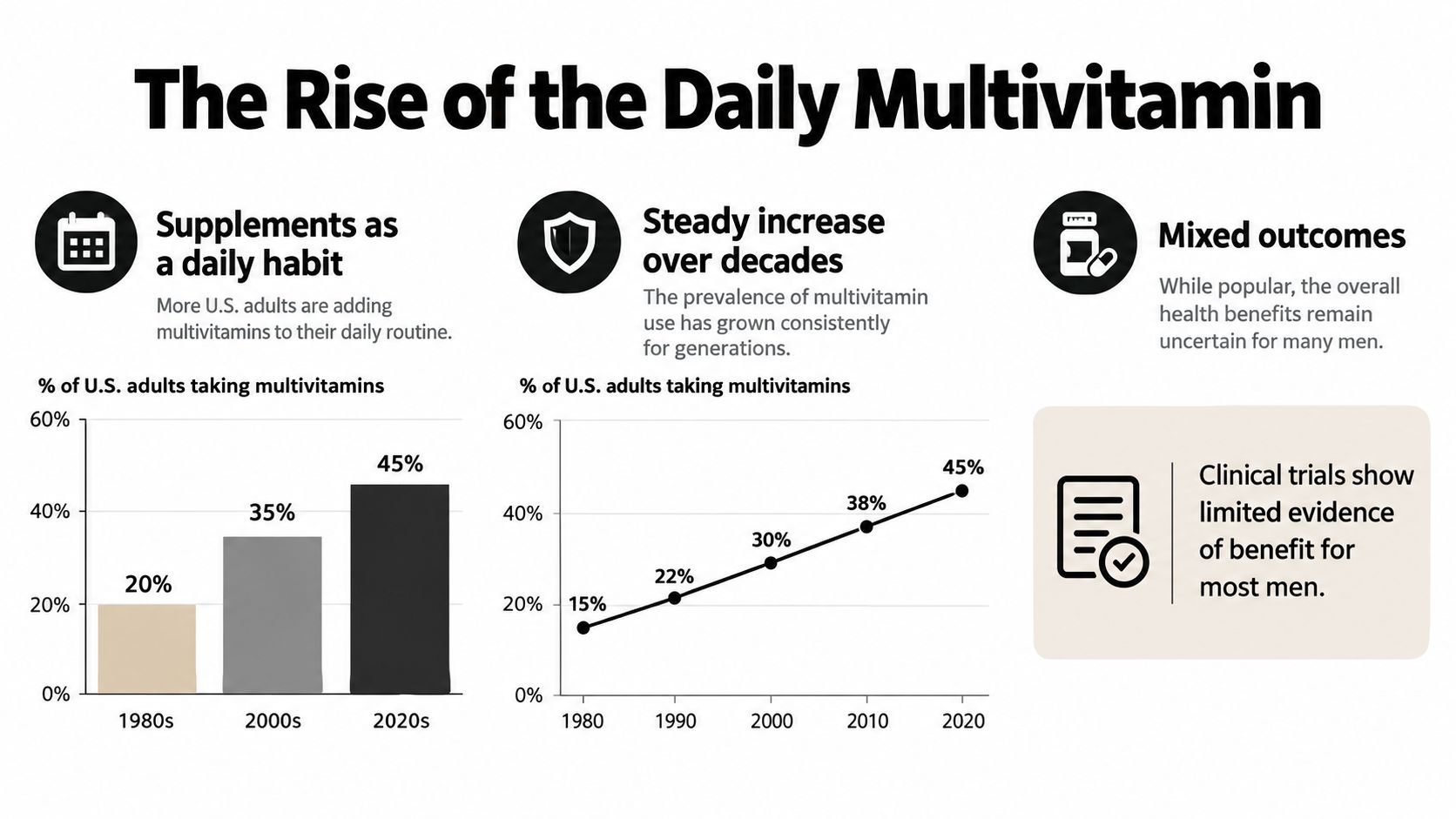
Popularity and prevention aren't the same thing
In a randomized trial of 1,708 male physicians followed for a median of 11.2 years, daily multivitamin use didn't significantly reduce major cardiovascular events. The reported event rates were 11.0 versus 10.8 per 1,000 person-years for multivitamin and placebo, respectively, with a hazard ratio of 1.01. Those findings make a daily multivitamin a poor replacement for blood-pressure treatment, exercise, dietary improvement, or other proven cardiovascular care.
The same trial category did produce a more limited signal for cancer incidence. In the reported cancer analysis from the Physicians' Health Study II, daily multivitamin use reduced total cancer incidence from 18.3 to 17.0 events per 1,000 person-years, corresponding to HR 0.92, with a 95% confidence interval of 0.86 to 0.998 and P=.04. The association was more pronounced among men with a baseline cancer history, where the reported hazard ratio was 0.73, with a 95% confidence interval of 0.56 to 0.96.
That result is worth acknowledging, but it doesn't support the sweeping idea that a multivitamin improves every dimension of men's health. It suggests a modest, specific clinical signal within a broader evidence base that remains limited for cardiovascular prevention and mortality.
The historical lesson is straightforward: the category succeeded as a convenient nutritional safety net, not as a proven all-purpose longevity intervention. For a broader discussion of how nutrients such as vitamin D and vitamin C fit into a food-first routine, see this guide to vitamin D and C.
Evaluating Bioavailability and Label Claims
A clinician doesn't begin with the product name. They begin with the Supplement Facts panel. The front of the bottle tells you what the manufacturer wants you to notice. The panel tells you which nutrients appear, in what amounts, and whether the product is likely to overlap with other supplements.
Start by separating coverage from concentration. A broad formula may provide meaningful amounts of several vitamins while offering only partial mineral coverage. One-A-Day Men's Complete, for example, lists 100% DV or more for vitamin C, vitamin D, vitamin E, thiamin, riboflavin, niacin, vitamin B6, folate, zinc, selenium, and iodine. The One-A-Day Men's Complete label also lists 0 mg of iron, 16% calcium, and 29% magnesium, along with 300 mcg of lycopene.
Read the formula in four passes
- Check the form. Nutrient forms can affect tolerability, stability, and how a product fits a person's needs. Don't assume that a larger number automatically means better absorption.
- Review what's missing. Calcium and magnesium require substantial amounts for full dietary coverage, so a compact one-a-day product often won't provide all a man needs from those minerals. Treat the multivitamin as a baseline, not a complete replacement for mineral-rich foods.
- Question the performance language. Higher-dose B vitamins or additions such as lycopene may make a formula sound specialized, but the presence of an ingredient doesn't prove that the finished product improves energy, prostate health, or athletic performance.
- Look for manufacturing transparency. Independent quality verification, clear allergen information, batch controls, and accurate labeling matter more than bright packaging. The supplement-label reading guide offers a practical framework for checking those details.
Iron deserves special attention. Many men's formulas omit it because adult men generally shouldn't add iron casually without a reason, especially when another product or fortified food already supplies it. A man with suspected iron deficiency needs medical evaluation, not a guess based on a generic men's formula.
Comparing Broad-Spectrum and Targeted Formulas
A broad-spectrum multivitamin and a targeted men's blend solve different problems. The first tries to provide a modest spread of essential nutrients in a convenient daily serving. The second may emphasize selected compounds, higher-dose vitamins, or a defined goal, but that added complexity can also increase the chance of redundancy.
| Feature | Broad-Spectrum Daily | Targeted / Performance Blend |
|---|---|---|
| Primary purpose | General micronutrient coverage | Focus on a selected concern or audience |
| Typical design | Multiple vitamins and minerals at moderate levels | Selected nutrients may receive greater emphasis |
| Iron strategy | Often excluded from men's formulas | Depends on the intended user and label |
| Mineral coverage | May leave calcium and magnesium partly covered | Can be even narrower if space is devoted to specialty ingredients |
| Add-on ingredients | May include limited extras such as lycopene | More likely to feature performance or condition-oriented additions |
| Main advantage | Simple nutritional safety net | More closely matched to a defined need |
| Main risk | False confidence that diet no longer matters | Overlap, megadosing, or unsupported expectations |
One-A-Day Men's Complete illustrates the broad-spectrum approach. Its label lists substantial coverage for several core vitamins and minerals, while still leaving calcium and magnesium below full daily coverage. That pattern isn't a manufacturing failure. It reflects a physical constraint: a compact one-a-day product can't efficiently deliver every nutrient in the amounts a complete diet would provide.
When targeted is actually more rational
A targeted formula makes more sense when the target is real. Examples include a restricted eating pattern, a documented deficiency, or a clinician-recommended nutrient plan. It makes less sense when the target is a vague promise such as “maximum energy” and the product stacks several overlapping ingredients.
Higher-dose B vitamins deserve the same scrutiny as any other feature. B vitamins are essential, but a label that emphasizes them doesn't establish that a well-nourished man will feel more energetic. Energy depends on sleep, calorie intake, iron status, thyroid function, physical activity, illness, and medication effects, among other factors.
Label-reading rule: A broad formula is not automatically superior, and a targeted formula is not automatically more effective. Match the nutrient profile to the problem you can identify.
The decision should also account for what you already take. A multivitamin plus separate vitamin D, zinc, magnesium, performance powders, and fortified drinks may create unnecessary duplication. Review the entire routine rather than judging each bottle in isolation.
Matching Formulations to Lifestyle and Age
The best choice changes when the person changes. A younger man eating a varied diet has a different nutritional profile from an older man with a smaller appetite. A vegetarian has different planning challenges from someone eating animal products regularly, and a person using a GLP-1 weight-loss medication may need to think about reduced appetite and reduced food volume rather than buying the most potent label.
Match the supplement to the subgroup
Healthy younger men. Start with dietary assessment. If meals regularly include varied protein sources, vegetables, fruit, legumes, whole grains, and mineral-rich foods, a multivitamin may add convenience without producing a noticeable change. It shouldn't be used to explain or self-treat persistent fatigue.
Men with restricted diets. Vegan, vegetarian, highly repetitive, or elimination diets can make particular nutrients harder to obtain. A broad formula may be reasonable, but the correct choice depends on the actual eating pattern. Iron shouldn't be added because a man avoids meat, and B12 shouldn't be treated as an afterthought in a diet that excludes animal foods.
Older men. Age, appetite, digestion, medication use, and food access can all change nutritional adequacy. A 2026 synthesis cited in independent coverage of subgroup-specific multivitamin evidence reported no overall all-cause mortality benefit, major cardiovascular benefit, or visual-acuity benefit, while noting modest cognition and blood-pressure benefits in older or at-risk groups. The same coverage noted a higher rate of age-related macular degeneration progression among supplement users, which is one reason older adults shouldn't make supplement decisions from a generic ranking.
Men using GLP-1 weight-loss medications. Reduced appetite can make it harder to maintain adequate protein and micronutrient intake. The answer isn't automatically a megadose. A clinician or dietitian can help determine whether a basic multivitamin, food adjustments, or specific laboratory testing is appropriate.
Men with diagnosed conditions. Kidney disease, liver disease, anemia, gastrointestinal disorders, and medication use can change the safety profile of supplements. In this group, the “best” product may be no product until the underlying issue has been reviewed.
The useful distinction is not young versus old alone. It's adequate intake versus nutritional vulnerability. A generic product ranking hides that distinction, while a subgroup-based decision exposes it.
Clean-Label Standards and Clinical Guidance
Clean labeling matters, but it needs a precise definition. It isn't a synonym for “natural,” and it doesn't prove that a product works. A sensible standard includes a readable ingredient panel, disclosed amounts, clear allergen information, appropriate serving directions, and manufacturing controls that support identity and purity.
The clean-label ingredient guide can help readers assess whether a supplement contains unnecessary colors, preservatives, sweeteners, fillers, or common allergens. Those features may affect preference and tolerability, but they shouldn't distract from the larger clinical questions: Is the nutrient needed? Is the dose appropriate? Does it duplicate another product?
Avoid the escalation trap
A common mistake begins with a modest multivitamin and ends with several high-dose add-ons. Men may add separate vitamin D, zinc, vitamin E, magnesium, “immune” blends, and performance products without calculating the combined intake. Fat-soluble vitamins deserve particular caution because the body can store them, and excessive intake can create risk rather than benefit.
The solution is not fear of every supplement. It's discipline:
- Check the whole stack: Include fortified foods, drinks, powders, and single-nutrient capsules.
- Avoid therapeutic improvisation: Don't use a multivitamin to treat unexplained fatigue, anemia, or neurological symptoms.
- Ask before combining products: A pharmacist or clinician can identify interactions and unnecessary duplication.
- Use evidence proportionally: A modest cancer signal shouldn't become a promise of heart protection, energy, or longer life.
A daily vitamin also works best inside a stable routine that includes adequate hydration, regular meals, protein, fiber, and sleep. Those habits address the foundations that a capsule cannot replace.
Safety principle: A clean label improves transparency. It doesn't turn an unnecessary high dose into a useful one.
If you have a diagnosed condition, take prescription medication, or are considering supplementation during a major dietary change, discuss the plan with a qualified healthcare professional. The right product is the one that fits your physiology and your treatment plan, not the one with the longest ingredient list.
Building Your Personalized Daily Routine
A practical decision matrix starts with the reason for taking the product. If you can't name the dietary gap, life-stage concern, or clinician-identified need, pause before purchasing. Convenience alone can justify a simple baseline for some men, but it shouldn't justify stacking multiple formulas.
Use this sequence:
- Define the context. Note dietary restrictions, appetite changes, age-related concerns, medication use, and any confirmed deficiency.
- Audit the panel. Check iron, calcium, magnesium, vitamin D, zinc, B vitamins, serving size, and specialty additions.
- Compare against your current routine. Include separate supplements and fortified foods so you don't duplicate nutrients.
- Choose a sustainable habit. Follow the label's directions and take the product consistently with the meal recommended by the manufacturer.
- Review the result. Track tolerance, digestion, and whether the original reason for taking it still exists. Don't interpret the absence of a dramatic sensation as failure, because a multivitamin's role is usually coverage rather than stimulation.
If hormone therapy or other specialized care is part of your health plan, cost and monitoring can also affect how you build a sustainable routine. For that practical planning question, these TRT cost insights provide relevant context without turning a multivitamin into a substitute for medical treatment.
Maximum Health Products offers Men's Multi™, described as a one-a-day nutrition boost for men taken as one capsule daily with a meal. It's one option to compare alongside other broad-spectrum products, provided its label fits your diet and doesn't overlap unnecessarily with your existing supplements.
The most defensible answer to “best one a day vitamin for men” is conditional. Choose a moderate, transparent formula when it solves a plausible gap, use targeted products only for defined needs, and involve a healthcare professional when age, medication, symptoms, or medical conditions complicate the decision.
Maximum Health Products offers men's vitamins and supplements designed for straightforward daily nutrition, with clean-label standards that can help you compare products more carefully. Visit Maximum Health Products to review the available formulas and build a supplement routine around your actual dietary needs.

