


A product can be sold as having “mild” side effects and still raise clinically serious safety questions. Hoodia gordonii is a good example. In human testing, the concern was not just a handful of nuisance symptoms. Investigators also observed a pattern that brought heart rate and blood pressure into the discussion, which changes how any careful reader should weigh the product's risk.
That gap between marketing and clinical concern exists for a reason. Consumer summaries often sort side effects by how annoying they feel in the moment. Dry mouth and nausea sound manageable. Cardiovascular stimulation is a different category because it points to the body being pushed systemically, not just irritated locally. A faster pulse is less like an upset stomach and more like a warning light on a dashboard. It may appear before a larger problem is obvious.
The harder truth is that Hoodia's commercial story was built around appetite control, while the human evidence has done little to show a clear weight-loss benefit. Once benefit becomes uncertain, even “minor” side effects matter more. The standard shifts from “can I tolerate this?” to “why accept this risk at all?”
That is a useful lens for any supplement review. Comparing products can help, including resources on exploring organic green tea side effects, but the principle stays the same. Plant origin does not predict safety. What matters is the observed balance between benefit, adverse effects, product quality, and the seriousness of the biological systems being affected.
Understanding the Hype and Hazards of Hoodia
Hoodia gordonii built its reputation on a simple promise. Take a desert plant, feel less hungry, eat less, lose weight. That story is tidy, memorable, and ideal for marketing.
Biology is less tidy.
A useful way to think about Hoodia is to separate the sales narrative from the clinical safety profile. The sales narrative focuses on fullness and self-control. The clinical profile focuses on what patients experienced under controlled conditions. Those are not the same thing, and with Hoodia they appear to diverge sharply.
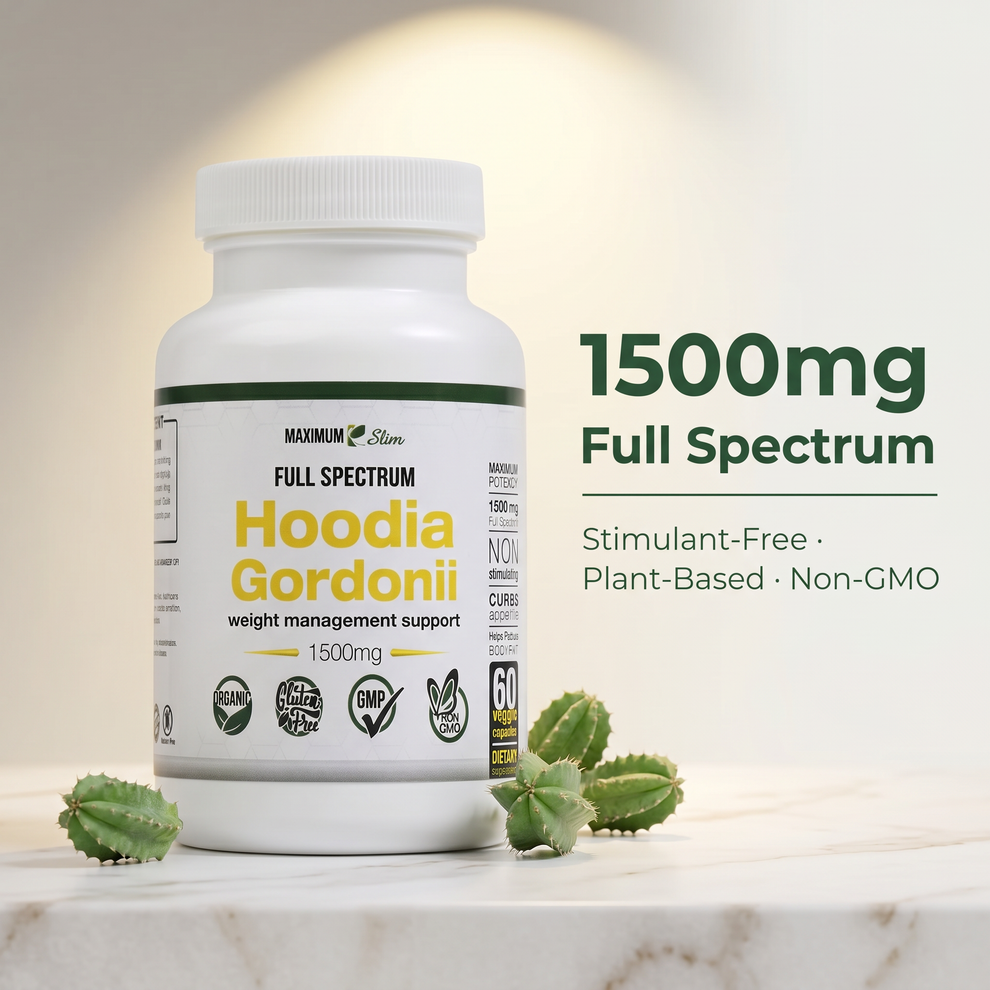
Featured Product
Maximum Slim Hoodia Gordonii
Made with a clean, filler-free formula for adults looking to include plant-based supplements as part of their daily wellness routine.
Shop Now →Why the “mild side effects” story is misleading
Consumer-facing pages often flatten side effects into a short list of annoyances. Dry mouth. A headache. Maybe some nausea. That framing creates the impression of a supplement that's uncomfortable at worst but broadly manageable.
The problem is that this summary can hide the more important pattern. Hoodia hasn't just been associated with isolated symptoms. It has also raised concern around heart rate and blood pressure, which shifts the issue from inconvenience to cardiovascular safety.
Mild symptoms can be the visible edge of a larger pharmacologic effect. A racing pulse is not in the same category as a transient bad taste in the mouth.
That difference matters because many people read side-effect lists symptom by symptom instead of mechanism by mechanism. If a product acts in ways that resemble stimulation of the body's fight-or-flight system, the relevant question becomes broader than “Will this upset my stomach?” It becomes “What else is this doing to my circulation, pulse, and medication handling?”
What a cautious reader should take from the evidence
The strongest conclusion isn't that Hoodia causes the same problem in every user. It's that the risk-benefit equation looks unfavorable based on the human data available in the verified sources.
That's especially important in weight management, where people may tolerate substantial side effects because they assume the product is at least effective. With Hoodia, the evidence provided here points in the opposite direction. The advertised benefit remains unproven in humans, while the harms are concrete enough that regulators raised safety concerns.
The Appetite Suppression Mechanism That Isn't
Marketing for Hoodia rests on a specific biological claim. It says a compound called P57 can mimic a fullness signal and act on the hypothalamus, the brain region involved in appetite regulation.
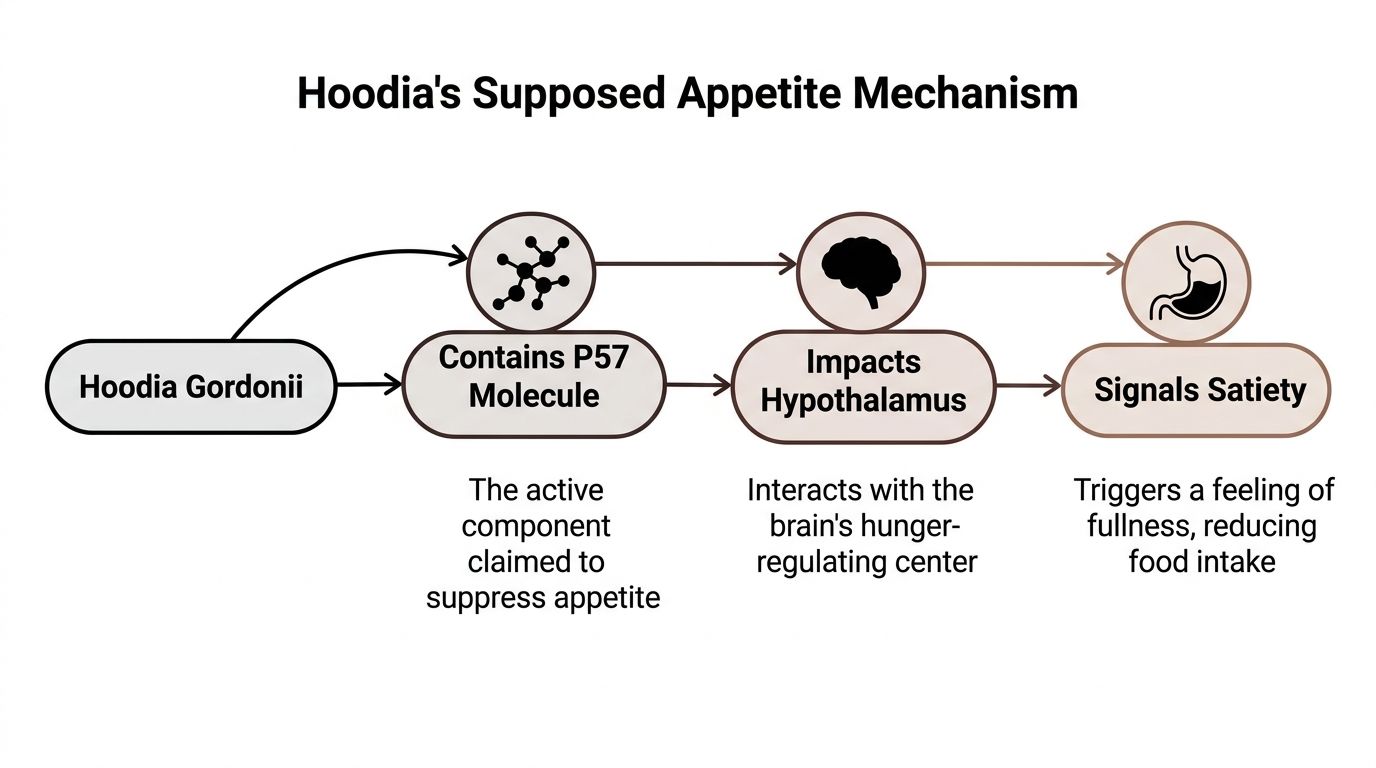
That theory sounds tidy. Human physiology is not.
A satiety signal is only useful if it survives the trip from capsule to bloodstream to brain in an active form and at a meaningful dose. Many compounds look promising in a mechanistic explanation and then fail once they meet digestion, absorption limits, liver metabolism, and the blood-brain barrier. Appetite biology also does not run on a single switch. Hunger is regulated by overlapping hormonal, neural, and behavioral systems, so a supplement marketed as a clean appetite "off" button deserves skepticism from the start.
That is why the primary question is not whether P57 can be described persuasively. The question is whether the proposed mechanism produces measurable benefits in people without producing other physiologic effects that matter more. Readers comparing claims in this category may find it useful to review non-stimulant appetite control options through that lens: human outcomes first, mechanism second.
In the human trial discussed earlier, Hoodia did not deliver the result consumers are being asked to buy. The advertised appetite and weight effects were not established in a clinically meaningful way, even though participants were exposed to enough of the product to reveal tolerability problems.
That mismatch helps explain a confusing pattern in supplement marketing. Companies often describe Hoodia's side effects as "mild" because the headline symptoms may begin as nausea, dizziness, or headache rather than an obvious medical emergency. But a compound does not become low-risk just because the first symptoms sound ordinary. In clinical medicine, a mild symptom can be the surface sign of a stronger systemic effect, much the way a dashboard warning light may appear before an engine fails.
For Hoodia, that distinction matters because the mechanism story and the safety signal point in different directions. If the product worked as a selective satiety aid, you would expect a clearer benefit with limited spillover into other body systems. Instead, the human evidence suggests broad physiologic activity without reliable appetite suppression. That raises a harder question for consumers. If the intended effect is inconsistent, what exactly is the body responding to?
From a safety standpoint, that is the central problem. The benefit remains uncertain, while the biologic activity is real enough to produce adverse effects. For a person trying to lose weight, that is a poor trade. It means Hoodia is being sold as a targeted appetite tool even though the human data fit better with a supplement that perturbs multiple systems and still may not reduce food intake in practice.
Reported Side Effects From Clinical Trials
In the human trial discussed earlier, the striking finding was not a rare, isolated complaint. It was the concentration of side effects in a short study of a product sold as a relatively gentle appetite aid.
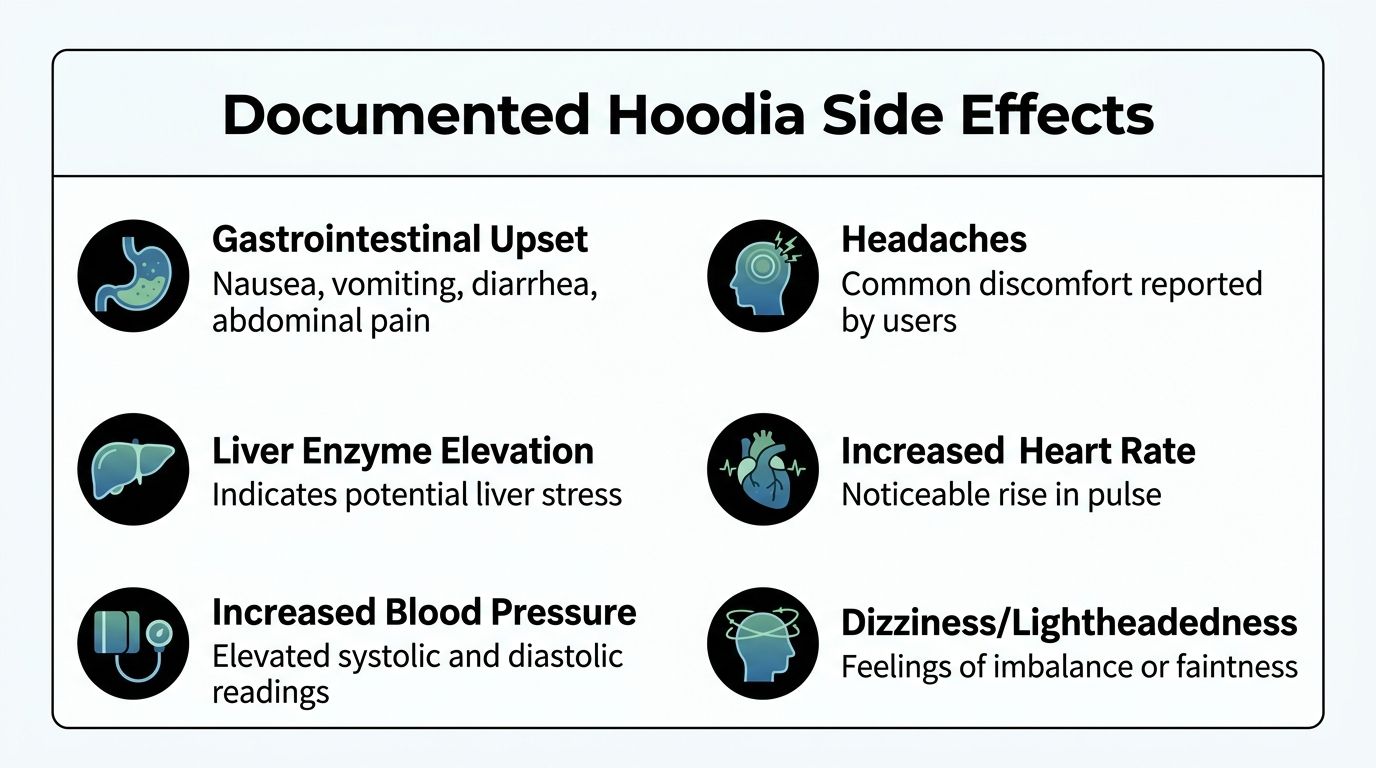
What participants actually reported
Participants reported a mix of symptoms that spanned several body systems:
- Nausea
- Vomiting
- Dizziness and giddiness
- Headaches
- Unusual skin sensations, including altered sensory feelings
On a supplement label, those complaints can sound routine. In a controlled trial, the pattern means more than the wording. Gastrointestinal upset, neurologic symptoms, and sensory changes appearing together suggest that Hoodia was not acting on one narrow satiety pathway. It appeared to be producing broader physiologic effects.
That point matters because marketing often frames these reactions as "mild" by focusing on the symptom names rather than the trial context. A headache in isolation is common. A headache that appears in a cluster with dizziness, vomiting, and abnormal skin sensations after exposure to the same product is harder to dismiss.
How to read the adverse-event burden
Earlier in the article, the trial showed a substantially heavier adverse-event burden in the Hoodia group than in the placebo group. The practical meaning is simple. Participants taking the extract felt unwell more often, in more ways, over a brief period.
For a patient, this is the safer way to interpret the evidence. Do not ask only whether a listed symptom sounds familiar. Ask whether the product produced that symptom more often than placebo while failing to deliver a clear weight-loss advantage. In this case, that is the relevant comparison.
Why the "mild side effects" description can be misleading
The disconnect between marketing and clinical concern comes from two different ways of describing harm.
Marketing language usually classifies symptoms by how dramatic they sound. Nausea, dizziness, and headache do not sound as alarming as chest pain or collapse, so they get grouped under "mild." Clinical safety review uses a different standard. It asks whether the product creates a reproducible pattern of adverse effects, whether those effects involve multiple systems, and whether there is enough benefit to justify the risk.
Hoodia performs poorly under that second standard. The human evidence did not show a dependable payoff in appetite control or weight loss, yet it still generated a noticeable side-effect signal. That combination should lower confidence, not reassure it.
A more accurate patient-level conclusion
A reasonable consumer might accept some temporary discomfort if a supplement produced meaningful, reliable benefit. The trial evidence discussed earlier does not support that trade.
The safer reading is that Hoodia can make users feel worse without clearly helping them eat less or lose more weight. That is why descriptions such as "only mild side effects" understate the actual issue. The concern is not only the severity of each individual symptom. The concern is repeated multi-system adverse effects attached to weak or uncertain benefit.
Clinical rule: A supplement with limited proven benefit and a clear excess of adverse effects over placebo has a poor safety margin, even when the first symptoms sound ordinary.
The Serious Cardiovascular and Blood Pressure Risks
In the human research on Hoodia, the concerning signal was not limited to ordinary discomfort. Investigators and regulators focused on measurable increases in heart rate and blood pressure. That matters more than the label "mild side effects," because cardiovascular stimulation can be clinically important even when the first symptoms feel ordinary.
What sympathomimetic activity means in plain language
A sympathomimetic effect is a chemical push toward the body's fight-or-flight system. It works like pressing the accelerator when the car is already idling. Heart rate rises. Blood vessels may tighten. Blood pressure can climb.
That response has a purpose during exercise, blood loss, or acute danger. During routine supplement use, it changes the risk calculation.
A temporary dry mouth is one thing. A supplement that consistently nudges pulse and blood pressure upward is different, especially in people who already have limited cardiovascular reserve.
Why “mild side effect” marketing misses the real safety question
The gap between marketing and clinical interpretation comes from what each side counts as important.
Marketing usually describes side effects by how dramatic they feel in the moment. Headache, nausea, or dizziness sound minor, so the product is framed as well tolerated. Clinical safety review asks a different question. Does the product produce a reproducible biological effect that could harm a subset of users, even if the early warning signs seem ordinary?
That distinction explains why Hoodia can be sold as causing only mild side effects while still raising concern among regulators. Symptoms such as headache or jitteriness may be the visible part of the problem. The more important issue is the physiology underneath. If the supplement increases sympathetic activity, those symptoms may be warning lights rather than isolated annoyances.
This is also why product quality matters. A buyer cannot judge cardiovascular risk by label language alone, especially in a category where adulteration and identity problems are common. Choosing supplements that undergo independent third-party testing for purity and identity reduces one layer of uncertainty, but it does not erase the underlying safety concerns tied to Hoodia itself.
The regulatory signal clinicians pay attention to
European regulators did not treat these findings as trivial. In its 2010 scientific opinion, EFSA declined to support the safety of dried Hoodia extracts after reviewing human trial data that raised concern about increased pulse and blood pressure.
That decision is more informative than advertising copy because regulators evaluate whether a product appears safe under expected conditions of use. A supplement does not need to cause dramatic emergencies in every user to fail that test. It only needs a concerning pattern, a weak benefit case, and too little safety margin.
Hoodia appears to fit that pattern.
Who should consider this a high-risk supplement
The cardiovascular concern is not evenly distributed. Risk rises when a person already has a condition that makes extra sympathetic stimulation harder to tolerate.
- People with hypertension face the clearest problem because the observed direction of effect is the one they are already trying to avoid.
- Patients with heart disease, prior arrhythmia, or palpitations may have less buffer for increases in pulse or shifts in autonomic tone.
- People with panic symptoms or marked anxiety may experience both physical worsening and more distress, since a faster heart rate can intensify the sense that something is wrong.
- Anyone using stimulants, decongestants, or other products that affect circulation should assume the combined effect could be greater than either product alone.
For these groups, the central issue is not comfort. It is whether a supplement with uncertain benefit adds cardiovascular stress that the body did not need in the first place.
Hidden Dangers of Drug Interactions and Contamination
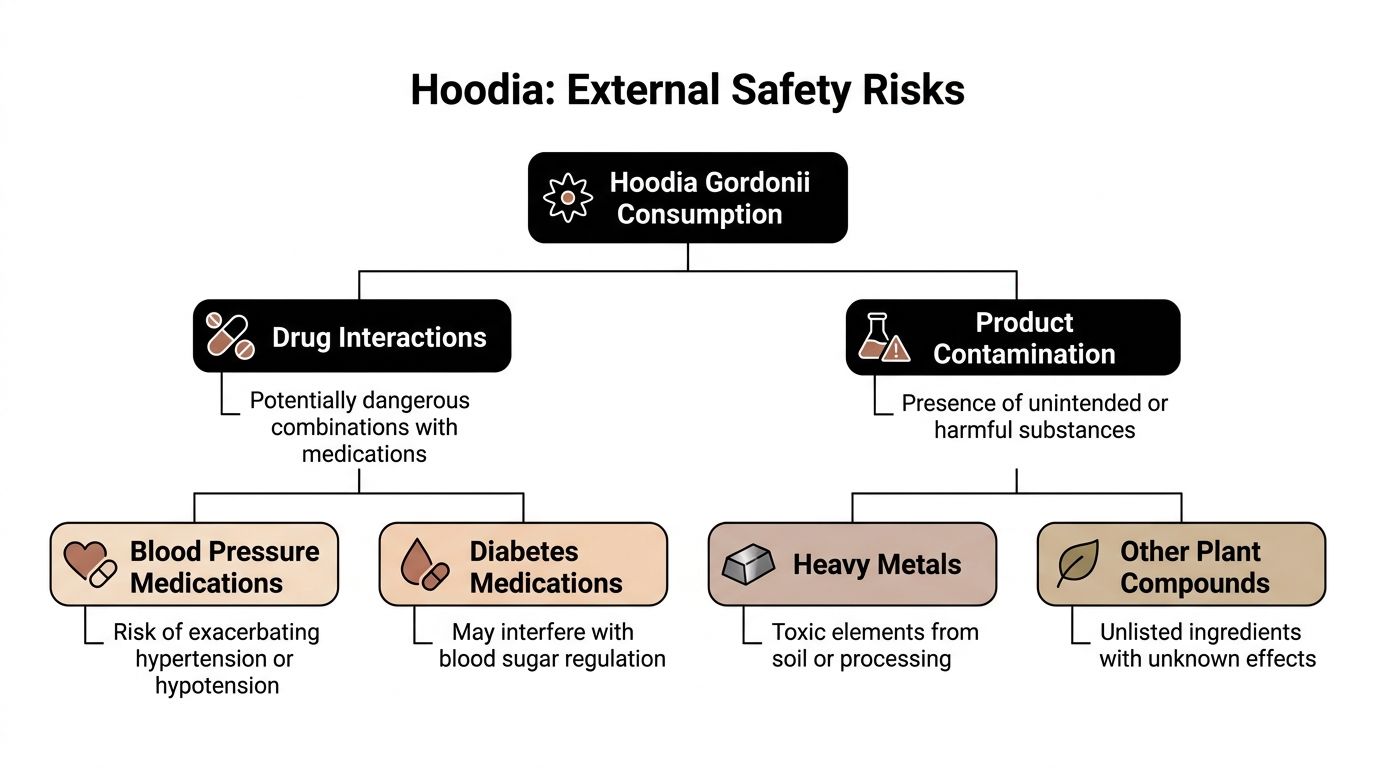
Some of the most important Hoodia Gordonii side effects may not come from Hoodia alone. They may emerge when Hoodia meets other medications or when the product in the bottle isn't what the label suggests.
The liver traffic jam problem
Many drugs are processed through enzyme systems in the liver. One of the most important is Cytochrome P450 3A4, often shortened to CYP3A4. You can think of it as a major highway in the body's chemical processing network.
If Hoodia interferes with that highway, traffic slows. Drugs that usually move through at a predictable rate may start to accumulate. When that happens, a normal dose of another medication can behave more like an excessive one.
The verified data states that Hoodia may increase the risk of side effects for drugs metabolized by CYP3A4, including common categories such as immunosuppressants and statins, because the supplement could contribute to medication toxicity (Drugs.com natural products monograph).
That isn't an abstract pharmacology footnote. For a transplant patient on an immunosuppressant, or for a person taking a statin long term, changing drug exposure can have serious consequences. If you want a quick framework for evaluating supplement quality claims before combining products, it helps to understand what third-party testing means and, equally, what it doesn't guarantee.
Why interaction risk is easy to miss
Patients usually look for interactions only when they're taking prescription stimulants, blood thinners, or sedatives. Supplements marketed as “natural appetite support” often escape that scrutiny.
That's a mistake. A supplement doesn't need to feel strong to alter drug metabolism. The interaction can be invisible until the patient notices muscle symptoms, blood pressure changes, unusual fatigue, or another clue that a regular medication is now hitting harder than expected.
If you take a prescription drug with a narrow safety margin, adding an unproven supplement is less like adding tea and more like changing part of the dosing equation.
The quality-control problem
There's a second hidden danger. The supplement market doesn't guarantee consistent product identity. With Hoodia, that matters because consumers may buy something labeled as Hoodia that contains varying plant material, impurities, or undeclared ingredients.
This makes risk harder to estimate. A patient may think they're evaluating one substance when they're really swallowing a moving target. That uncertainty is one reason clinical caution around Hoodia should remain high. Even if the plant itself raises concern, a poorly controlled product can make the picture worse.
Building a Safer Path to Weight Management
The most useful lesson from Hoodia isn't merely “avoid this supplement.” It's broader than that. Weight management works better when you stop looking for a chemical shortcut that promises effortless appetite control and start building conditions that make hunger easier to manage.
What works more safely in practice
A safer approach usually looks less dramatic and more consistent:
- Build meals around protein and fiber. These are the two dietary levers that most often make fullness feel physiologic instead of forced.
- Drink enough fluid through the day. Thirst and hunger blur together more often than people realize.
- Slow your eating pace. Appetite signals are delayed. Fast eating can outrun them.
- Protect sleep. Poor sleep can push hunger and food reward in the wrong direction.
- Keep meals predictable. Long gaps followed by impulsive eating make “appetite control” feel harder than it really is.
When medical treatment is appropriate
Some people need more than lifestyle changes, and that's a legitimate medical issue, not a personal failure. If appetite, weight, or metabolic health remain difficult despite structured habits, supervised treatment may be appropriate. For a balanced overview of one modern medical route, The Lagom Clinic has a useful explainer on GLP-1 medications, including how they work and the tradeoffs they carry.
If you're still interested in supplements generally, it's worth stepping back and comparing options critically rather than assuming all “natural” products belong in the same safety category. A broader review of natural weight-loss supplements can help frame the bigger question: what, if anything, deserves a place alongside diet, sleep, movement, and medical care.
The central conclusion on Hoodia is straightforward. The verified human evidence doesn't support the appetite-suppression promise in a meaningful clinical way, and the documented harms are substantial enough to make caution the rational default.
If you want a cleaner, more evidence-aware approach to wellness, Maximum Health Products offers nutrition-focused options built around simple routines, clean-label standards, and sustainable daily support rather than hype. Explore their range if you're looking to support energy, metabolism, and overall well-being with a more careful standard in mind.

