


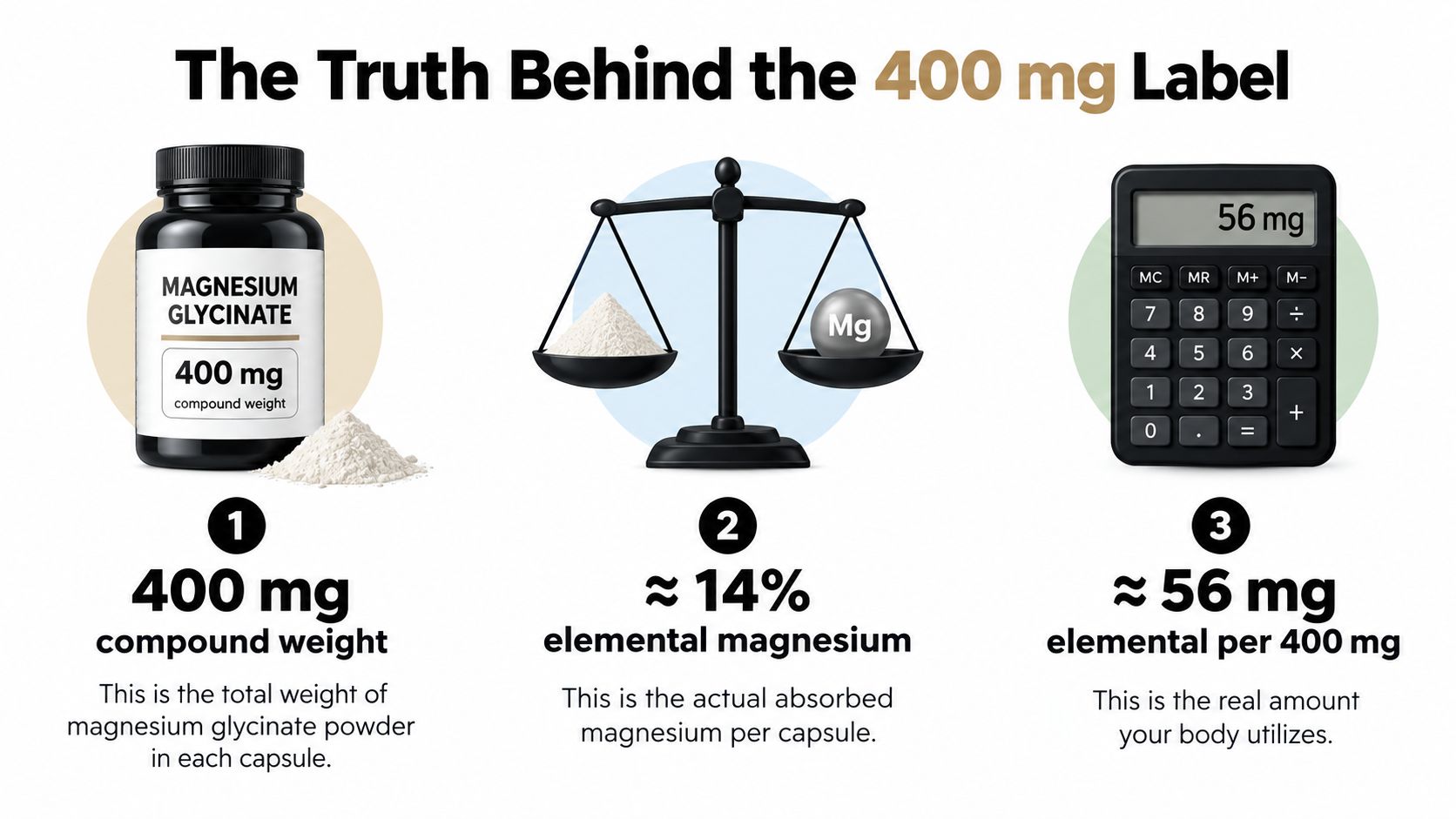
A product labeled “Magnesium Glycinate 400 mg” usually contains only about 56–60 mg of actual elemental magnesium, not 400 mg. The difference comes from the weight of the entire magnesium glycinate compound, so you need to check the Supplement Facts panel for the elemental magnesium amount before buying or taking it.
The popular advice to “take 400 mg of magnesium glycinate” sounds simple, but it hides the most important part of the label. Four hundred milligrams may describe the compound, or it may describe elemental magnesium, depending on the manufacturer. Those are very different doses.
That distinction can affect how you compare products, understand research, and judge whether a serving is modest or substantial. It also matters for safety, because a product providing 400 mg of elemental magnesium has a different risk profile from one providing 56 mg.
The Truth Behind the 400 Mg Label
Most shoppers see Magnesium Glycinate 400 mg on the front of a bottle and reasonably assume they're getting 400 mg of magnesium. Usually, that number describes the total weight of the magnesium glycinate compound, which includes magnesium bound to glycine. Magnesium itself makes up only about 13% of magnesium glycinate by weight, according to the verified label information provided for this guide.
One National Institutes of Health Dietary Supplement Label Database entry lists 400 mg of magnesium glycinate as providing 56 mg of elemental magnesium. That works out to about 14% of the listed compound weight, showing how a large front-label number can translate into a much smaller amount of actual magnesium.
The two numbers to find
A supplement label can contain several relevant quantities:
- Compound weight: The total amount of magnesium glycinate, including the magnesium and glycine components.
- Elemental magnesium: The amount of magnesium supplied by that compound. This is the number that matters for nutrition guidance and dosing.
- Serving size: The number of capsules, tablets, or scoops needed to provide the listed amount.
The front of the bottle may emphasize the compound name and weight. The Supplement Facts panel should tell you whether the stated magnesium amount refers to elemental magnesium. If the panel says “Magnesium, as magnesium glycinate,” the number beside “Magnesium” is generally the figure you should use for dose calculations.
Practical rule: Never compare magnesium products by the large number on the front label alone. Compare the elemental magnesium amount per serving.
Why brands appear to disagree
Two products can use similar wording while delivering very different elemental amounts. A “400 mg” label may function more like a 56–60 mg elemental magnesium dose, depending on the formulation, or it may mean a full 400 mg of elemental magnesium. The label wording and Supplement Facts panel determine which interpretation applies.
That's why the phrase “magnesium glycinate 400 mg” isn't enough to answer whether a product is appropriate. First identify what the 400 mg measures. Then consider your total magnesium intake, your reason for supplementing, and any health conditions or medicines that could affect safety.
What Is Magnesium Glycinate and Why It Absorbs Better
Magnesium glycinate is a form of magnesium in which magnesium is bound to glycine, an amino acid. In everyday terms, think of it as magnesium traveling with a companion molecule rather than appearing as an isolated mineral salt. The resulting compound is called a chelate.
That chemistry helps explain why labels can be confusing. The capsule contains the complete compound, not just the magnesium portion. Glycine contributes to the compound's weight, while the elemental magnesium figure tells you how much magnesium the serving provides.

Why the form matters
Different magnesium compounds contain different amounts of elemental magnesium and can feel different in the digestive system. Magnesium glycinate is widely marketed and studied as a gentler, well-tolerated chelated form, which is one reason people often consider it when other magnesium products cause digestive discomfort. That doesn't mean every person will respond identically, and it doesn't remove the need to read the dose correctly.
The glycine component also gives this form a distinct character. People commonly choose magnesium glycinate for evening routines, relaxation, or general supplementation because the combination feels less harsh than some alternatives. Those are practical reasons for choosing the form, but they don't change the central calculation: the dose is based on elemental magnesium, not the total chelate weight.
A simple label analogy
Imagine buying a bag of trail mix labeled by its total weight. The bag contains nuts, fruit, and seeds, but the total weight doesn't tell you how much of any one ingredient you'll eat. Magnesium glycinate labels work similarly. The compound weight describes the whole mixture at the chemical level, while elemental magnesium identifies the mineral portion.
This is also why capsule size alone tells you very little. A larger capsule doesn't automatically provide more usable magnesium, and a smaller serving isn't necessarily weaker. Check the elemental magnesium line, then compare serving sizes across brands.
Magnesium Glycinate vs Other Common Forms
No magnesium form is automatically best for every goal. The useful comparison is practical: what does the label provide, how does your digestive system tolerate it, and what are you trying to accomplish?
The table below avoids assigning precise absorption rates because the verified information available here doesn't establish directly comparable rates for each form. Product quality, formulation, dose, and individual response can all influence the experience.
Magnesium Form Comparison
| Form | Absorption Rate | GI Tolerance | Best For |
|---|---|---|---|
| Glycinate | Often selected as a well-tolerated chelated form | Commonly considered gentle, though individual responses vary | Evening routines, general supplementation, people who prefer a gentler form |
| Citrate | Commonly used when people want a readily available magnesium form | May be less comfortable for people sensitive to loose stools | General supplementation when digestive response is acceptable |
| Oxide | Provides magnesium in a different compound format and should be judged by its elemental amount | May be less comfortable for some users | People comparing cost and label amounts, with tolerance assessed personally |
| Chloride | Used in supplemental magnesium products in several formats | Tolerance depends on the product and person | People following a clinician's recommendation or selecting a particular formulation |
| Threonate | Chosen for its distinctive compound structure rather than a simple front-label comparison | Individual tolerance still matters | People specifically exploring this form with professional guidance |
Glycinate often appeals to people who want magnesium without making their supplement routine feel hard on the stomach. If sleep is your priority, a practical overview of magnesium for sleep can help you think about supplementation alongside broader sleep habits.
Match the form to the reason
For general magnesium support, start with the elemental amount and your tolerance. For digestive regularity, some people deliberately choose a form that affects the bowel more, while others want to avoid that effect. For relaxation, glycinate is a popular choice because it combines magnesium with glycine and is commonly positioned as a gentle option.
You can also compare magnesium bisglycinate and citrate when deciding between two forms that may appear similar on a supplement shelf. Whichever form you choose, don't assume that a larger compound number means a larger magnesium dose.
Benefits of 400 Mg Elemental Magnesium Glycinate
The 400 mg elemental magnesium on a label refers to the magnesium itself, not automatically to the total weight of the magnesium glycinate compound. That distinction is the hidden math behind this product category. Magnesium is bonded to glycine, so the compound weighs more than the magnesium it supplies. A label that lists the compound weight may therefore provide far less elemental magnesium than the headline number suggests.
Read the Supplement Facts panel as you would read a recipe: identify the amount of the active ingredient, then check how many capsules make one serving. Clinical research also describes magnesium doses by their elemental magnesium content, because that is the amount being assessed. A product listing can illustrate how manufacturers present these figures, but it is not evidence for a particular clinical trial or a guarantee of a particular outcome. The provided clinical product and research reference is best treated as a product example.
What people usually hope to support
Magnesium glycinate is often selected for several related goals:
- Sleep and relaxation: Some adults include it in an evening routine intended to support calm and rest.
- Muscle comfort: People may consider magnesium when they experience tension or occasional cramping.
- Mood and stress support: The combination of magnesium and glycine appeals to people seeking a gentler wind-down routine.
- Blood-pressure support: Magnesium has been studied in relation to blood pressure, but anyone managing hypertension or another cardiovascular condition should involve a clinician.
These are possible areas of support, not promises. Persistent insomnia, repeated cramps, mood changes, or abnormal blood pressure still call for proper evaluation rather than self-treatment with a supplement.
The practical benefit of understanding elemental magnesium is better decision-making. If a bottle lists only a modest elemental serving, its amount may differ from the dose discussed in research. If it supplies a full elemental dose, another magnesium product could create an unintended overlap. Anyone comparing heart health supplements should review the complete routine, including other products and medicines, before adding another source.
How to Dose and Time Magnesium Glycinate Safely
The number on the front of a bottle can mislead you. A product labeled “magnesium glycinate 400 mg” may refer to the weight of the glycinate compound, not 400 mg of elemental magnesium. The compound is the carrier, while elemental magnesium is the mineral your body can use. Read the Supplement Facts panel before deciding how much to take.
Find the elemental magnesium per serving, check how many capsules provide that serving, and add magnesium from other supplements or medications. Food contributes magnesium as well, so a capsule is only one part of your total daily intake.
For healthy adults, the established tolerable upper intake level for magnesium from supplements and medications is 350 mg per day. The adult recommended dietary allowance is 400–420 mg per day for men and 310–320 mg per day for women, depending on age. These figures, explained in the Mayo Clinic Press explanation of magnesium glycinate, show why the source and form of magnesium matter. The upper limit applies to supplements and medications, not magnesium naturally present in food.
A cautious routine
- Read the elemental amount. Use that figure, rather than the total weight of the glycinate compound, for dose calculations.
- Begin conservatively. A lower elemental serving lets you assess tolerance before considering a change.
- Take it with a meal if your stomach is sensitive. Some people tolerate magnesium glycinate without food, while others find food easier on the stomach.
- Choose a consistent time. Evening use may fit a relaxation routine. Morning use may suit someone who feels better taking it earlier.
- Review the plan if symptoms appear. Diarrhea, nausea, or gastrointestinal irritation can mean the supplemental amount is too high for you.
Timing with medicines
Magnesium can reduce the absorption of certain medicines, including some antibiotics and bisphosphonates. If you take prescription medication, ask a pharmacist or healthcare professional how far apart to take it from magnesium. People with kidney impairment need particular caution because the body may not clear supplemental magnesium normally, increasing the risk of accumulation and toxicity.
The video below is general educational material; individual dosing decisions belong with your clinician.
A dose that sounds familiar online may not match your label. Base the calculation on elemental magnesium, then consider dietary intake, health status, and medications.
Who Should and Should Not Take Magnesium Glycinate
Magnesium glycinate may be gentle on digestion, but that does not make every product or dose suitable for every person. Start with the label. A product named “magnesium glycinate 400 mg” may be describing the glycinate compound, not 400 mg of elemental magnesium. The elemental amount is the magnesium your body can use, so check the Supplement Facts panel before deciding whether the product fits your needs.
People with kidney impairment should speak with a healthcare professional before using supplemental magnesium. The kidneys help clear magnesium from the body, so reduced function can allow it to accumulate and raise the risk of toxicity. A clinician can assess the product, elemental amount, and personal health history rather than relying on the front-label number.
Professional guidance also makes sense if you take medicines that may interact with magnesium, have a chronic condition, or are pregnant or breastfeeding. A pharmacist can review the full supplement routine and identify overlaps, including products that contain other minerals. For broader planning, see this guide to calcium, vitamin D, and magnesium together.
When symptoms need attention
Muscle twitches, poor sleep, mental fog, or an irregular heartbeat can lead someone to try magnesium. These symptoms have many possible causes, so they do not confirm a magnesium deficiency. An irregular heartbeat deserves prompt medical attention instead of a trial-and-error supplement plan.
Diarrhea, nausea, or gastrointestinal irritation may indicate that the supplemental amount is not agreeing with you. Stop and seek advice if symptoms are severe, persistent, or concerning. A comfortable form cannot make an unsuitable amount safe.
If you manage supplements for a household or wellness business, manage supplement subscriptions Shopify can help with recurring orders. It cannot determine who should take magnesium or whether a label's compound weight matches its elemental amount. That decision belongs to the person taking the product and their healthcare professional.
Building a Clean Magnesium Routine with Maximum Health
A clean routine starts with fewer assumptions. A busy professional might use a greens powder or coffee-based product in the morning, eat a balanced lunch, keep hydration and meals consistent through the day, then reserve magnesium glycinate for an evening routine after checking the elemental amount.
That routine doesn't need to include every available supplement. Someone interested in comparing broader wellness categories can browse OneTwenty supplements, but the same label discipline applies everywhere: identify the active nutrient, check the serving size, and look for unnecessary overlap.
A practical label checklist
- Elemental amount: Confirm the magnesium number rather than relying on “400 mg” in the product name.
- Serving clarity: Check how many capsules or scoops provide the listed amount.
- Ingredient simplicity: Look for a panel that makes the active ingredients and other components easy to understand.
- Personal fit: Consider digestion, medications, kidney health, pregnancy, breastfeeding, and your actual reason for supplementing.
- Routine consistency: Use a time that you can follow without adding unnecessary complexity.
The cleanest supplement routine is the one you can understand and use responsibly. Product transparency matters more than an impressive front-label number, especially with magnesium glycinate.
Maximum Health Products offers clean-label vitamins and supplements, along with Functional Cocoa, Organic Detox Tea, SuperGreens, and other products designed to support a straightforward wellness routine. Visit Maximum Health Products to explore the range and choose products with clear ingredients that fit your daily goals.

