


You're scrolling after dinner, the lights are low, and a warm mug is steeping beside you. The question feels simple but isn't: will this green tea help you settle, or will its caffeine keep your mind active when you're trying to sleep?
That tension defines sleep green tea. Green tea contains compounds associated with calm, yet it can also contain caffeine that interferes with nighttime rest. The answer depends less on the label and more on the tea's formulation, caffeine content, brewing method, and timing.
A useful way to think about it is this: sleep green tea isn't one special tea plant or a guaranteed sleep remedy. It's a formulation choice. The most sensible products reduce stimulant exposure while preserving tea compounds such as L-theanine, sometimes adding herbs traditionally used in relaxing evening blends.
The evidence also asks you to separate two experiences. You might feel calmer or fall asleep more comfortably without seeing a dramatic change in sleep-tracker data. Recent reviews report improvements in several subjective sleep outcomes, while findings for objective sleep measurements and tea combinations remain inconsistent (2025 systematic review and meta-analysis). The sections below translate that nuance into practical choices, so you can judge a cup by its ingredients and timing rather than by marketing language.
Why People Are Reaching for Sleep Green Tea Tonight
By 9 p.m., many people want the comfort of a ritual without the heaviness of alcohol, a sugary dessert, or a strong sedative product. A warm drink gives the evening a clear transition point. You finish work, lower the lights, steep the leaves, and create a small pause before bed.
Green tea seems to fit that ritual because it has a softer reputation than coffee. L-theanine, the amino acid naturally found in tea, is associated with relaxation, while caffeine can support alertness. That combination explains why green tea often feels calm during the day, even though it may still be a poor choice close to bedtime for someone who reacts strongly to caffeine.
The cup can pull in two directions
Suppose you drink a standard green tea after dinner. You may enjoy its warmth and notice less mental tension. At the same time, the caffeine may make it harder to remain asleep or may leave you more alert than expected. In a controlled study of healthy young women, 30 mg of caffeine increased wake after sleep onset, while adding 50 mg of L-theanine suppressed that caffeine-related increase. The combination didn't improve every sleep measure, however, so the finding doesn't mean theanine cancels caffeine (controlled tea study).
That distinction matters for anyone who has said, “Tea relaxes me, but I still sleep badly after it.” The calming sensation and the biological effect on sleep can coexist. A person may feel less stressed yet experience more nighttime wakefulness.
Practical rule: Treat evening green tea as a caffeine-management decision, not as an automatic sleep aid.
Featured Product
Maximum Slim Original Green Coffee
Made with green coffee and carefully selected herbal ingredients such as green tea leaf and ginseng root, this unique blend is designed to complement a balanced lifestyle.
Shop Now →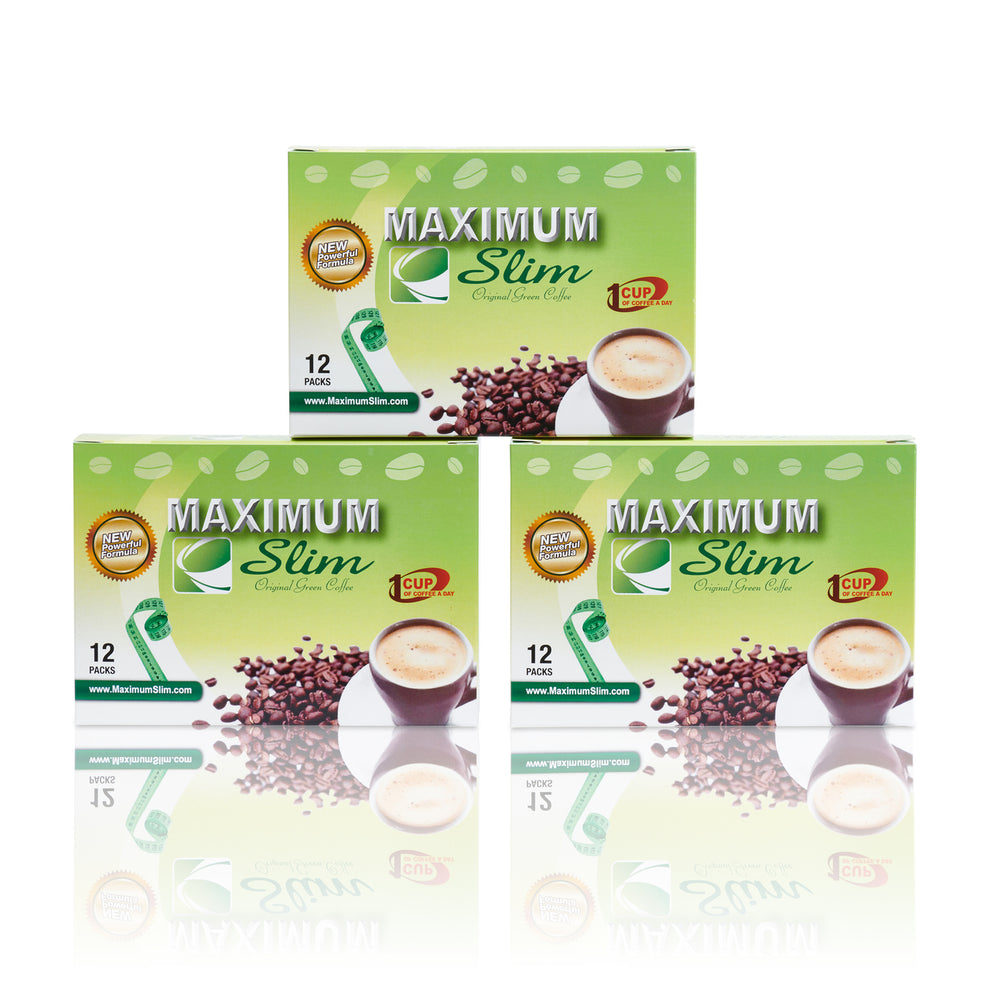
Why formulation matters more than the name
A low-caffeine green tea blended with a calming herb is a different bedtime choice from a strong, heavily brewed sencha. A decaffeinated base is different again. Even the same tea can behave differently when brewed briefly with cooler water or left to steep longer.
The right question isn't just, “Does green tea help you sleep?” Ask instead:
- What's in the blend? Look for a green tea base, L-theanine, and any added botanicals.
- How much caffeine might remain? “Nighttime” on the package doesn't guarantee a caffeine-free cup.
- When will you drink it? A cup earlier in the evening may suit you, while the same cup near lights-out may not.
- What result are you evaluating? Calmness, faster sleep onset, fewer awakenings, and better morning alertness are different outcomes.
That framework helps you choose a drink that supports your wind-down without assuming that every sleep-focused label reflects the same formulation.
What Sleep Green Tea Actually Is
Sleep green tea is a blend category, not a single cultivar. It usually means green tea made from Camellia sinensis that has been selected, processed, blended, or marketed for evening relaxation. The product may use a low-caffeine or decaffeinated green tea base, or it may combine ordinary green tea with herbs associated with calm.
The first step is to identify whether the product contains green tea. A full herbal infusion made only from flowers, leaves, roots, or spices is technically a tisane, not green tea. It may be an excellent caffeine-free bedtime drink, but it belongs to a different category.
Read the blend in three parts
Start with the tea base. Look for terms such as green tea, decaffeinated green tea, roasted green tea, or low-caffeine green tea. A standard green tea may provide the familiar grassy flavor and tea-derived L-theanine, but its caffeine load can vary with the leaves and preparation.
Then check the relaxation additions. Nighttime blends commonly include chamomile, lemon balm, lavender, or valerian. These ingredients have different evidence bases and shouldn't be treated as interchangeable. Their presence tells you that the product is positioned for relaxation, not that it will necessarily change your sleep.
Finally, inspect the serving guidance. A blend intended for evening use may recommend a particular steeping time or serving size. Follow the label first, then adjust the timing if you notice restlessness, delayed sleep, or early-morning wakefulness.
The practical difference between morning green tea and sleep green tea is therefore a combination of caffeine exposure, ingredient selection, and intended use. A morning tea may prioritize a bright flavor and stimulating effect. An evening formulation usually tries to soften that effect through lower caffeine, gentler processing, or complementary herbs.
If you're comparing green tea with coffee, the matcha caffeine comparison can help clarify why tea products with similar names may produce very different experiences. Matcha, for example, involves consuming powdered leaf, while an infusion extracts compounds into water.
What belongs on your shelf
A product generally fits the sleep green tea category when it includes:
- A green tea base, whether regular, low-caffeine, roasted, or decaffeinated.
- A relaxation-oriented blend, such as green tea paired with chamomile or lemon balm.
- Evening positioning, reflected in the name, serving suggestion, or formulation.
- Transparent ingredients, so you can judge the likely stimulant load and possible interactions.
If the ingredients list contains only chamomile, rooibos, or peppermint, you have a herbal evening infusion rather than sleep green tea. That's not a problem. It means you're choosing a naturally tea-free alternative instead of trying to balance tea compounds with caffeine.
Key Ingredients That Make a Green Tea Sleep-Friendly
A cup chosen for bedtime has to solve a formulation problem. It should offer the tea compounds associated with a calmer experience while keeping stimulant exposure low enough for your sleep sensitivity. No ingredient guarantees better sleep, and a brewed cup may contain far less of a compound than a supplement used in research.
L-theanine provides the tea-specific angle
L-theanine is the central ingredient in the tea-and-sleep conversation. This amino acid occurs naturally in tea and has been studied in connection with relaxation, stress, and sleep-related outcomes. A 2023 randomized, double-blind, placebo-controlled trial tested a green-tea amino-acid beverage supplying 100 mg, 200 mg, or 400 mg of L-theanine daily for 14 days in 60 adults with mild to moderate sleep disturbances. Its four-arm design assessed both objective and subjective sleep, along with stress markers, giving the ingredient discussion a firmer basis than anecdotal bedtime advice (clinical trial and later synthesis).
A mug of tea should not be treated as equivalent to a concentrated supplement. The product label, serving size, tea type, and brewing method all affect how much L-theanine you receive. A guide to L-theanine timing offers useful context for comparing these formats and deciding when to take them.
Herbal companions add a different layer
Chamomile often appears in sleep-oriented blends because it contains apigenin, a compound discussed in relation to GABA-A receptor activity. Lemon balm, lavender, magnolia bark, and valerian are also used for relaxation-focused formulations, although their proposed pathways and evidence quality are not identical.
The herbs can change the ritual as well as the chemistry. A floral aroma, mild flavor, and familiar preparation may help mark the shift from work or screens to bedtime. That calming experience can matter to the person drinking it, while remaining different from proof of improved sleep architecture.
The base determines the stimulant trade-off
Regular green tea can be a poor bedtime fit for someone who responds strongly to caffeine, even when the package uses sleep-focused language. Low-caffeine and decaffeinated versions reduce that concern while retaining a tea base and some of the compounds associated with green tea.
Roasted green tea offers another formulation choice, with processing affecting flavor and caffeine exposure. “Low caffeine” still does not mean “no caffeine.” If even a small stimulant amount affects your sleep, a caffeine-free herbal infusion gives you a clearer way to remove that variable.
| Ingredient | Proposed relaxation mechanism | Typical amount in sleep blends |
|---|---|---|
| L-theanine | Supports a calmer state and may moderate some caffeine-related effects | Varies by product; check the label |
| Chamomile | Apigenin is discussed in relation to GABA-A receptor activity | Varies by product; check the label |
| Lemon balm | Traditionally used for calming and stress support | Varies by product; check the label |
| Lavender | Aromatic and relaxation-oriented botanical | Varies by product; check the label |
| Valerian | Traditionally used in sleep-focused preparations | Varies by product; check the label |
| Green tea base | Provides tea polyphenols and may contribute L-theanine, but can add caffeine | Depends on tea type and preparation |
| Decaffeinated green tea | Retains a tea base while reducing caffeine exposure | Depends on product processing |
The useful choice is not the blend with the longest ingredient list. Choose one with a flavor you will drink, a stimulant load you can tolerate, and a label clear enough to connect the formulation with your own bedtime response.
What the Evidence Says About Sleep and Relaxation
Suppose a cup leaves you feeling calmer at bedtime, yet your sleep tracker shows little change. Both observations can be real. Sleep research separates subjective outcomes, such as perceived sleep quality or easier sleep onset, from objective measures, such as recorded awakenings and sleep duration. A calming sensation may therefore be useful without proving that the tea changes every measurable feature of sleep.
A 2025 systematic review and meta-analysis found improvements in several self-reported sleep outcomes, including sleep-onset latency, daytime dysfunction, and overall sleep quality (sleep review and meta-analysis). The authors also called for more research on pure L-theanine, dose, and duration. The practical reading is cautious optimism: research supports possible benefits, but it does not establish that every green tea blend will improve sleep.
What the controlled studies suggest
Controlled research helps explain why formulation matters. Studies of L-theanine have examined amounts that may be much higher than an ordinary cup provides, so supplement findings cannot be transferred directly to tea. A later synthesis of clinical studies also reported support for healthy adult sleep, while leaving open questions about the most useful dose and duration. Treat those findings as research benchmarks, not as a reason to assume that a stronger beverage will work better.
The caffeine and theanine relationship is conditional rather than predictable. In one controlled study of healthy young women, theanine alone did not differ from placebo, caffeine increased wake after sleep onset, and the combination reduced that caffeine-related increase (controlled caffeine and theanine study). Other sleep measures did not change. L-theanine may soften part of caffeine's effect, but it does not turn a caffeinated drink into a caffeine-free one.
Low-caffeine green tea offers a different clue. In a double-blind crossover study of middle-aged and elderly participants, the tea was associated with lower morning salivary alpha-amylase. Lower morning stress biomarker levels also correlated with better sleep quality, and reports on the intervention described improvements in sleep parameters (low-caffeine green tea study). This points toward a useful formulation question: reducing caffeine may matter as much as adding calming herbs.
| Evidence question | What the research suggests | How to interpret it |
|---|---|---|
| Do people feel better rested? | Self-reported sleep quality and related outcomes can improve | Useful for judging perceived benefit, but vulnerable to expectation and recall |
| Do sleep measures change? | Objective findings are less consistent across studies | A calmer feeling does not guarantee longer or more continuous sleep |
| Can theanine offset caffeine? | It may reduce one caffeine-related disruption in some conditions | Buffering is possible, not complete protection |
| Does lower caffeine help? | Low-caffeine tea has been linked with stress-related and sleep-quality findings | Test caffeine reduction before assuming more ingredients are needed |
| Does a study dose equal a tea dose? | Research amounts may differ substantially from a brewed cup | Read the product label and avoid direct dose comparisons |
For product comparisons, the Sleep All Nite supplement comparison can serve as a broader category resource. Apply the same test to every option: identify the ingredients, estimate the stimulant exposure, separate personal impressions from measured outcomes, and judge the formulation by how it affects your own night.
How to Brew and Time Your Cup
Brewing changes the cup you drink, so it deserves as much attention as the ingredient list. A strong, hot, long-steeped infusion can deliver a different caffeine experience from a lighter preparation made with cooler water.
Use a gentle first infusion
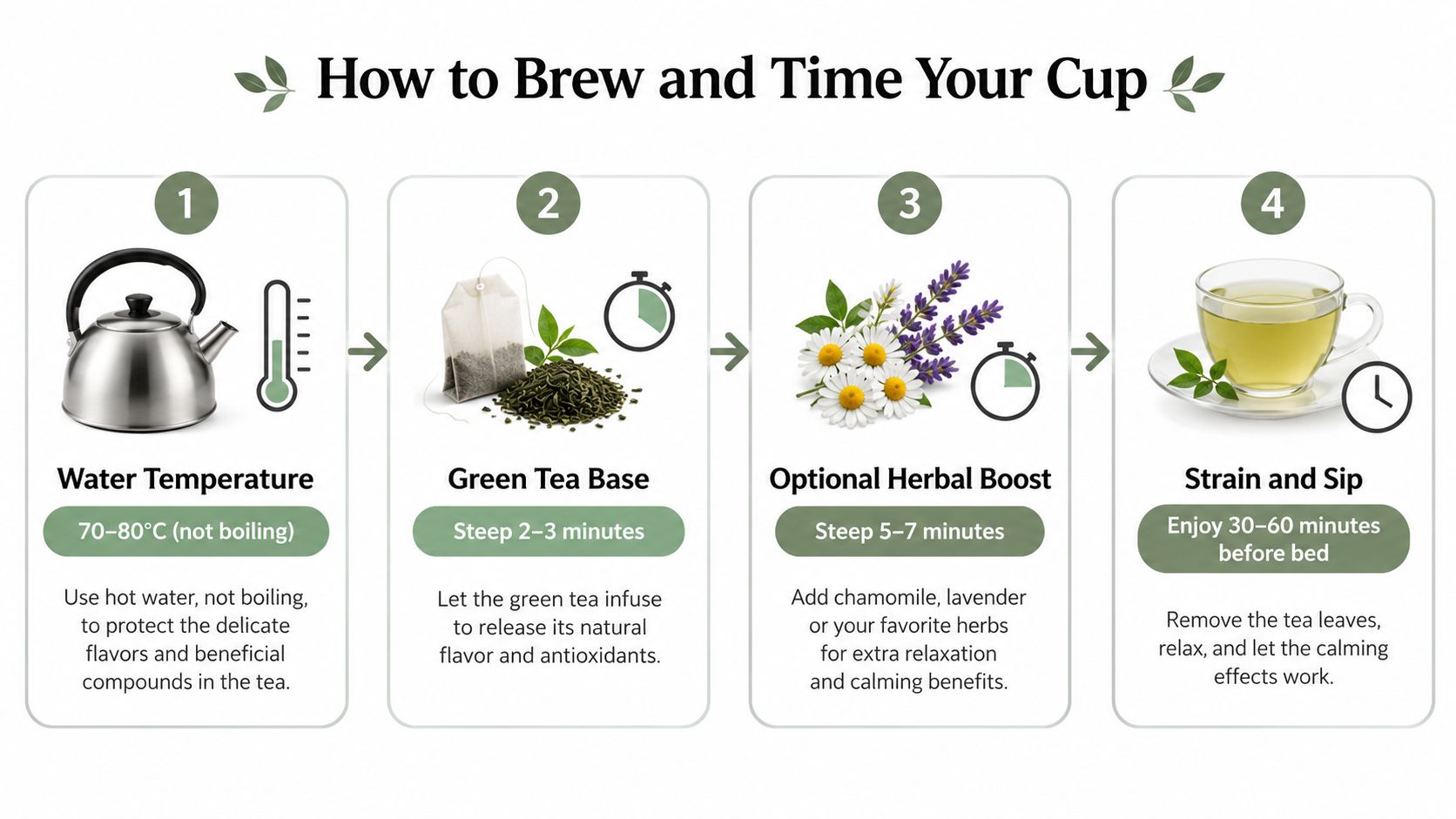
For a green tea base, begin with water around 70 to 80°C, rather than boiling water. Steep the green tea for 2 to 3 minutes, then taste it before making the brew stronger. This approach usually produces a smoother cup and reduces the chance that bitterness will turn the drink into an alertness cue.
If chamomile or other herbs are included, they may need a longer infusion. Many blends work well when the herbal portion steeps for 5 to 7 minutes, but follow the product's instructions because cut size and formulation affect extraction.
Use the minimum leaf or bag quantity that gives you a satisfying flavor. More material and longer contact time generally create a stronger drink, which may not suit an evening experiment.
Consider the second infusion
Loose-leaf tea can often be infused again. A second, lighter infusion may taste softer and give you more control over total strength. It doesn't guarantee a particular caffeine-to-L-theanine ratio, but it can be a practical way to avoid drinking an overly concentrated first cup.
Brewing cue: If the tea tastes sharp, bitter, or unusually stimulating, reduce the temperature, shorten the steep, or move it earlier. Don't keep strengthening the cup because the package says it's for sleep.
Build a personal cutoff
A practical starting point is to finish caffeinated green tea 6 to 8 hours before bed. That range is a personal trial window, not a universal rule. Some people tolerate a small early-evening serving, while others notice sleep disruption from much less caffeine.
Test one formulation for 3 to 5 nights before judging it. Record when you finished the cup, how long it seemed to take to fall asleep, whether you woke during the night, and how you felt in the morning. Keep the rest of your routine as stable as possible so you're not comparing several changes at once.
If the tea suits you, pair it with a predictable wind-down cue. Drink it 30 to 60 minutes before bed, finish before you're ready to lie down, and combine it with dim lighting, gentle stretching, or quiet reading. The ritual may help you disengage even when the measurable sleep effect is modest.
Who Should and Should Not Drink It at Night
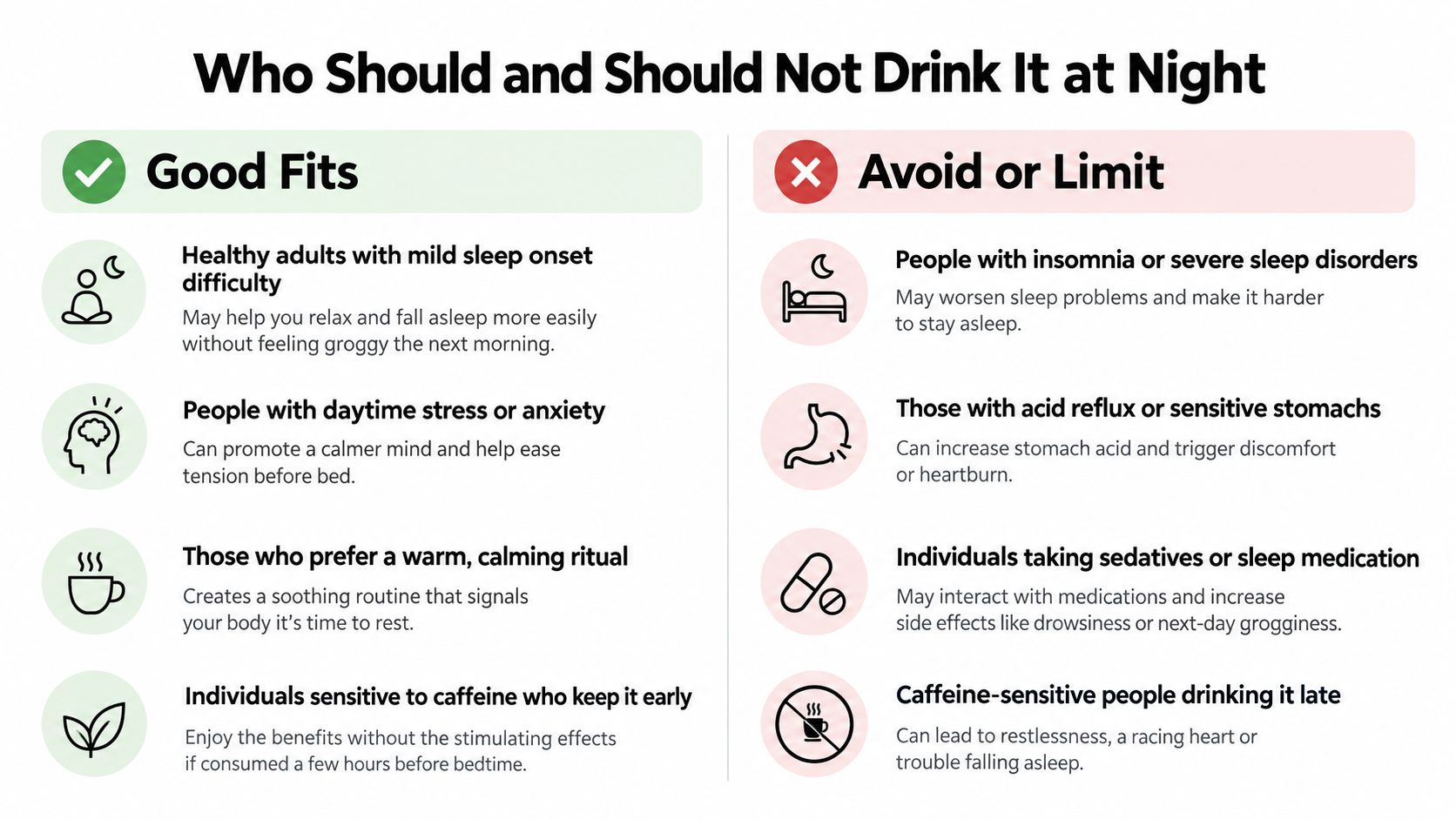
Sleep green tea can make sense for a healthy adult who wants a warm, non-alcoholic evening ritual and has only mild difficulty settling down. It may also suit someone who feels stressed at night but doesn't want a strongly sedating product.
The important qualifier is caffeine tolerance. A low-caffeine or decaffeinated blend may be reasonable for a sensitive person earlier in the evening, while a standard green tea may be a poor choice late at night. The low-caffeine intervention discussed earlier supports the idea that reducing stimulant exposure can matter, especially when stress and sleep quality are connected.
Profiles that call for caution
If you're pregnant or breastfeeding, ask your clinician about caffeine and any herbal ingredients before using a blended product. Herbal formulas can contain several botanicals, and safety depends on the full ingredient panel rather than the front label.
Use extra care if you take sleep medication, sedatives, blood pressure medication, or other prescription products. Valerian and some calming botanicals may not be appropriate alongside sedating medicines, and tea products don't always provide the same standardized dosing as supplements.
People with diagnosed insomnia, severe sleep disorders, significant anxiety, acid reflux, or a sensitive stomach shouldn't treat sleep green tea as a substitute for assessment. Caffeine, tannins, fluid volume, or added botanicals may worsen symptoms for some individuals.
Older adults may be more affected by nighttime bathroom trips, medication interactions, or changes in sleep timing. Shift workers face a different challenge because their sleep window may occur during daylight or vary across workdays. For both groups, the key question is not whether the product is marketed for sleep, but whether its caffeine and fluid load fit the actual sleep schedule.
Use this quick screen
Before adding a cup, ask yourself:
- Do I know whether it contains caffeine?
- Have I checked every herb against my medicines and health conditions?
- Does caffeine make me restless, anxious, or prone to nighttime waking?
- Will the fluid volume create bathroom interruptions?
- Am I using it as a ritual, rather than expecting it to treat a sleep disorder?
If you can answer those questions comfortably, start with a small, lightly brewed serving earlier in the evening. Stop if your sleep worsens, and seek professional guidance when symptoms persist.
Building a Simple Bedtime Routine Around It
A cup works best as one cue in a sequence, not as a magic switch. Your brain responds to repeated patterns, so a stable wind-down routine can make the transition from active time to sleep more predictable.
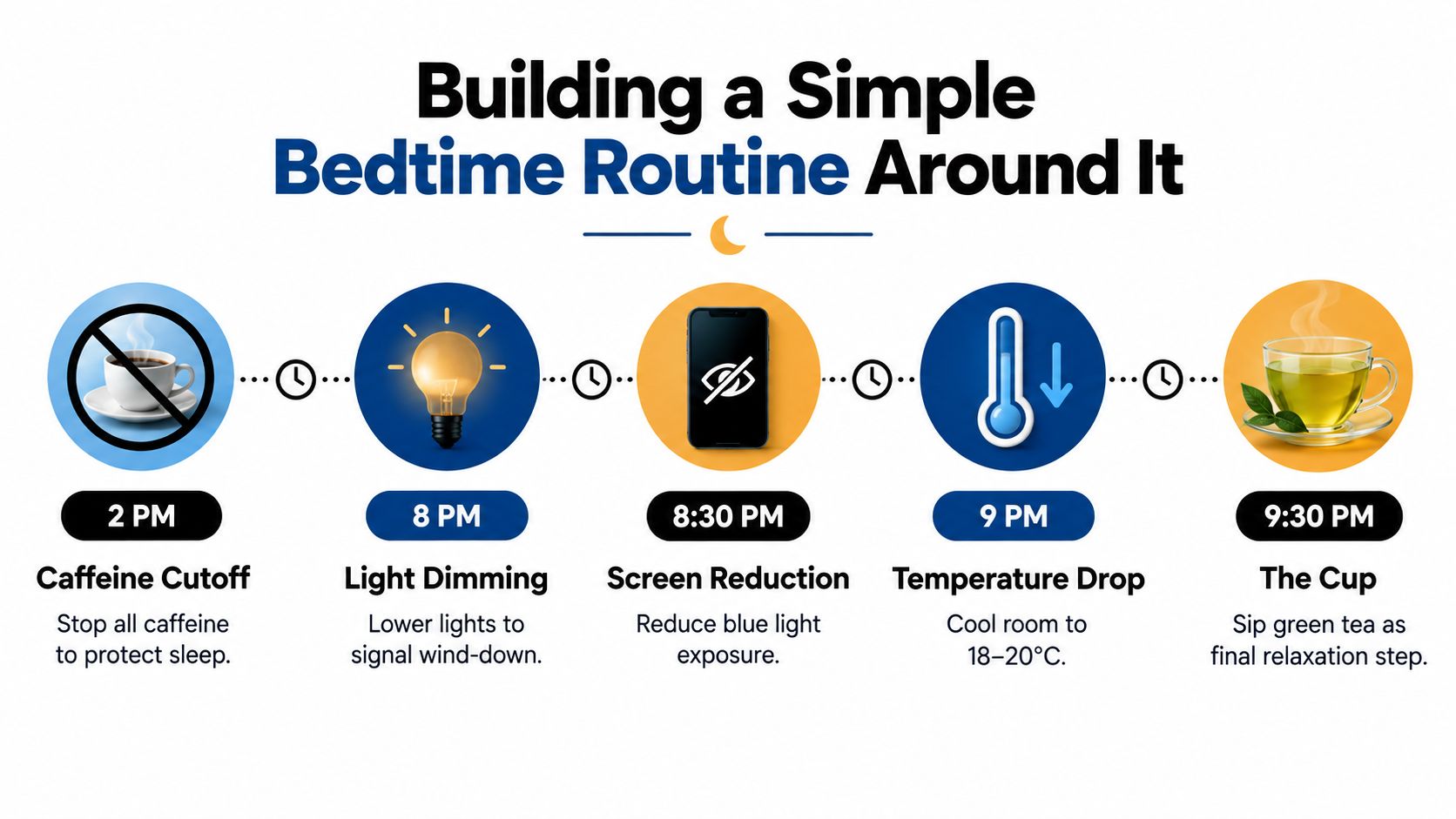
Start by protecting the afternoon. If caffeine tends to affect you, stop caffeinated drinks early enough that your evening tea doesn't become the last stimulant of the day. Then lower the intensity of your surroundings, reduce demanding work, and make the tea part of a quiet activity rather than something you drink while answering messages.
A workable evening sequence
Earlier afternoon: Set your caffeine cutoff based on your sensitivity and target bedtime. If you're unsure, start earlier rather than trying to rescue sleep after a late cup.
About 60 to 90 minutes before bed: Brew the sleep green tea. Choose low-caffeine or decaffeinated green tea if you want the tea character, or switch to a caffeine-free herbal infusion if any stimulant feels risky.
Thirty to 45 minutes before lights out: Finish the drink. This leaves time for digestion and reduces the chance that a large volume of liquid will interrupt sleep with a bathroom trip.
During the final wind-down: Choose one quiet activity. Journaling can move unfinished thoughts onto paper. Light stretching can release physical tension. Slow breathing can give your attention a simple anchor. The best choice is the one you'll repeat without turning it into another task.
A broader guide to healthy sleep habits for families can help you adapt the routine when children, partners, or household schedules affect bedtime. For individual adjustments, review these practical ideas on improving sleep quality, especially if your tea ritual needs to fit around an inconsistent evening.
The included video offers another way to think about the routine and relaxation process:
Keep the experiment consistent for roughly two weeks, while tracking sleep onset, awakenings, and morning alertness in simple notes. If you feel calmer but your sleep remains fragmented, try lowering the caffeine, moving the cup earlier, or replacing the tea base with a caffeine-free infusion. If sleep problems continue, discuss them with a qualified healthcare professional rather than increasing the blend or adding more products.
Maximum Health Products offers tea, supplements, and wellness formulas across areas including Sleep & Relax, Energy & Focus, and daily nutrition, so you can compare a sleep-oriented routine with other clean-label options in one place. Visit Maximum Health Products to explore products and choose an approach that fits your ingredients, caffeine tolerance, and nightly habits.

