


Clean caffeine is caffeine from minimally processed plant sources, such as green coffee, tea, guarana, or yerba mate, delivered without artificial sweeteners, fillers, or excess processing. For most healthy adults, the practical safety reference is up to 400 mg of caffeine per day, roughly 3 to 5 cups of brewed coffee.
Why does a molecule that has existed in coffee, tea, cacao, and other plants for centuries suddenly need the prefix “clean”? The question exposes the main problem with the label. Clean caffeine isn't a different chemical. It's a clean-label idea describing where caffeine comes from, how it's extracted, what accompanies it, and how accurately the final product delivers its dose.
Why the Term Clean Caffeine Confuses So Many People
The caffeine molecule in a green coffee extract and the caffeine in a conventional energy drink acts on the body as caffeine. Your body doesn't recognize a special “clean” version of the molecule. The distinction appears earlier, in the supply chain and formulation, not in caffeine's basic identity.
A useful working definition is this: clean caffeine is plant-derived or minimally formulated caffeine with transparent sourcing, limited processing, and no unnecessary additives. That definition has four separate parts:
- Source: The label names a plant such as coffee, tea, guarana, or yerba mate.
- Processing: The manufacturer explains or substantiates how the caffeine was extracted and purified.
- Formulation: The product avoids artificial sweeteners, excessive flavor systems, fillers, and other unnecessary ingredients.
- Dose: The package states the caffeine amount clearly and supports reliable, consistent delivery.
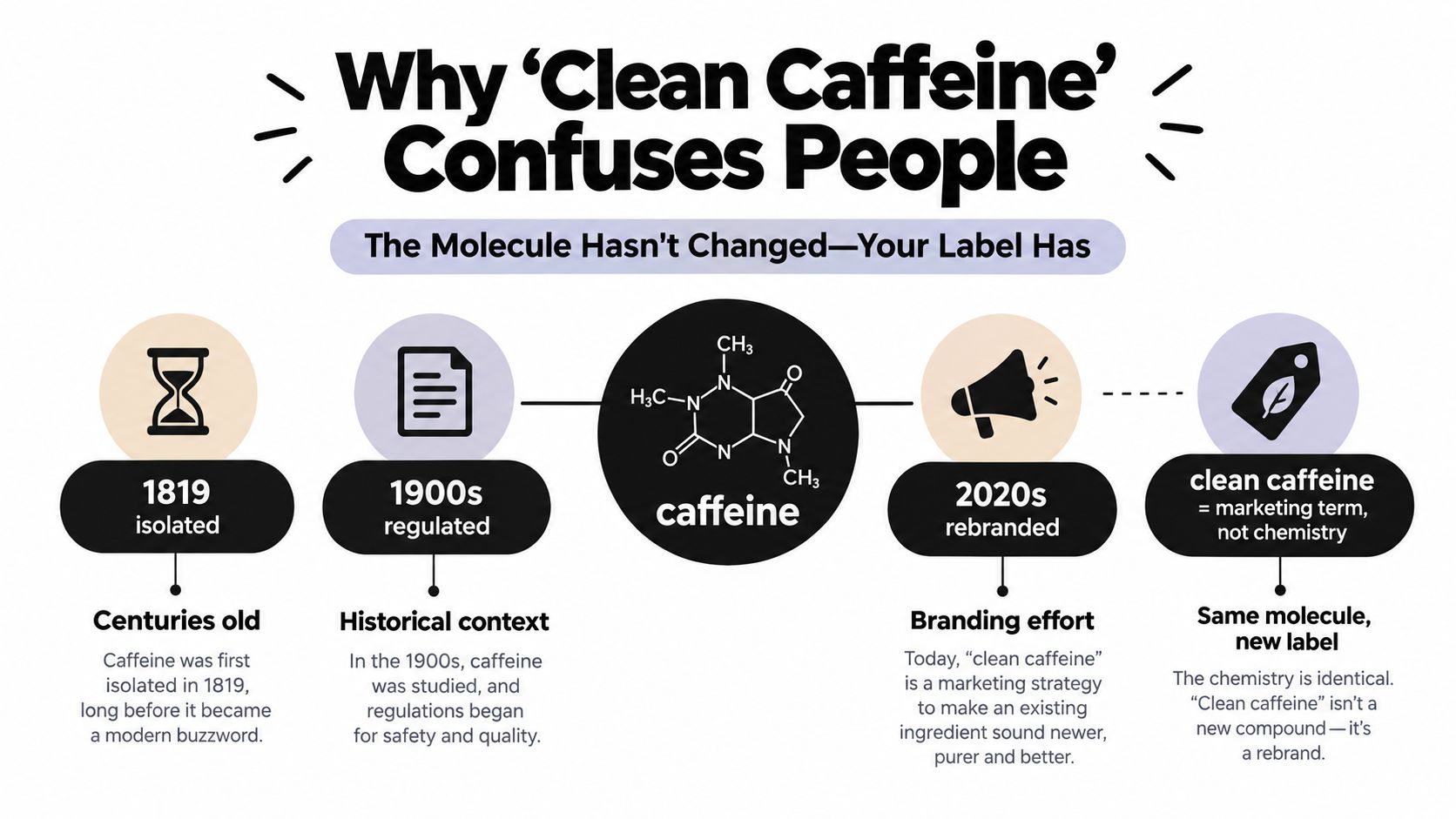
The molecule has stayed the same
Caffeine occurs naturally in coffee beans, tea leaves, cacao beans, guarana berries, and yerba mate leaves. Modern clean-label products separate the stimulant from the rest of the plant material, then make a claim about the simplicity of the resulting product. That claim may concern the botanical source, the extraction method, or the absence of added ingredients. It doesn't automatically describe every part of the finished formula.
This is why “natural caffeine” and “clean caffeine” shouldn't be treated as synonyms. Plant-derived tells you something about the starting material. It doesn't, by itself, tell you whether the extract contains unwanted residues, how much caffeine reaches each serving, or whether the drink also contains sugar and several other stimulants.
Practical rule: Treat “clean” as a prompt to investigate, not as proof that a product is safe, low-dose, or effective.
The rest of the label-reading process becomes easier once you separate these questions. First, identify the source. Next, consider the extraction and purification process. Then inspect the complete ingredient panel and verify the caffeine dose. That framework is more useful than judging a package by its front label.
Where Clean Caffeine Actually Comes From
Think of caffeine production as the difference between a café and a laboratory. A café starts with a plant and prepares a beverage that carries caffeine alongside other compounds. A manufacturer may start with that same plant, extract its soluble ingredients, concentrate the result, and purify the caffeine for use in a capsule, powder, or drink.
The main botanical sources include green coffee beans, tea leaves, guarana seeds, and yerba mate leaves. Green coffee means unroasted coffee, while tea generally refers to the leaves of Camellia sinensis. Guarana and yerba mate are separate botanical sources that are often used in energy formulas.
The plant part matters because it determines which additional compounds accompany the caffeine. Green coffee can contain chlorogenic acids. Tea can contribute polyphenols and, depending on the variety and processing, L-theanine. Guarana and yerba mate contain their own broader mix of plant compounds. Those co-compounds can affect taste, texture, and the way a product is experienced, but they don't turn caffeine into a different stimulant.
A manufacturer may use water, ethanol, or other extraction approaches, then concentrate and dry the extract. Supercritical carbon dioxide extraction is described in industry coverage as selective for caffeine, with little flavor material left behind and extraction efficiency often cited around 96% to 98%. Those figures come from the process discussion in industry coverage of natural and clean caffeine. The important consumer question is not just whether a product began as a plant. It's whether the manufacturer can explain the process and verify the final ingredient.
| Source | Plant part used | Native region | Caffeine per gram, approximate | Key co-compounds |
|---|---|---|---|---|
| Green coffee | Unroasted coffee bean | Tropical coffee-growing regions | Varies by bean and extract | Chlorogenic acids and other coffee compounds |
| Tea | Leaf of Camellia sinensis | East and South Asia, now widely cultivated | Varies by tea type and preparation | Polyphenols and, in some teas, L-theanine |
| Guarana | Seed | Amazonian South America | Varies by seed and extract | Polyphenols and other botanical compounds |
| Yerba mate | Leaf | South America | Varies by plant and preparation | Polyphenols and other mate compounds |
The table uses qualitative ranges because caffeine concentration changes with the plant variety, growing conditions, extraction ratio, and serving format. A label that names “botanical caffeine” without identifying the plant leaves too much uncertainty.
For readers comparing coffee-based options, this guide to green coffee extract and caffeine offers useful background on the ingredient. People who want to explore a coffee alternative can also discover mushroom coffee with Herbswell, while remembering that mushrooms themselves aren't a source of caffeine unless the blend also contains coffee, tea, or another caffeinated botanical.
“Natural” also doesn't guarantee that the final caffeine is purer, safer, or better dosed. It identifies the origin of the raw material. Purity depends on extraction, purification, contaminant controls, and testing.
Clean Caffeine vs Conventional Caffeine
The easiest comparison isn't “natural molecule versus artificial molecule.” Both products deliver caffeine once you consume them. The more useful comparison looks at everything surrounding that molecule.
| Dimension | Clean caffeine | Conventional caffeine |
|---|---|---|
| Source origin | Named botanical source, such as green coffee, tea, guarana, or yerba mate | May list caffeine broadly or use a blend with unclear source details |
| Processing intensity | May emphasize water, ethanol, or carbon dioxide extraction and purification | May use a more heavily processed ingredient or provide little process information |
| Added ingredients | Often aims for a shorter ingredient list without artificial sweeteners, colors, or unnecessary fillers | May include sweeteners, flavorings, dyes, and several stimulant ingredients |
| Dose transparency | Caffeine amount is stated as milligrams per serving | Dose may be clear, but proprietary blends can make comparison difficult |
| Product format | Coffee, tea, botanical extract, capsule, or simple powder | Energy drink, shot, pre-workout, tablet, or complex stimulant blend |
A clean formulation can still contain a concentrated dose. A conventional product can also state its caffeine amount accurately and contain relatively few ingredients. That's why the label deserves more attention than the category name.
Source and processing
The phrase “caffeine from green coffee” tells you the source material. It doesn't reveal whether the manufacturer retained a broad plant extract or purified caffeine almost completely. Those are different ingredients with different sensory and formulation characteristics.
Some products use a whole or partial botanical extract. Others isolate caffeine from a plant and use it as a neutral ingredient. Neither approach automatically wins. The better choice depends on whether you want the taste, co-compounds, and variability of a botanical extract or the predictable behavior of a purified ingredient.
The additive load
A can marketed as an energy product may combine caffeine with sweeteners, flavors, colors, acids, and other stimulants. A capsule may contain much less around the caffeine itself. That doesn't mean every capsule is cleaner, because fillers and undisclosed blends still matter.
Clean doesn't mean caffeine-free, sugar-free, or low-caffeine by definition. It means the product makes a stronger effort to keep the source, formulation, and dose understandable. You still need to check serving size, total daily intake, and your response.
Benefits of Choosing Clean Caffeine
People often describe clean caffeine as smoother, steadier, or less harsh. Those experiences may come from the delivery format, not from a special form of caffeine.
A plain coffee or tea without added sugar gives you caffeine in a relatively simple matrix. A product with a modest serving and fewer ingredients may also be easier to evaluate because you can identify what caused a benefit or side effect. By contrast, a highly sweetened drink with multiple stimulants makes the experience harder to interpret.
Why energy can feel smoother
Tea and green coffee contain plant compounds beyond caffeine. Polyphenols, chlorogenic acids, and, in some teas, L-theanine may change the taste and overall experience of the drink. It's reasonable to say these compounds can contribute to a different experience, but the evidence provided here doesn't establish a universal “slow release” effect or guarantee a smoother rise and fall for every person.
The strongest explanation for fewer jitters is often simpler: the person consumed less caffeine, or consumed it without a large sweetener load. Caffeine sensitivity varies widely. Someone who feels calm after tea may feel uncomfortable after a concentrated capsule, even when both products use a plant source.
A short ingredient list can also reduce digestive uncertainty. If a product avoids artificial flavors, sweeteners, and unnecessary fillers, a consumer has fewer ingredients to investigate when the product doesn't agree with them. That doesn't make every additive harmful, and “natural” ingredients can still cause discomfort.
The practical benefit of clean-label caffeine is better control. You can compare a plain coffee with a tea, then compare either one with a clearly dosed extract. You can adjust the serving instead of guessing which ingredient in a complex energy formula affected your focus, mood, stomach, or sleep.
Those benefits remain personal. A clean product can still cause anxiety, palpitations, reflux, or poor sleep if the dose is too high or the timing is wrong. Clean sourcing improves transparency, but it doesn't cancel caffeine's effects.
Safe Dosing and How Much Is Too Much
How much caffeine is safe depends on the full daily total, not whether the label calls it clean. For healthy adults, medical and public-health guidance commonly uses up to 400 mg of caffeine per day as a general reference. The American Heart Association's caffeine guidance describes that amount as roughly 3 to 5 cups of brewed coffee, with four 8-ounce cups as a useful comparison.
That figure is a ceiling for general guidance, not a target. Add the caffeine from morning coffee, afternoon tea, chocolate, energy drinks, and supplements to one running total. A clean source or short ingredient list does not change the caffeine dose.
| Format | Typical caffeine per 8-ounce serving | Variability note |
|---|---|---|
| Brewed coffee | About 70 to 100 mg | Brewing method and serving size change the amount |
| Instant coffee | About 60 mg | Product strength and preparation vary |
| Decaf coffee | About 2 to 15 mg | Decaffeination does not remove every trace |
| Clean-caffeine supplement | Label-dependent | Verify the stated amount and testing information |
The coffee figures in the table follow the same American Heart Association reference. Serving size still matters. A large mug may contain more caffeine than the 8-ounce comparison, just as a concentrated supplement may deliver its dose in a much smaller volume.
Pregnancy calls for a lower reference point. The American Medical Association's caffeine overview summarizes 200 mg per day as the pregnancy limit. People who are breastfeeding, adolescents, and those with anxiety, heart rhythm concerns, reflux, or unusual caffeine sensitivity should ask a qualified clinician for personal guidance.
Dose accuracy matters
The source and extraction process help explain where caffeine came from. The formulation tells you what else is in the product. The labeled milligram amount, serving size, and testing record determine whether you can judge the dose accurately.
Independent analysis of dietary supplements has found products containing up to 149% more caffeine than declared, while another result in the same sample found measured amounts higher than declared across all tested products. This published analytical study shows why third-party testing and batch controls matter.
Choose a stated caffeine amount in milligrams instead of an undefined “energy blend.” Keep a simple daily log covering coffee, tea, soft drinks, energy products, and capsules. If caffeine causes shakiness, restlessness, or poor sleep, this guide to stopping caffeine jitters offers practical ideas for reviewing timing and reducing intake. A fat burn coffee buying checklist can support a broader label review, but no checklist replaces medical advice.
How to Choose a Clean Caffeine Product
A “clean” product should survive a label audit. Start at the back of the package, not the large claim on the front.
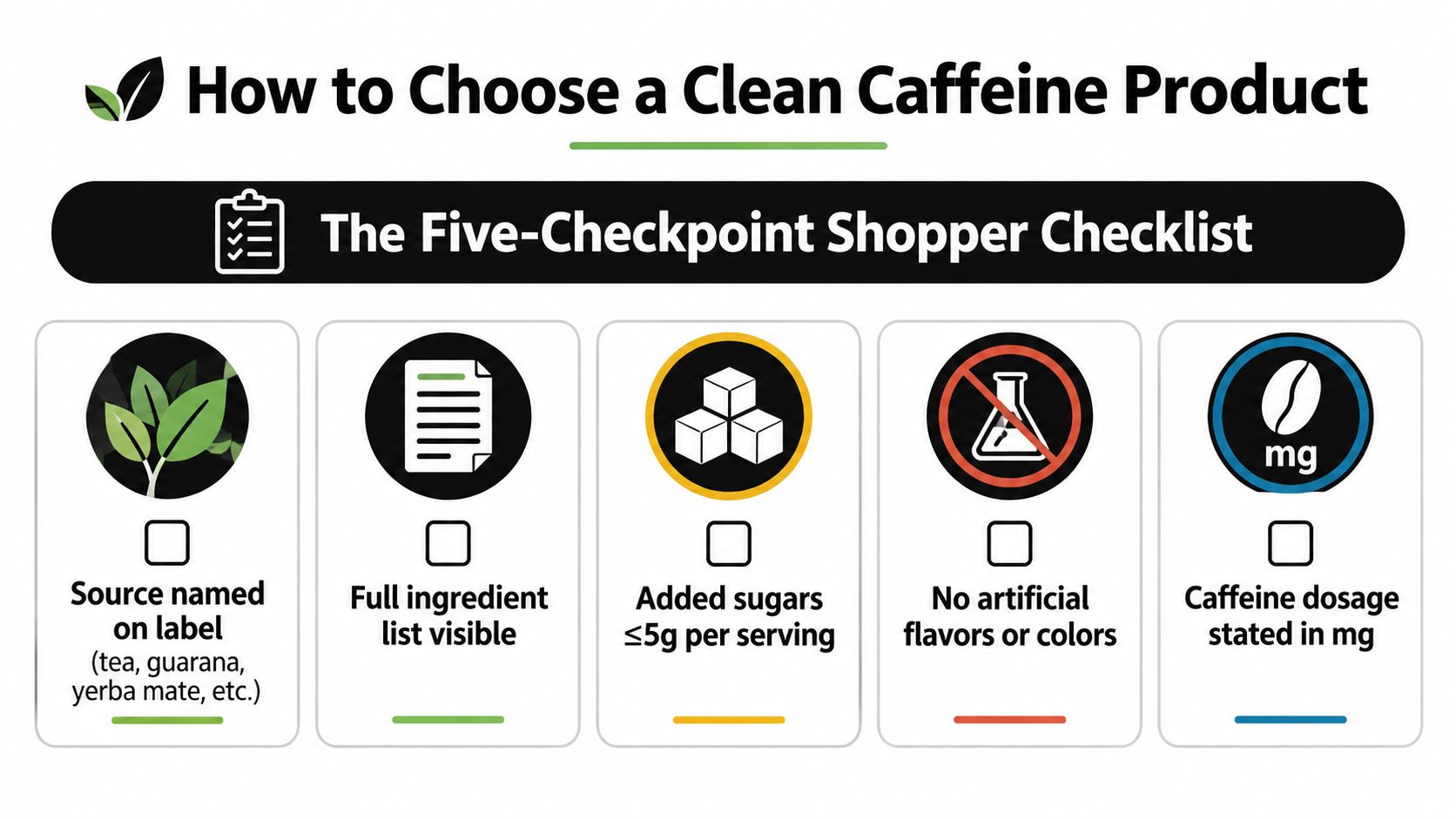
Five checkpoints for the label
- Name the source. Look for green coffee bean, tea, guarana, yerba mate, or another specific botanical. “Caffeine” may be accurate, but it tells you less about origin. “Energy matrix” tells you even less.
- Look for process information. Water, ethanol, or carbon dioxide extraction can give you more context than a bare natural-caffeine claim. If the manufacturer provides no meaningful information about extraction or purification, treat the source claim as incomplete.
- Read every ingredient. Check for artificial colors, artificial flavors, added sweeteners, and unnecessary fillers. Sugar alcohols aren't automatically bad, but they can upset digestion for some people. A short ingredient list is easier to evaluate, not automatically healthier.
- Seek independent verification. Programs such as USP, NSF, Informed Sport, or ConsumerLab may offer useful quality signals where applicable. A batch-level Certificate of Analysis can be even more informative when it identifies the actual caffeine result and contaminant screening.
- Confirm the dose. Find the caffeine amount per serving, the number of servings, and the serving size. Then compare the product with your personal daily caffeine budget rather than treating the serving as harmless by default.
A proprietary blend is a major obstacle because it may conceal the amount of caffeine or other stimulants. “Natural flavor” also deserves context, especially when the brand doesn't explain the flavor system. A very low price isn't proof of poor quality, but it can justify closer scrutiny of sourcing, testing, and dose consistency.
When comparing products, write down the source, caffeine milligrams, sweetener, stimulant ingredients, and testing information. That simple record turns a vague clean-label impression into a direct comparison.
The Tradeoffs Behind the Clean Label
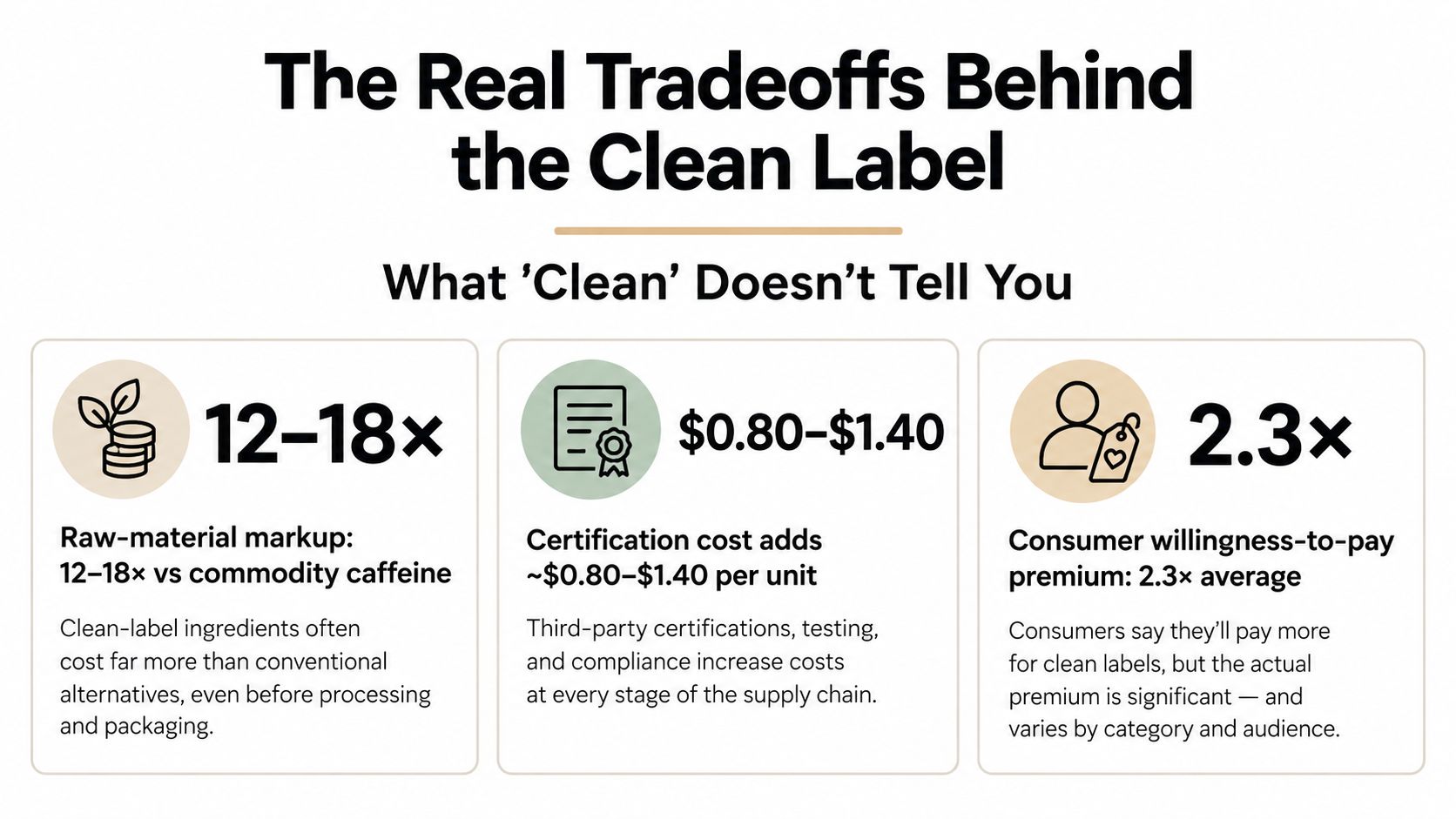
What does a clean caffeine label leave out? Often, the answer is not a single ingredient but the chain behind it. Plant-derived caffeine can bring agricultural variability, limited production scale, and more complicated sourcing than a commodity caffeine ingredient. Those conditions may affect availability, consistency, and formulation choices.
A useful comparison is a food supply chain: the farm is only the first stop. One brand may blend caffeine sources to manage supply or keep the dose consistent. Another may choose a more processed caffeine ingredient while keeping the rest of its formula simple. Neither choice proves deception, yet a front-label claim can conceal the source, extraction method, purification steps, or formulation details.
“Clean” also does not establish that a product is more sustainable, less expensive, better absorbed, or more effective. Market interest in natural caffeine is growing, which makes clear label education more important, not less. Consumer demand can encourage better disclosure, while commercial pressure can also make broad claims attractive.
For a broader explanation of clean-label ingredients, apply the same four-part framework: source, processing, full formulation, and dose.
- Coffee drinkers may value a whole beverage with a short ingredient list.
- Pre-workout users may prioritize an exact caffeine dose and independent verification.
- Sensitive consumers may give greater attention to sweeteners, flavors, and fillers.
- Busy professionals may choose portability, while still checking serving size and total daily intake.
Clean caffeine works best as a multi-variable filter, not a stamp of approval. Read the label like a map. Trace the caffeine to its source, examine how it was processed, review everything in the formula, and confirm the stated dose.
Maximum Health Products offers green coffee products and clean-label nutrition options for people comparing plant-based caffeine and daily wellness formulas. Visit Maximum Health Products to review its coffee, cocoa, tea, and supplement options, then compare each label using that framework.

