


By midmorning, a lot of people are already negotiating with themselves. Another coffee, or risk dragging through the day. Skip it, and concentration slips. Take it, and you may get the wired feeling, the shaky hands, the afternoon drop, or the familiar bedtime problem where your body is tired but your brain won't shut off.
That tension is why interest in the best caffeine free energy supplements keeps growing. People aren't just looking for a substitute drink. They're trying to break a pattern. They want energy that feels usable, steady, and compatible with real life.

Featured Product
Maximum Slim Original
Science-backed formula to support metabolism, curb appetite, and help you reach your goals faster.
Shop Now →Beyond the Jitters The Rise of Sustainable Energy
The old model of energy is simple. You feel flat, you take a stimulant, and you push through. It works fast, which is why it's tempting. But fast energy often acts like an advance on tomorrow's reserves. You can get the lift now, then pay for it later with irritability, poor sleep, or a harder crash.
That pattern has become more common in the supplement aisle. From 2009 to 2020, the median caffeine content in dietary supplements labeled with "energy" increased from 57.4 to 80 mg up to 135 to 150 mg per serving, reflecting a strong move toward high-stimulant formulas, according to research on energy-labeled supplements. Many people can tolerate caffeine in moderation, but a market built around stronger and stronger stimulation leaves a real gap for products that support energy differently.
Borrowed energy versus built energy
Think of caffeine like revving a car engine harder when the fuel tank is already low. You may get moving. You haven't fixed the underlying problem.
Caffeine-free support works more like improving the engine, refilling the tank, and reducing the drag on the system. Instead of forcing alertness, it aims to help your body make and manage energy more efficiently.
That matters most when fatigue isn't only about needing a "boost." Sometimes the underlying issue is poor sleep, chronic stress, pain, inconsistent meals, or recovery that's never quite complete. If fatigue keeps circling back, it's worth looking at broader contributors such as addressing sleep and pain issues, because supplements work best when they support a body that's also getting basic needs met.
Sustainable energy feels calmer than a stimulant buzz. That's often how you know you're moving in the right direction.
What caffeine-free energy should mean
A good caffeine-free product shouldn't pretend to be an instant jolt in disguise. It should support steadier output, clearer focus, and less wear-and-tear on your nervous system.
You'll also see different formats on the market. Some people prefer capsules, while others start with beverages and compare options like these caffeine-free energy drinks before moving to more targeted formulas.
The key idea is simple. You aren't trying to squeeze more out of an exhausted system. You're trying to help the system function better.
How Caffeine Free Supplements Actually Work
Caffeine-free energy support usually works through two lanes. One helps your cells produce energy. The other helps your brain and stress response stop wasting it.
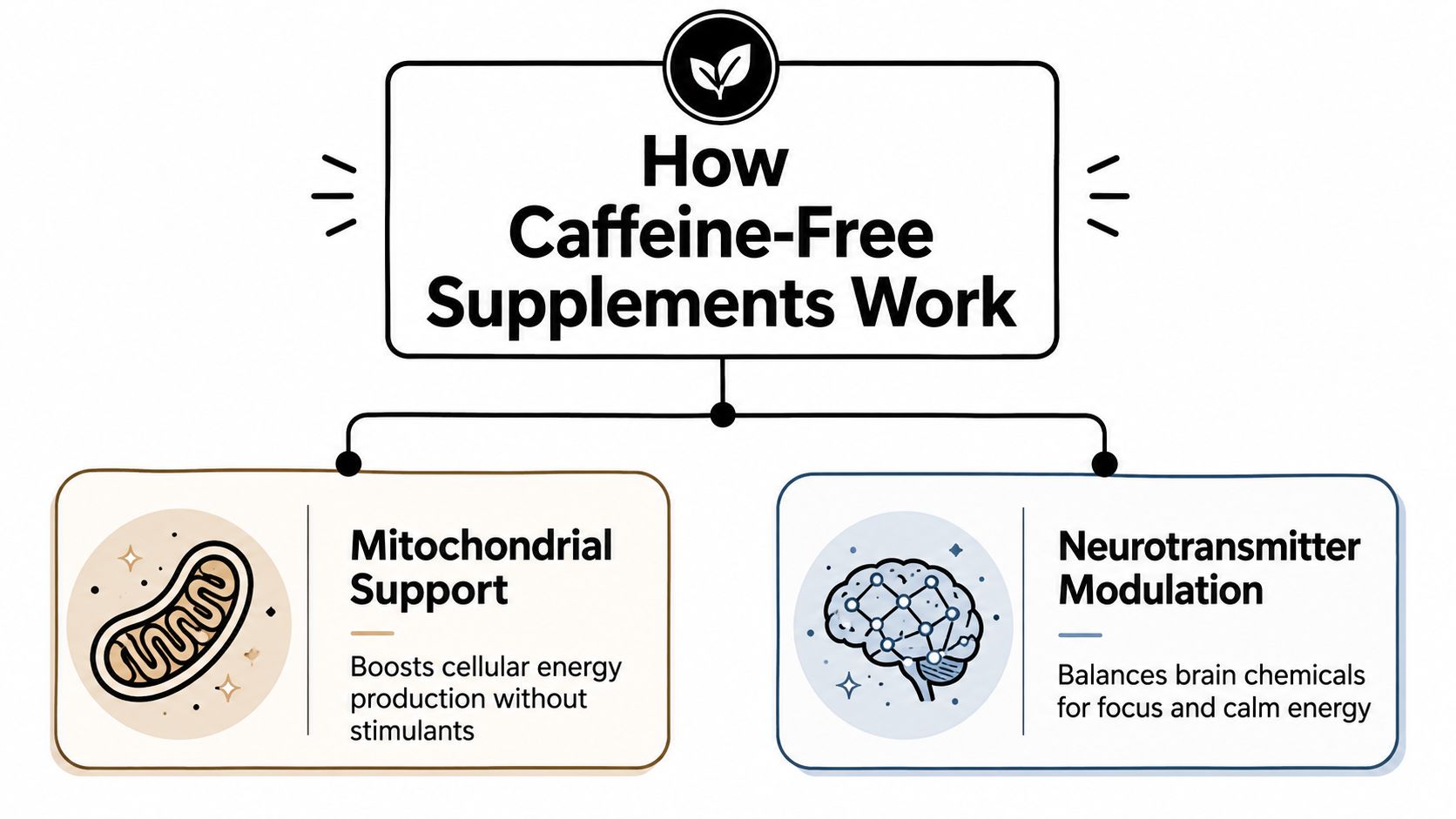
They support your cellular power supply
Your cells make usable energy in mitochondria. If you think of your body as a city, mitochondria are the power plants. Caffeine doesn't build more power plants. It turns up demand.
By contrast, caffeine-free ingredients are often chosen to support the conditions your cells need for stable output. The broader safety context matters too. The general population usually treats 400 mg of caffeine per day as the upper safe limit, while many commercial energy drinks contain 100 to 300 mg per serving, according to this overview of caffeinated energy drinks and alternatives. That same source notes that caffeine-free alternatives may use ingredients such as Maca root and Ginseng to support steadier energy without the same crash or sleep disruption pattern.
Maca is often discussed as an antifatigue botanical. Ginseng is commonly marketed for stamina and resilience. Neither works like a switch you flip. They're better understood as supports for a system that needs consistency.
They reduce energy leaks from stress
A second mechanism is less obvious. Stress burns energy.
When your stress response stays heightened, focus gets scattered, sleep quality can drop, and your body spends more time in a defensive state. That's one reason many caffeine-free formulas include calming or balancing ingredients alongside energy-supportive ones. The goal isn't sedation. It's smoother function.
One useful comparison comes from other wellness categories that also aim to support energy through body systems instead of a stimulant hit. If you're curious how that thinking shows up elsewhere, this guide on deciphering peptide energy mechanisms offers a helpful parallel.
Why the effects feel different
People sometimes try a stimulant-free product and say, "I don't feel it." What they usually mean is, "I don't feel the surge."
That's the point. Better energy from non-caffeine supplements often shows up as:
- Fewer peaks and drops: your day feels more even
- Clearer mental stamina: you can stay with tasks longer
- Less sleep interference: support doesn't fight your bedtime
- Calmer alertness: attention improves without the edgy feeling
Practical rule: If a product promises stimulant-free energy but feels like a sudden blast, read the label carefully. Something else may be doing the heavy lifting.
The Building Blocks of Clean Energy Key Ingredients to Look For
If you want the best caffeine free energy supplements, don't start with branding. Start with ingredients and what job each one is supposed to do.
Some compounds help with basic cellular fuel. Others help your body adapt to stress. A few are included for mental performance so your energy feels useful, not just physical.
The stress managers
Many strong stimulant-free formulas distinguish themselves from weak ones.
Rhodiola rosea stands out because it isn't just described as a calming herb. It's been characterized as a mitochondrial adaptogen that enhances cellular energy production by upregulating ATP synthesis and modulating cortisol, which supports endurance and mental clarity without overstimulation, based on this explanation of natural caffeine alternatives.
That description matters because fatigue and stress often travel together. If your system is constantly burning through reserves under pressure, an ingredient that supports both energy production and stress handling makes more sense than one that only tries to stimulate alertness.
Ashwagandha is another adaptogen people often look for. It's generally used for stress resilience, recovery, and a steadier sense of capacity. In real life, that may mean your energy improves because your body isn't spending so much effort staying tense.
The cellular fuelers
Some ingredients are less flashy but still important.
B vitamins are commonly used in energy formulas because they're involved in normal energy metabolism. They don't create energy out of thin air. They help your body do the work it's already designed to do.
CoQ10 is often included for mitochondrial support. It's especially popular in formulas meant to support endurance and daily vitality.
Electrolytes also deserve more respect in this category. When hydration is off, people often read the feeling as "I need caffeine" when the body may instead need fluid and minerals. Magnesium, potassium, and sodium can support steady function, especially if low intake, sweating, or inconsistent routines are part of the picture.
The brain support ingredients
A lot of people say they want more energy when what they want is better mental drive.
That's why some caffeine-free products include compounds aimed at focus and clarity. Examples often seen on labels include L-theanine, L-tyrosine, and citicoline. These ingredients are typically chosen to support attention, calm focus, or neurotransmitter balance rather than brute-force stimulation.
L-theanine is especially useful to understand. Even though people often associate it with tea, it can be used in caffeine-free formulas to support alertness with a calmer feel. It doesn't mimic caffeine. It smooths the experience.
Good energy support helps you do the task in front of you. It doesn't just make you feel more activated.
The clean fuels
Some products use ingredients that function more like alternate fuel sources.
MCT oil is a common example. It's often added to powders or drinks for people who want sustained fuel, especially in the morning or between meals. For some users, that can feel smoother than a stimulant product taken on an empty stomach.
Key Caffeine-Free Energy Ingredients at a Glance
| Ingredient | Primary Function | Mechanism of Action |
|---|---|---|
| Rhodiola rosea | Stress resilience and mental stamina | Supports ATP production and helps modulate cortisol |
| Ashwagandha | Recovery and stress balance | Helps the body adapt to ongoing stress load |
| Maca root | Antifatigue support | Used to support steady vitality without stimulant action |
| Ginseng | Stamina support | Commonly used to promote endurance and resilience |
| B vitamins | Energy metabolism | Help the body convert nutrients into usable energy |
| L-theanine | Calm focus | Supports alertness without a wired feeling |
| Electrolytes | Functional energy support | Help hydration and nerve-muscle function |
| CoQ10 | Mitochondrial support | Assists cellular energy processes |
| L-tyrosine | Cognitive support | Used to support mental performance under demand |
| Citicoline | Brain energy and focus | Supports cognitive function and mental clarity |
| MCT oil | Alternative fuel source | Provides readily usable fat-based energy |
What a smart formula looks like
You don't need every promising ingredient in one bottle. In fact, more isn't always better.
A sensible formula usually has:
- A clear purpose: daily energy, stress support, focus, or workout stamina
- Compatible ingredients: not a random pile of trendy names
- Transparent amounts: so you can tell what's likely doing anything
- A realistic feel: steady support, not an imitation energy shot
When labels stack ten buzzwords but don't explain the blend, that's usually a sign to slow down and look closer.
How to Read Labels and Ensure Product Safety
A surprising number of shoppers assume caffeine-free means low-risk. That's not a safe assumption.
A product can be free of caffeine and still be poorly designed, under-dosed, contaminated, or packed into a proprietary blend that tells you almost nothing useful. The most important label skill isn't spotting the word "natural." It's spotting what the company is hiding.
Why proprietary blends deserve skepticism
A proprietary blend groups several ingredients under one total amount without telling you how much of each ingredient is inside. That creates two problems. First, you can't judge whether the formula has meaningful amounts. Second, you can't judge safety very well.
That concern isn't theoretical. A 2017 study in the Journal of the American Heart Association found that energy drinks with non-caffeine proprietary blends produced significantly higher systolic blood pressure and irregular heart rhythms compared with caffeine-only beverages, as summarized by CardioSmart's report on non-caffeine ingredients and heart effects.
If a company won't tell you what is doing what, you're being asked to trust the marketing more than the formulation.
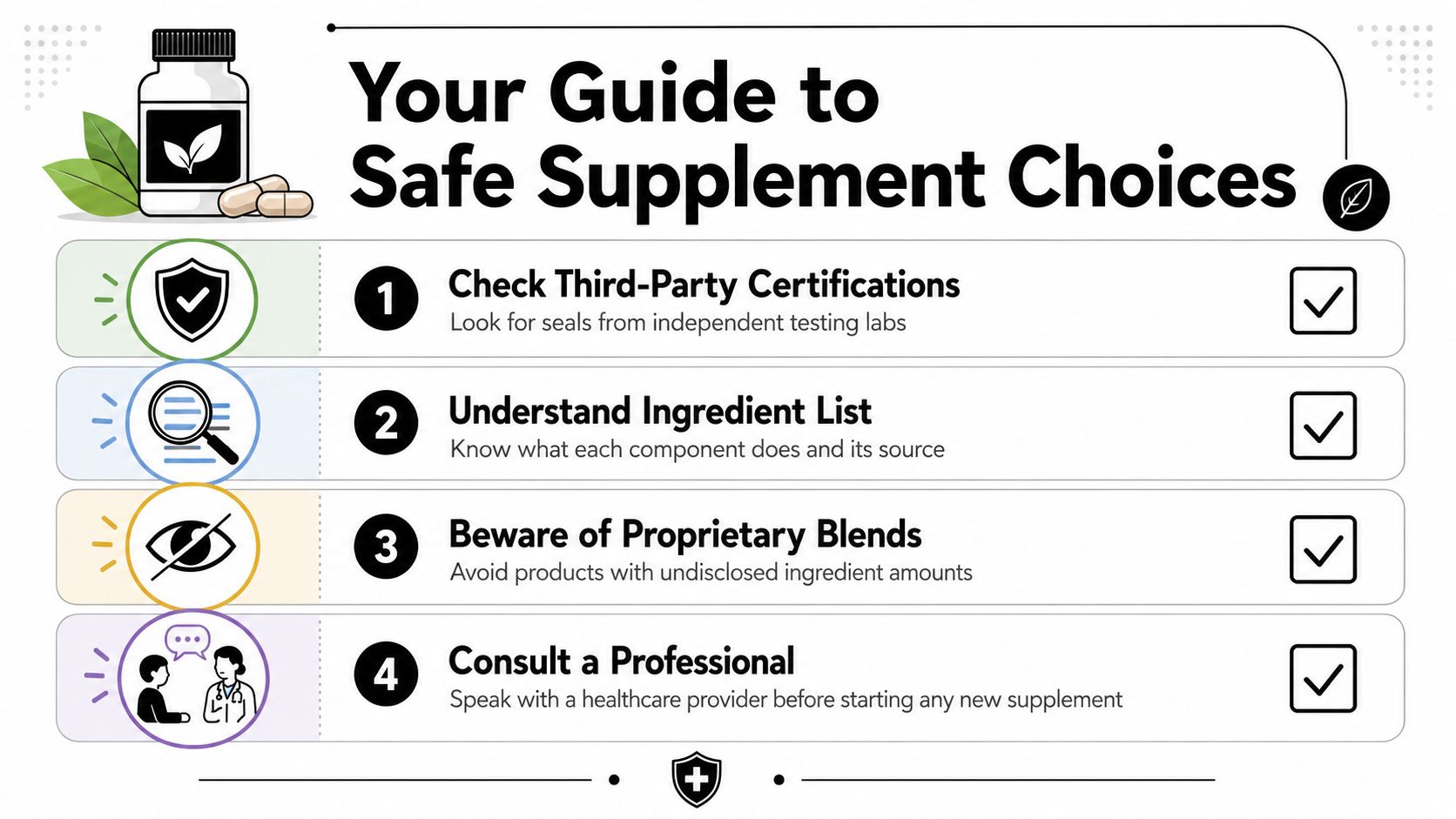
A quick label checklist
Use this simple screen before you buy:
- Named ingredients with exact amounts: You should be able to see each active ingredient and how much is included.
- No mystery stimulants: Some formulas say "caffeine-free" but rely on other activating compounds that may still feel harsh.
- Third-party testing: Independent verification matters for identity, purity, and potency. If you want a practical overview, this guide on what third-party testing means for supplements is a good place to start.
- A clear use case: A product for calm focus should look different from one for endurance support.
Watch for mismatch between promise and formula
Labels often blend several ideas into one fantasy result. "Calm energy, laser focus, all-day stamina, mood support, metabolism support." Sometimes that means the product is trying to be everything and may not do any one job well.
A cleaner way to evaluate a label is to ask:
- What problem is this meant to solve?
- Which ingredients match that goal?
- Are the ingredient amounts visible?
- Does the formula look balanced enough for daily use?
If you can't explain why each main ingredient is there, the company probably hasn't made it easy enough to trust.
Using Supplements Correctly Dosing Timing and Expectations
The most common mistake with stimulant-free energy products isn't choosing the wrong ingredient. It's expecting the wrong timeline.
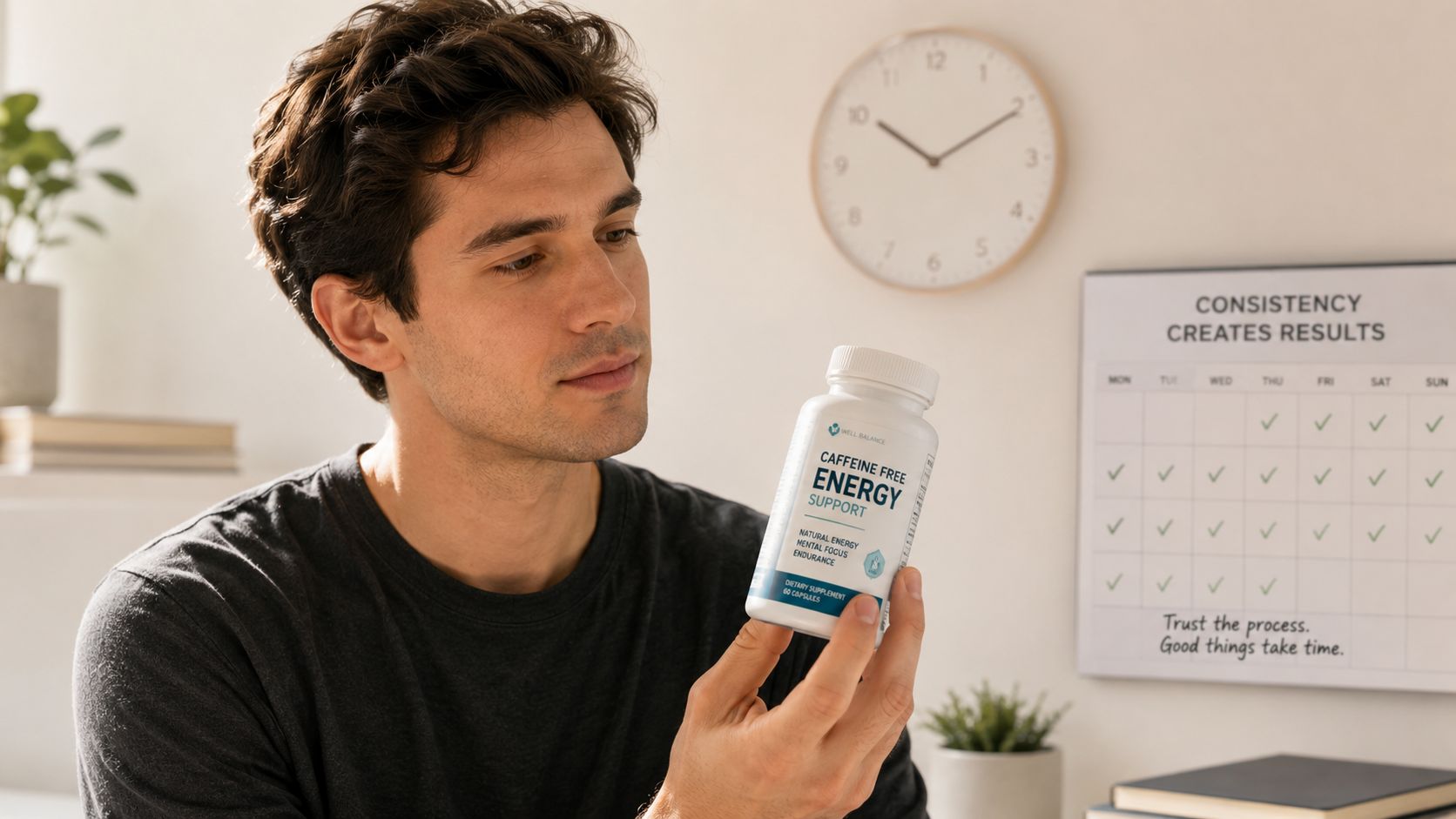
Many users stop adaptogens too early because they're waiting for a dramatic first-day effect. But adaptogens often need 4 to 8 weeks of consistent use to produce measurable energy benefits, according to this consumer education article on caffeine-free supplements. That delay is one of the least understood parts of stimulant-free support.
What to expect in the first few weeks
During the first days, you may notice very little. That doesn't always mean the product isn't working. Some ingredients are supporting regulation, recovery, and resilience in the background before the change feels obvious.
By the later part of a consistent trial, people often notice the effects indirectly:
- Mornings feel less punishing
- Focus lasts longer between meals
- Stress drains less of the day
- Sleep may feel less disrupted than with stimulants
This is a good time to note that not every "energy" strategy needs to be a capsule. If you're exploring nutrient status, especially B12-related questions, this practical piece offering expert advice on B12 shots can help frame when injectable support is discussed versus oral routines.
How to start without overcomplicating it
Start with one product, not three. That makes it easier to judge your response.
A steady approach usually works best:
- Begin low: If the label offers a range, start at the lower end.
- Take it consistently: Missing days makes slower-acting ingredients harder to evaluate.
- Match timing to the formula: Energizing adaptogens or focus blends often fit better earlier in the day.
- Track how you function, not just how you feel: attention, stamina, mood, sleep, and afternoon dips all matter.
If your formula includes L-theanine or a calming focus ingredient, timing can change the experience. This guide on the best time of day to take L-theanine gives a helpful framework for thinking about dose timing.
For a quick overview of practical use, this short video is useful:
When patience matters most
Adaptogens are not energy shots. They behave more like training, nutrition, or sleep repair. The benefit builds.
That means your goal isn't to ask, "Did this hit me?" A better question is, "After using this correctly for long enough, do I function better across the day?"
Building Your Routine with Maximum Health Products
The easiest way to apply all of this is to think in routines, not miracle products. Individuals do better when they choose one or two supports that match their main friction point, then keep the routine simple enough to repeat.
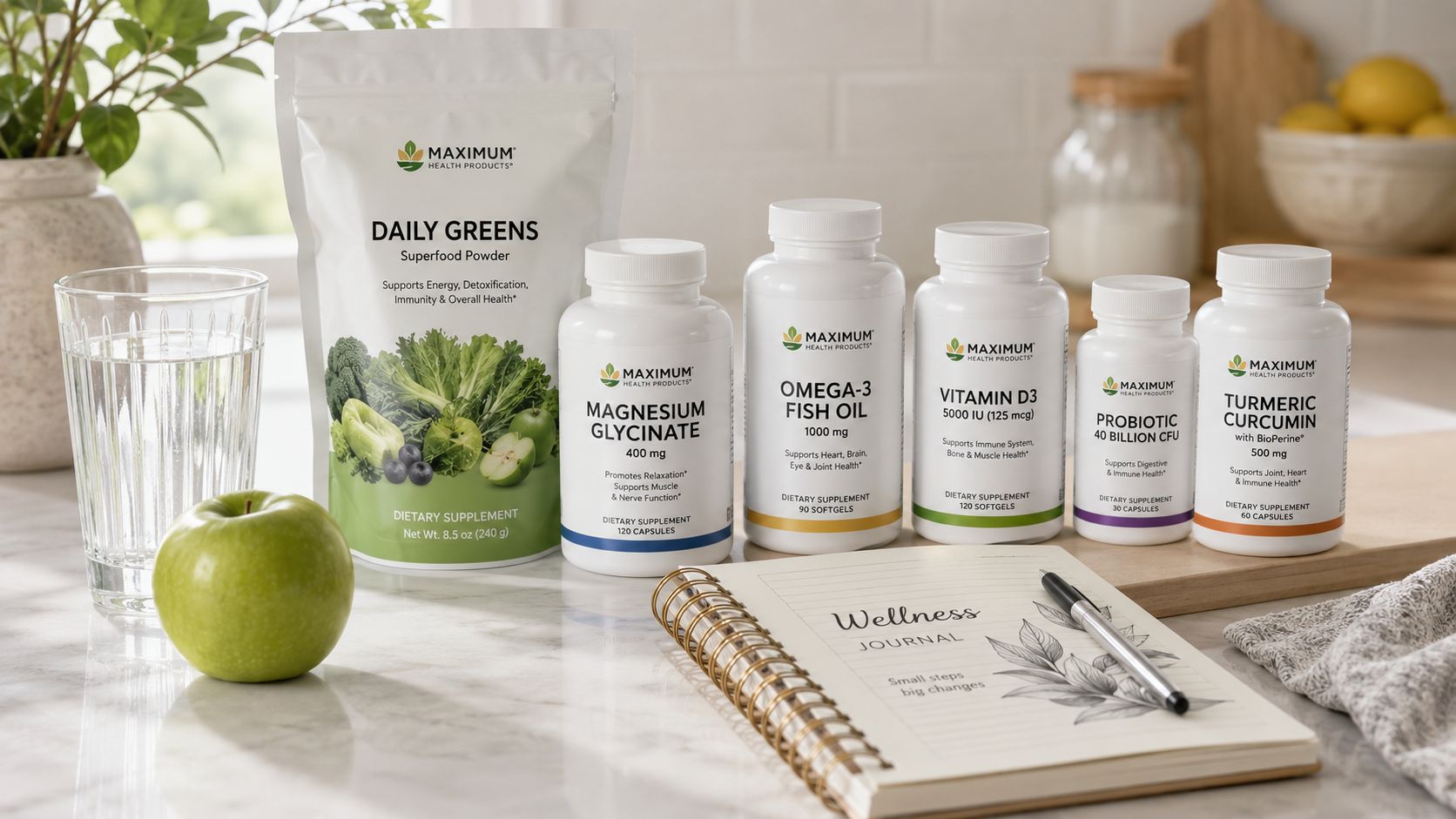
A thoughtful routine usually has three traits. It respects your sleep. It doesn't rely on a hard stimulant surge. And it uses clean, transparent products you can stay with long enough to judge.
A simple way to build your stack
Some people need calmer cognitive support more than "energy." Others need help with stress load, hydration, or morning momentum. The right choice depends on what keeps draining your reserves.
A practical routine might include:
- Morning support for focus: useful if your problem is mental fog
- Foundational nutrient support: helpful when your diet or schedule is inconsistent
- Stress-balancing support: better when fatigue tracks closely with pressure and poor recovery
What to prioritize when choosing
The strongest fit usually comes from matching product design to your actual goal, not buying the formula with the loudest promise.
Look for:
- Clean-label standards: fewer unnecessary additives and fillers
- Transparent formulas: clear ingredient amounts
- Ingredients with a job: not just trendy label decoration
- Real-world usability: something you can take consistently
That approach is more sustainable than cycling between energy drinks, random powders, and products you stop using after a week because the effect wasn't immediate enough.
Frequently Asked Questions on Caffeine-Free Energy
Are caffeine-free energy supplements supposed to feel immediate
Usually, no. Some ingredients may support alertness or calm focus fairly quickly, but many of the best caffeine free energy supplements work gradually. If adaptogens are a central part of the formula, patience matters.
Are they automatically safer than caffeinated products
Not always. "Caffeine-free" doesn't guarantee a better product. Hidden ingredient amounts, proprietary blends, and poor formulation still matter.
Can I take more than one stimulant-free product at once
You can, but it isn't the best place to start. If you begin with multiple formulas, it's harder to tell what's helping and what's causing side effects or wasted spending.
Should I take them every day
That depends on the ingredient and the product design. Daily use often makes sense for foundational nutrients or slower-building adaptogens. Some formulas are better used more strategically. Always follow label directions and check with a qualified clinician if you take medications or have a medical condition.
Who should be extra careful
Anyone with cardiovascular concerns, pregnancy-related questions, medication use, sensitivity to supplements, or a history of reactions to energy products should talk with a healthcare professional before starting a new formula.
If you want clean-label options that align with a steadier, stimulant-free approach to daily wellness, explore Maximum Health Products. Their formulas focus on targeted support for energy, focus, metabolism, and overall well-being without relying on the usual quick-fix mindset.

